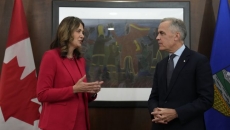
The head of the Royal Canadian Air Force has only been in the job for half a year — but it's been an eventful period as the force has worked to rapidly overhaul its fleets and turn a corner on persistent personnel shortages.
In a wide-ranging interview, Commander Lt.-Gen. Jamie Speiser-Blanchet told The Canadian Press that while change is happening incrementally behind the scenes at the RCAF, it will amount to a dramatic makeover of the force within a decade.
"There's so many things that are changing at once," she said. “Overall, we're trying to make sure that we maintain a realistic vision on what we can achieve with limited resources.
"So, yes, we are absolutely on a path of growth, but not everything can grow immediately, so I want to make sure that we're doing things iteratively.”
A year from now, she said, the RCAF may start to shift where it deploys its personnel and fine-tune its organizational structure as its adjusts.
The air force is undergoing a massive, 20-year-long modernization project that will bring in advanced capabilities as it overhauls its fleets. It's replacing the Aurora marine patrol fleet with new P-8 Poseidons, adding new CC-295 Kingfisher search-and-rescue aircraft and bringing in a new aerial drone capability with MQ-9B SkyGuardians.
And that's all aside from the main event: replacing Canada’s elderly F-18 fighter jets with modern F-35s.
“In one year, we will have members in Luke Air Force Base learning to fly on our new F-35s. That's a fairly big change,” she said, referring to the United States Air Force base in Arizona.
Canada's political class is gripped by the Liberal government's review of the plan to acquire a full fleet of 88 F-35s; Ottawa has so far committed only to buying 16. But Speiser-Blanchet is staying out of the fray as the force prepares to usher in a next-generation fleet.
“I'm very focused on the existing government direction, which is to transition the F-18 fleet to the F-35 fleet,” she said, declining to answer when asked what a mixed fighter fleet would mean for the service.
The RCAF's list of aircraft replacements and upgrades is a long one. It's adding CC-330 Husky tankers to replace the CC-150 Polaris and replacing the aging Challengers that conduct VIP transport.
Speiser-Blanchet also faces the added challenge of personnel shortages and organizational changes. The number of experienced staff in some key positions has dropped, while new capabilities will require even more people.
“Priority one remains on people, always,” she said. "We're continuing to try to think in innovative ways to ensure that we can increase our intake of personnel, increase the speed at which we train them and also, at the same time, retain our experienced members who are obviously very, very valuable."
The force is also adapting to the future of aerial combat — drones deployed alongside crewed aircraft.
“I think it's closer than we think, certainly, when we think of what our allies are doing and even what I believe is possible with Canadian industry. There is a lot of rapidly developing technology,” Speiser-Blanchet said. “We have, I believe, a lot of opportunities coming in the next few years to be able to really advance that.”
National Defence has been researching drone technology, which could expand the power of its future fighter fleet at a fraction of the cost of crewed aircraft.
Speiser-Blanchet said in the time since she took command of the RCAF, she has been gripped by the threats posed by online disinformation and persistent cyberattacks by adversaries.
She declined to give precise examples but said she was struck by the extent to which such disruptions can affect the day-to-day work of the RCAF.
She said the world has re-entered an era of great power competition and she sees a role for the military and the defence sector in explaining the new threat environment to Canadians and expanding their understanding of national security issues.
“In Canada, we have had the luxury of geography keeping us safe for a very long time … But the threat dynamics are changing and have changed. That is what has driven us down this path of modernization.”
Picture Courtesy: THE CANADIAN PRESS/Adrian Wyld