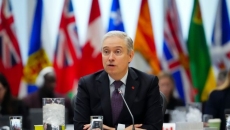
The Conservatives plan to put a motion before the House of Commons on Tuesday aimed at reviewing how health benefits are provided to asylum seekers and restricting who has access to those services.
The planned motion also includes language calling for the immediate deportation of foreign nationals convicted of a crime in Canada.
Conservative Leader Pierre Poilievre shared his party's position in a social media video Monday morning.
"Enough is enough, we can't allow foreign criminals to take advantage of our system, false refugee claims to overwhelm the services that you pay for," Poilievre said in his video.
That data was pulled from a report by the parliamentary budget officer published earlier this month.
In that report, which was requested by the House of Commons health committee, the PBO projects the program's cost will reach $1.5 billion annually in 2028-29.
The federal government provides a host of medical services to asylum seekers, refugees and other protected persons through the Interim Federal Health Program.
Those services include routine medical treatment, hospital visits and lab work, and supplementary coverage for services like urgent dental procedures, some vision care, psychological therapy and prescription drugs.
The Conservative motion calls for a review of the benefits provided to asylum claimants to find savings, and for asylum seekers appealing a rejected claim to be covered only for emergency, life-saving care.
The motion also calls for an annual report to Parliament on program usage, with a specific focus on supplementary benefits, which generally aren't covered for Canadians.
The PBO report says about 624,000 people were beneficiaries of the Interim Federal Health Program in 2024-25, up from about 200,000 people in 2020-21. A majority of those beneficiaries are asylum claimants.
The Immigration and Refugee Board has about 300,000 pending asylum claims in its inventory.
Immigration, Refugee and Citizenship Canada data shows asylum claims decreased by about a third in 2025 compared to 2024 — dropping from about 190,000 claims to almost 108,000.
The federal government is introducing a co-pay for supplementary coverage and prescription drugs covered by the program, starting May 1.
This measure was first introduced in the November federal budget as part of IRCC's attempt to find 15 per cent savings over the next three years.
A notice published by IRCC last month says claimants will pay 30 per cent of the cost of services under supplemental coverage, including dental care, vision care, counselling and assistive medical devices. There will also be a $4 charge for each eligible prescription filled or refilled under the program.
The PBO did not include these measures in its report on the Interim Federal Health Program due to time and data limitations.
Former prime minister Stephen Harper restricted supplementary coverage under the Interim Federal Health Program for privately sponsored refugee claimants and those who made claims after arriving in Canada.
That policy was overturned after the Liberals beat the Conservatives in the 2015 election.
On the crime front, Poilievre said the Conservative motion would ensure judges to give "the full sentence" to foreign nationals and the "complete" deportation of non-citizens convicted of crimes.
Canada has laws on the books allowing for the deportation of foreign nationals and permanent residents convicted of crimes with maximum sentences of 10 years — even if the individual's sentence is less than 10 years — and for people sentenced to more than six months in prison.
People facing removal under these laws have access to appeal options.
Picture Courtesy: THE CANADIAN PRESS/Adrian