On the morning of Jan. 24, 2006, newspapers across the Prairies spread the word with headlines like, "The West Is In!" and "Tories Turn The Tide!"
Stephen Harper's Conservative Party had just been elected, eking out a minority in his second election as leader of the still-new party and ending 12 years of Liberal government.
"I think that the 2006 win was a confirmation of his ability as a leader to learn and to adapt," said former Conservative cabinet minister Jason Kenney.
The celebrations in the West were tempered by questions about what the incoming government would do. Would a Harper-led Canada pull out of the Kyoto climate accord? (It did.) Would it undo the legalization of same-sex marriage? (Harper allowed a vote on the matter but it failed.)
A report by The Canadian Press that morning warned the softwood lumber dispute would put pressure on the new prime minister, who had promised a more cordial relationship with the administration of George W. Bush, the newly re-elected U.S. president.
Another quoted an expert who said expanding the Norad defence pact could help Harper keep his election pledge to shore up Canada's Arctic sovereignty.
Twenty years on, the parallels are hard to ignore. Canada has a Liberal minority government, the relationship with the United States is the dominant force in domestic politics, Arctic security is at the forefront of defence spending plans and worries about territorial sovereignty are more pressing than ever.
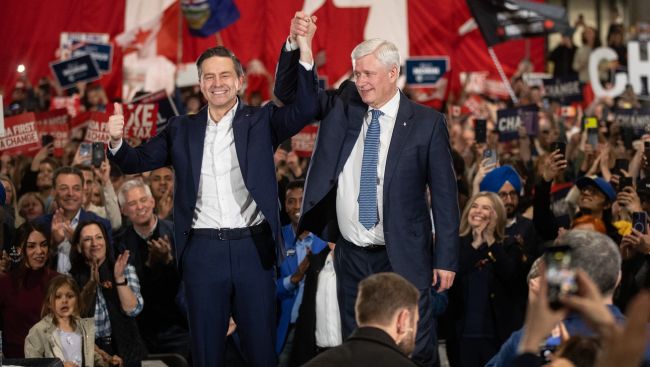
Conservative Leader Pierre Poilievre has just come off a disappointing election loss that echoes Harper's 2004 run, and will soon learn if the party will grant him a second chance.
With all that as a backdrop, the Tories are preparing to hold both a national convention and a week of celebrations to honour Harper's historic win.
Kenney said his former boss was "one of the most consequential prime ministers" in postwar Canadian history, one who defined modern conservatism by unifying the country's right-wing parties.
Conservative MP Jamil Jivani said Harper "made it possible for Conservatives in my part of the country, Ontario, to feel like we were on the same page as Conservatives in places like Alberta or Saskatchewan."
"I feel old," Tory MP Michelle Rempel Garner joked at a recent press conference when asked about the anniversary.
J.D.M. Stewart, historian and author of the 2025 book "The Prime Ministers: Canada's leaders and the nation they shaped," said Harper is best known today as a hard-working, serious, detail-oriented leader.
"The Harper years are less about a signature achievement than they are about a reasonably smoothly running federation," he said.
Harper's first chief of staff, Ian Brodie, said the government's reforms stamped out corruption concerns after the sponsorship scandal and it established a record of "sober financial management" — a record which included steering the country through the 2008 global financial crisis. Canada was widely recognized as a leader among G7 nations coming out of the recession.
"What it was, was 10 years of extremely disciplined management as a federal government," Brodie said.
The Harper years brought change. The GST was cut to five per cent, sweeping and controversial tough-on-crime policies were introduced and Ottawa set out to negotiate dozens of free trade agreements overseas.
Kenney said the government took on "some areas of bold and successful policy reform," particularly when it overhauled the immigration system — a file he oversaw in cabinet.
Harper introduced a successful motion in the House of Commons in 2006 that recognized the Québécois as "a nation within a united Canada."
He also formally apologized in 2008 on behalf of Canadians for the residential schools system.
More than 150,000 Indigenous children were forced to attend the government-funded, church-run schools between 1857 and 1996, where they were banned from speaking their languages and often subjected to abuse. An estimated 6,000 children died in the schools, though experts believe the number could be much greater.
Despite that gesture, Harper's government had a fractious relationship with Indigenous people, culminating in the widespread Idle No More protests.
The Conservative government was deeply unpopular by 2015, allowing the Liberals under Justin Trudeau to sweep to power. The next decade saw a drastically different style of government.
"The Trudeau years of government certainly make the Harper years of government look much stronger, because the Trudeau government was not as serious as the Harper government. I don't think they had the same clarity of purpose," Stewart said.
Still, no Conservative leader since Harper has managed to win over the electorate. Poilievre's Tories also have faced the accusation that they're less serious than their predecessors.
Kenney agreed the current crop of MPs has a tendency to focus on generating clips for social media.
"I think some of that's just inevitable. Some of it's a little regrettable," he said.
Tom McMillan, a political scientist who served in former prime minister Brian Mulroney's Progressive Conservative cabinet, wrote a scathing review of Harper's leadership and politics in his 2016 book "Not My Party."
His view today is still dark. In an emailed response to questions from The Canadian Press, he wrote that "no reasonable person" could view the Harper years as successful since they lacked legacy-building measures.
He said the party should return to its roots by "largely turning its back on almost everything Stephen Harper stood for and did, in government and politics alike." He also called Poilievre "a lightweight."
Poilievre agreed to an interview for this story but his office cancelled at the scheduled time, and did not provide a written comment. Harper didn't respond to requests for comment.
An aggressive partisan and fierce debater in Parliament, Poilievre has struggled with negative public perceptions of his personality since Trudeau resigned. A recent Abacus Data survey found that 48 per cent of Canadians polled had a negative impression of the Conservative leader — a jump of five points since Abacus’s previous poll in early December.
His signature populism has lost ground to Prime Minister Mark Carney, the former Bank of Canada governor. Brodie said Carney has borrowed heavily from the Harper playbook.
Stewart argued Harper and Poilievre have a similar problem when it comes to electability.
"Stephen Harper always had a tone problem, where he came across as a bit petty and a bit grumpy, but behind the scenes he was actually a pretty pleasant guy," he said.
In 2005, after losing the 2004 election, Harper faced a mandatory leadership review, where delegates at a national convention voted on whether he should have another chance to form a government. They said yes.
The party is set to hold only its second such review at a convention in Calgary on Jan. 31. Poilievre is expected to win the vote by a wide margin.
Rumours abound in Ottawa about more Tory MPs crossing the floor after the convention — two already have. If those rumours pan out, Carney could be leading a majority government by the spring.
If that happens, it undoubtedly would put a damper on the celebrations planned for the modern Conservative party's first leader.
Harper's official portrait is set to be unveiled on Parliament Hill on Feb. 3, and a gala event the next evening will mark the anniversary. The week also includes the opening of the Harper wing of the National Archives.
Brodie said he expects there will be "an interesting contrast" between the Calgary convention and the events in Ottawa, which will feature a lot of faces from the party's old guard. He said that once the matter of Poilievre's leadership is settled, he expects talk to turn to the future.
"Now the question is, are the Conservatives going to present a governing case or not?" he said.
As Stewart sees it, the lesson today's Tories should take from the last two decades is this: "Be adaptable and flexible and managerial, as opposed to ideological."
Picture Courtesy: THE CANADIAN PRESS/Jason Franson