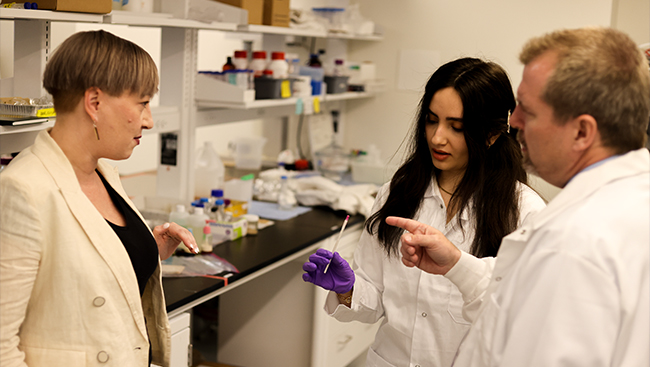
Contaminants in some generic medications used to treat heart disease, diabetes and other common conditions could damage DNA, affect basic cell functions and increase the risk of cancer, suggests a study from the University of British Columbia.
Corey Nislow, a professor in the faculty of pharmaceutical sciences, said the findings from his lab on nitrosamines, impurities that are considered probable carcinogens, suggest overseas facilities that manufacture cheaper generic drugs in high volumes require strict regulation and enforcement to ensure they're complying with standards.
Health Canada was among regulators in several countries that announced recalls in 2018 on medications containing the active ingredient Valsartan, which was found to contain a nitrosamine impurity before at least six other associated toxins were later detected in some other drugs made by different manufacturers.
Valsartan, sold under several trade names, is used to treat heart failure and high blood pressure.
While Health Canada said there is no immediate health risk associated with the use of medications containing low levels of a nitrosamine impurity, Nislow said an estimated 50 million prescriptions were written for so-called sartans in Canada alone since nitrosamines were detected in many types of generics in 2012.
It's not known if patients who took the drug for six years before the recalls could experience long-term effects, he said.
In order to better understand the impact of nitrosamines, researchers at Nislow's lab studied them in yeast, which shares about half of its genes with humans, making it a good substitute for human cells in experiments that could later lead to studies in people.
Researchers started with 4,800 strains of yeast and added high doses of nitrosamines to the entire batch. Then they deleted each gene, one at a time, to try and determine how the toxin would affect its growth.
The strains that were missing genes that repair DNA and the machinery that makes cell proteins grew five to 50 times slower, Nislow said.
A study outlining the results was published this week in the journal Scientific Reports.
"The one single take-home message is that people have been taking medicines with this contaminant for a long time and we don't know the long-term consequences," he said. "Now that we can follow up on those genes and figure out exactly why they're needed, we could get clues as to how we can help people who have been taking those contaminants for six years without knowing it."
Damage to DNA can cause mutations that could be inherited and if they're unrepaired by the body, could lead to cancer, Nislow said.
Health Canada said it is collaborating with six other international regulators including the U.S. Food and Drug Administration, the European Medicines Agency and Japan's Ministry of Health to better understand the global issue of nitrosamines.
The agency said it sent a letter last December to drug manufacturers to conduct detailed evaluations of their manufacturing procedures for the potential presence of nitrosamines.
It said patients should talk to their health provider before stopping a prescribed medication and that not treating a condition may pose a greater risk than the potential exposure to a nitrosamine impurity.
Most of the inspections of facilities that make so-called active pharmaceutical ingredients are based on a self-reporting system, potentially putting consumers at risk, Nislow said.
"This particular case, with this particular contaminant, we think arose when they changed their manufacturing process to a cheaper process and no one was informed. And because no one was looking for this contaminant, it went unreported and undetected for nearly a decade."
Health Canada, the U.S. Food and Drug Administration and the European Medicines Agency are among regulators that have been testing drugs that are shipped from overseas.
However, he said that's not good enough.
"In order to effect a long-lasting change, they should be testing at the point of manufacture, which is overseas."
Many of the drugs are made in China and India, where costs are lower, Nislow said.
"But I wonder if this is an elaborate game of Whack-A-Mole, where we're chasing after the last quality control failure.
"If we want our drug prices low and we're willing to source our materials from overseas and we want them to be safe, we have to go back to 20 years ago when the enforcement mechanisms were more consequential."
Ultimately, consumers may need to demand better quality control for generic drugs, Nislow said.