Canadian climate negotiators are headed to Brazil for the next two weeks as leaders gather for annual United Nations climate talks.
The talks come as Prime Minister Mark Carney, whose credentials as an international climate advocate helped win him support in this year's election, comes under increasing scrutiny for his reversal of some key Trudeau-era climate policies — and his government's perceived softening on the oil and gas sector, the biggest source of Canada's emissions.
One focus is expected to be on how the world will adapt to climate change risks — and how countries will pay for those mitigation efforts.
This year marks the 10th anniversary of the landmark Paris Agreement, and leaders will face questions about whether the deal is working and if countries are pulling back from their climate commitments, says Catherine Abreu, a leading Canadian climate policy expert.
But she is optimistic: "I think we'll see strong political signals coming out of (the conference) that the vast majority of the world is definitely still committed to this process," Abreu, a member of an independent group of federal climate advisors, said ahead of the meetings.
Here's what else you need to know.
What is COP30?
The summit's name stands for the 30th Conference of the Parties who signed the 1992 United Nations Framework Convention on Climate Change.
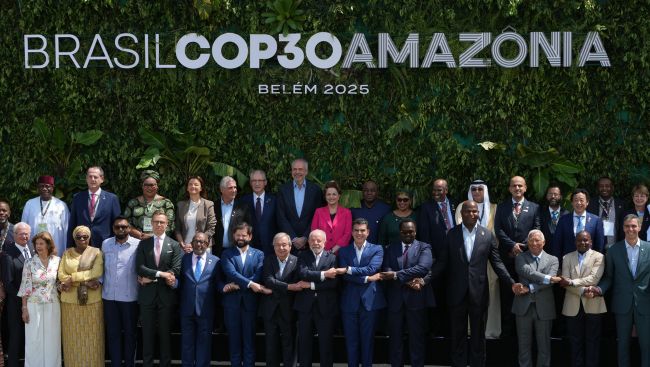
This year, Brazil will host the summit in Belém, a city known as a gateway to the Amazon River.
That location is a stark reminder of what's at stake if emissions aren't kept in check, as climate change and deforestation fuel the rainforest's transformation into a drier, fire-prone savanna.
Unlike the summit 10 years ago in Paris, the host Brazil has indicated this COP is focused on following through on existing deals, rather than advancing new rulemaking.
What will be discussed?
A key focus will be on adaptation — how to make countries more resilient to increased climate risks, from rising sea levels to extreme heat. Negotiators are set to finalize a list of about 100 indicators used to track global progress, such as how many people have access to reliable drinking water capable of withstanding climate-fuelled drought.
There is still debate over how to track the money developing countries say they need to turn adaptation goals into reality. Parties are looking at indicators that could include measuring what portion of all adaptation funding is flowing to local governments, small island nations or Indigenous Peoples, reflecting a broader goal to promote equity and justice in how money to fight climate change is distributed.
Negotiations will look to advance a major outcome of last year's talks: the pledge to mobilize at least $1.3 trillion annually by 2035 for climate finance. There will also be discussions about the agreement two years ago to triple renewable energy capacity by 2030 and transition away from fossil fuels, the major driver of human-caused climate change.
More than half of the countries attending the talks have yet to submit updated national climate plans, called Nationally Determined Contributions. Those plans, due earlier this year, represent each country's contribution to the climate change fight and are intended to be strengthened every five years in an escalating cycle of ambition.
Abreu said she expects to see a push at the talks for leaders to explain how "countries will fill that gap."
What is Canada's role?
Federal officials say Canada will continue to play a bridge-builder role to help countries reach a consensus on some of the summit's key issues. The officials, who briefed reporters ahead of the talks, say Canada will support calls to scale up climate finance and keep global warming targets within reach.
But climate observers say Canada's support for oil and gas expansion, as well as its silence on whether it will meet its 2030 and 2035 emissions targets, could be among issues undermining its position.
Advocates pointed to the latest federal budget, which offered no details on how the industrial carbon price would be strengthened, talked of potentially setting aside an oil and gas industry emissions cap and also opened the door to the Canada Infrastructure Bank supporting projects in that sector, rather than limiting its work to sustainability-linked projects.
"There's just no way that we can make those commitments given the current ways in which the government is pushing for oil and gas industry in Canada," said Eriel Tchekwie Deranger, president of nonprofit Indigenous Climate Action and a member of the Athabasca Chipewyan First Nation.
Deranger said Canada has over the past decade been receptive to Indigenous proposals at the UN climate summit, especially around increased funding for adaptation and climate finance.
Yet "when it comes to implementation at home, it's falling flat," she said.
Who will be there?
Environment Minister Julie Dabrusin will lead Canada's delegation for the first week of the conference. Prime Minister Mark Carney, a former UN special envoy on climate finance and veteran of the summit, is not expected to attend as his government faces confidence votes on the budget.
There has been reduced participation in pre-summit events, taken by some as a sign of a dwindling global focus on climate change. A meeting of heads of state earlier this week saw about half the attendance that last year's summit had, with notable absences from the leaders of the planet's three biggest polluters: China, the United States and India.
This summit will also take place in the shadow of the U.S. withdrawing from the Paris Agreement for a second time under President Donald Trump.
Abreu said it may be for the best.
"I think that that might actually result in the rest of the world being able to come up with some solutions together without that obstructionist presence," she said.
Does the Paris Agreement still matter?
A decade ago, world leaders adopted a deal in Paris to limit global warming to two degrees and aim for 1.5 C above pre-industrial times, while charting a course for the future of climate diplomacy.
Catherine McKenna, who helped negotiate the deal as Canada's then-environment minister, said the deal has been "foundational." Before Paris, there was no clear global temperature target and no framework for how each country could do their part.
In 2015, the planet was on track to warm by about 3.5 C by the end of the century, the UN says. Now, if countries live up to their climate plans, that could be closer to 2.5 C.
While that is an improvement, experts say that level of warming would still make heat waves unbearable in some areas, threaten coastal countries with sea-level rise and lead to major biodiversity losses, among a range of other issues.
"That's not where we need to be," said McKenna. "But (the Paris Agreement) was critically important. Without that, we wouldn't have this framework, we wouldn't have ways to evaluate integrity, we wouldn't have targets."
The agreement's legacy is also showing up in the uptake of renewable energy, Abreu said.
This year, investments in clean energy are expected to double the money put into fossil fuels. Fossil fuels continue to dominate the global energy mix at about 60 per cent, but for the first time, renewable and nuclear energy sources covered two-fifths of total annual power generation in 2024, the International Energy Agency said.
What's important now is to see renewables scale up even quicker to push out fossil fuels, she said.
"We really need to reach a turning point on that."
Picture Courtesy: THE CANADIAN PRESS/AP-Fernando Llano