

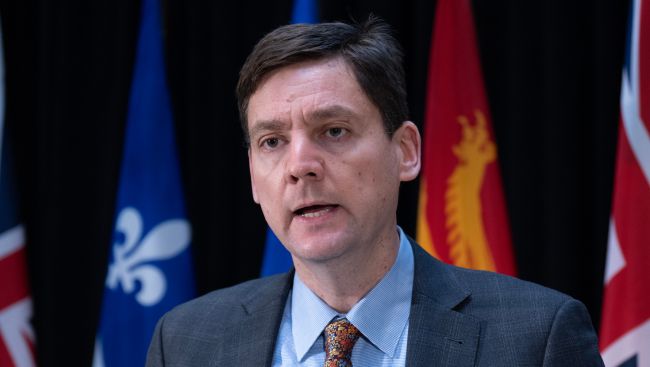
Federal lawmakers must close "corrosive" loopholes hampering the crackdown on extortion-related shootings in British Columbia, including one that allows suspects to apply for refugee status, as the "paralyzing" situation undermines public confidence and commerce, Premier David Eby said Tuesday.
There have been dozens of shootings aimed at members of the South Asian community since the new year in Surrey, B.C., and Eby said the loopholes must be quickly shut to help police in their investigations.
Eby pointed to Bill C-12, the Strengthening Canada's Immigration System and Borders Act, which is in second reading in the Senate, while Bill C-14 is designed to strengthen bail laws.
"We cannot wait any longer," Eby said. "These are essential tools that police need now. They reflect the understanding of Canadians of what should happen when someone is arrested for these serious crimes that cut at the very heart of the community."
The premier met with South Asian business leaders Tuesday, telling him that some in the community were feeling abandoned and considering closing their doors.
"I heard from business leadership about how this is really undermining commerce and business success south of the Fraser," Eby said.
While Surrey appears to be epicentre of extortions in B.C., the shootings and intentional fires are also a problem in the Prairies and Ontario, with some incidents linked to the Lawrence Bishnoi crime group based in India.
Surrey is the fastest growing city in B.C. and many of its businesses have connections with major trading partners in India and elsewhere in Asia that B.C. wants to develop, he said.
"So, the fact that they are apprehensive about advertising, about being publicly visible, it cuts against not just their own business success and the success of their employees, but our whole province's success, and to some extent, the country's success," Eby said.
The provincial government will appoint a community advisory group to work with the B.C. Extortion Task Force to ensure police understand what Eby described as the "slow-motion terrorism" of extortion.
"I have been very concerned about inconsistent communications between the task force and the Surrey Police Service to the community," he said.
The "inconsistent communications" lead community members to feel that "everybody is not on the same page" or co-ordinating on the issue, Eby said.
"That is not acceptable."
The national head of the RCMP was expected to meet with the Surrey Police Service and the head of the task force to reinforce that message, the premier said.
Eby said he was "heartened" by the fast actions of police who arrested three men after receiving reports of a fire and shots being fired outside a home in Surrey over the weekend.
The arrests took place while officers were patrolling the area, and Eby said arresting suspects shortly after an incident helps with public confidence.
"This is what people have been expecting from the beginning," Eby said.
The Surrey Police Service said it has been investigating 46 extortion incidents so far this year, while the task force said it has 32 active files across the Lower Mainland as of last month.
Surrey Police Service Chief Norm Lipinski said in a statement said the extortion crisis won't be solved by police alone and must involve the community.
"Residents and business owners are asking difficult questions of police and those questions are both valid and necessary," Lipinski said.
The Canada Border Services Agency, meanwhile, said it investigates people identified by police as extortion suspects who may be in the country without status or in violation of immigration conditions.
A statement from CBSA said its Pacific Region office has been investigating 111 foreign nationals, who may be inadmissible based on alleged offences related to the immigration and Refugee Protection Act, as of Jan. 20.
It said nine people have so far been removed from Canada.
"Making a refugee claim does not exempt lawbreakers from the consequences of their actions and the CBSA continues to aggressively pursue the removal of extortionists attempting to evade justice by abusing Canadians' concern for genuine refugees in need of protection," it said in an email.
Surrey Mayor Brenda Locke was in Ottawa on Tuesday, where she has been lobbying the federal government to declare a national emergency over the extortion crisis.
Her trip follows Ottawa's announcement last week of additional resources in the fight against extortion, including helicopters and 20 officers, but Locke said more help was needed.
Locke said in a statement that she looks forward to the work of the advisory group to improve communication between the public and the extortion task force.
"It’s crucial we amplify the voices of residents and business owners who have been victimized by extortion and violence for far too long," Locke said. "I agree with Premier Eby that communication must be improved with regular updates from police, and I’m optimistic that this committee is a positive step in that direction."
B.C. Conservative Interim Leader Trevor Halford and Steve Kooner, critic for attorney general, said in a statement that an advisory group is insufficient.
New Democrats should have been listening from the very start, Halford said.
“Instead, they ignored dozens of cases, the repeated pleas from business owners, and the cries from communities who were warning that this crisis was escalating.”
Kooner said that creating an advisory body without real enforcement risks giving false hope to communities already exhausted by violence and intimidation.
“People are scared,” he said. “They want to know what is being done right now too protect their families and their livelihoods. An advisory committee doesn’t put offenders behind bars, and it doesn’t shut down criminal networks.”
Picture Courtesy: THE CANADIAN PRESS/Adrian Wyld


