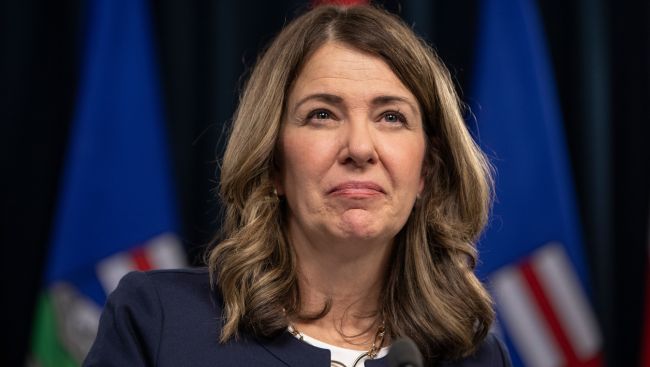
Danielle Smith has become the second Alberta premier – and the first in almost 90 years – to face a citizen-led petition drive to get her removed from her seat in the legislature.
Smith and two more of her United Conservative Party caucus members saw recall campaigns officially approved and launched Wednesday by Elections Alberta.
In total, 20 in the 47-member UCP caucus are facing recall petitions. A formal signature-gathering drive has also been launched against one Opposition NDP member, Amanda Chapman.
Heather VanSnick is leading the petition drive in Smith’s southern Alberta riding of Brooks-Medicine Hat. VanSnick needs to collect just over 12,000 signatures to move the process forward.
In her application, VanSnick writes that Smith has been ignoring local constituents and experts in developing policies.
"Effective leadership requires genuine connection and consistent engagement, both absent in her tenure," VanSnick wrote.
VanSnick also said Smith needs to go because the premier has been weakening public services in favour of privatization.
"Ms. Smith is no longer fit to serve," VanSnick said.
Smith, at an unrelated news conference Wednesday, denied any suggestion that she wasn't accountable to local residents or that she didn't make time to hear their concerns.
"I can tell you that Brooks-Medicine Hat used to call themselves the 'forgotten corner.' They're not forgotten anymore," she said.
"I continue to do quarterly town halls and there's actually another town hall happening this weekend, so I'm looking forward to getting feedback."
Smith, as she has said in response to previous petitions against members of her caucus, told reporters she thinks the recall process is being weaponized, saying its intent is to address serious ethical breaches rather than resolve policy disputes.
"I think that this is sadly undermining confidence in our democratic processes, in our democratic system," she said.
"This is just a political difference of opinion. You solve those at the ballot box."
Smith had mused about changing the act this fall, citing concerns about shadowy foreign actors or unions being behind the recall drives — an allegation denied by the Alberta Federation of Labour — but her government announced that changes wouldn't be made during the fall legislative session.
Asked Wednesday if the petition against her meant the government would change its mind, Smith said it had missed its chance.
"Well, we had an opportunity to and we didn't," she said.
But Smith added that doesn't mean changes can't be made in the future.
"We're watching it with great interest to see if there's any changes that need to be made, and we'll continue to watch it."
Petitions were also issued Wednesday for Technology Minister Nate Glubish in Strathcona-Sherwood Park, east of Edmonton, and Environment Minister Rebecca Schulz in Calgary Shaw.
Like many other petitioners, those behind the campaigns to unseat Glubish and Schulz said the politicians have failed to address concerns and viewpoints of constituents. Glubish and Schulz both said they're communicating while getting tangible results for constituents.
Out of Alberta's 19 premiers, only Smith and Social Credit leader William Aberhart have faced a citizen recall. Their scenarios are similar despite being decades apart.
Aberhart’s party campaigned on and, after winning government, passed in 1936 the Legislative Assembly (Recall Act) to hold representatives accountable between elections. A year later, it was turned on Aberhart by members of his Okotoks-High River constituency, unhappy with what they called failed promises, mainly around monetary reform.
Aberhart blamed shadowy forces behind the scenes pulling strings to orchestrate his ouster. Weeks later, his government voted to repeal the act.
In 2019, the UCP under Jason Kenney ran on introducing the Recall Act once again, and his government passed the law in 2021. Kenney has agreed with Smith that its being misused.
Earlier this year, under Smith, the UCP changed the law to make it easier for citizens to collect enough signatures to trigger a recall.
The process to get a legislature member recalled is daunting and lengthy. The petitioners have three months to collect signatures equal to 60 per cent of the total number of votes cast in the constituency in the 2023 election.
If successful, a vote would be held on whether the MLA keeps their seat. If the member loses, a byelection is held.
The fixed date for Alberta’s next general election is less than two years away, on Oct. 18, 2027.
Picture Courtesy: THE CANADIAN PRESS/Amber Bracken