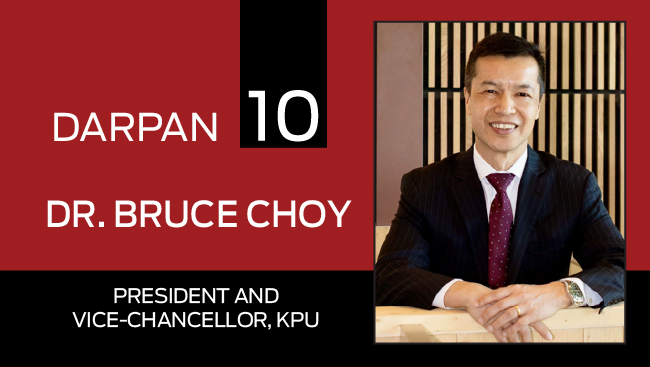
Q1. Congratulations on your new appointment at KPU. As you step into this role, what are your immediate priorities for the university?
Thank you! I am honored to have been asked to join this incredible institution. My priority is personal: to meet and connect with colleagues across KPU’s campuses, which span nearly 50 km from Richmond to Langley. My immediate priority is to be able to credibly retell these stories to our various external parties. KPU feels to me like British Columbia’s “best kept secret,” and I aim to become the institution’s #1 cheerleader and strongest advocate.
Q2. KPU is known for its strong focus on applied learning and career-ready education. How do you plan to further strengthen this identity in an evolving job market?
As a public education institution, we are stewards of a significant amount of taxpayer funds invested in us to do an important societal good. Hence, ensuring that our programming meets society’s needs is critically important. To that end, work-integrated learning and co-op opportunities are signature features of KPU. Practicums are another means for our students to apply their skills in the community, and you can experience this in practice across our programs. For example, the City of Surrey reached out to KPU History students to build a public-facing tour of the historic Surrey Centre Cemetery. Our programs embed real-world impact and will continue to do so.
Q3. With the federal government announcing reduced international student permit targets for 2026, how do you see this impacting KPU specifically?
While revenue declines from the loss of international students have caused financial challenges, KPU is approaching this challenge as an opportunity to set a platform for its future. We have already started a realignment of our administrative functions to empower our revenue-generating operations, while we continue to prudently manage expenses. Positioning KPU as a center of lifelong learning is another means of bringing a different type of student through our doors, those who reside locally and are looking for upgrade pathways and mid-career social mobility options.
Q4. Experts argue that international student intake should be tied more closely to housing and labor-market needs. Do you agree, and how does KPU factor these realities into its planning?
Rather than debate policy, I’ll focus more on how KPU is part of the solution. Firstly, on housing, KPU’s Surrey campus will be the site of our first on-campus student housing facility. This, along with our existing partnerships with external housing providers, is ensuring students coming to KPU from afar have more accommodation options without excessively burdening the local community. Finally, I wish to recognize the recent provincial government announcement of more funding for skilled trades, which will help with waitlists in our highly sought-after KPU’s Red Seal programs and assist in meeting upcoming labor-market gaps.
Q5. For graduate students, the removal of PAL/TAL requirements in 2026 aims to simplify applications. Do you expect this to change the profile of students coming to KPU?
KPU is working on its first master's degree in the field of operations and supply chain management. Once launched, we expect it will be a draw for both domestic and international students who are looking for applied learning in supply chain management and will prepare them for the increasingly complex world of global trade.
Q6. For non-graduate international students, provincial caps mean fewer study permits. What message would you give to prospective international students?
Studying at KPU has many advantages, including a focus on applied learning that provides students with experience in Canadian workplaces, and small class sizes that provide more interaction with instructors, which can be an important source of support for students new to the Canadian education system. In addition, B.C. is the first province in Canada to implement the Education Quality Assurance designation, a globally recognized quality standard for post-secondary education that assures institutions like KPU meet or exceed government-mandated quality standards.
Q7. With international tuition being a key revenue stream, do you foresee financial pressure on post-secondary institutions as student caps tighten?
We are unfortunately seeing the impact already. This reality underscores the need for diversification of revenue streams and building strategic partnerships to maintain sustainability.
Q8: Your background in governance, risk management, and navigating uncertainty is extensive. How will that experience shape your leadership approach at KPU?
As we design our new strategic plan to strengthen KPU’s relevance in the society of the future, it needs to be executed effectively under strong governance. This will include close management of tasks on the critical path to maintain focus on the actions that really move the dial and a robust program of contingency playbooks for if things go wrong, rather than hoping that things won’t go wrong. A risk management mindset also means actively taking risks and seeking out the reward of innovation.
Q9: How do you see KPU’s role in helping meet British Columbia’s workforce needs?
B.C. labor needs feature skilled trades as an immediate near-term shortfall, in which KPU is keen to do its part in addressing the province. Macro drivers of an aging society will keep demand for healthcare practitioners over the next decade. Particularly in a world of rapid technological advancement in AI, and the resultant proliferation of misinformation and disinformation, critical thinkers will be needed more than ever before in history. Whereas creatives and scientists will be needed to solve those integrated, complex problems that we are facing, like climate change.
Q10. What would success look like for you as President of KPU by the end of your first full term?
Returning to your first question, success in my first term is when KPU is no longer a “best kept secret”, but rather my role as KPU’s #1 cheerleader no longer needs to be done because we have advocates across a broad spectrum of B.C. society’s leaders. To achieve this, we must tighten up a focused sense of purpose: one that is bold, impactful, and supports the community in which KPU resides in.