


The country's top soldier and outside experts say that finding almost $1 billion in savings in the Department of National Defence budget will affect the Armed Forces' capabilities, although the defence minister insisted Friday the budget is not being cut.
Deputy minister Bill Matthews told MPs on the House of Commons defence committee that the department is identifying "proposals for spending reductions" that total more than $900 million over four years, while trying to minimize the impact on military readiness.
"We have to prioritize those decisions so that there is the least amount of impact possible, acknowledging that there will be impact," Matthews said Thursday.
The chief of the defence staff, Gen. Wayne Eyre, said top military leaders were meeting to discuss what that will mean.
"I had a very difficult session this afternoon with the commanders of the various services as we attempt to explain this to our people," Eyre said.
"There's no way that you can take almost a billion dollars out of the defence budget and not have an impact."
Yet in a statement on Friday, Defence Minister Bill Blair's spokesman Daniel Minden said: "Any claim that Canada is 'cutting' defence spending is not accurate, because overall defence spending has increased and will continue to increase."
The most recent federal budget projects that the department's budget will be $39.7 billion in 2026-27, up from $26.5 billion in the current fiscal year. Most of the budget for the next several years is tied up in long-term spending commitments — for example, the purchase of 88 F-35 fighter jets.
In the same budget, the government announced plans to find more than $15 billion in savings over five years by cutting consulting, professional services and travel by 15 per cent and departmental spending by three per cent.
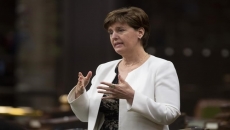
Anita Anand, who was shuffled from defence to become president of the Treasury Board over the summer, told her colleagues they need to start making those decisions by October.
Anand's new role was announced just a few weeks after she and Prime Minister Justin Trudeau attended the NATO summit in Lithuania, where allies agreed to make two per cent of GDP the new minimum spend on defence, and pledged that 20 per cent of that money would be spent on equipment.
Blair told the committee Thursday that Canada may need to push off some major procurement projects, such as the shipbuilding strategy, and make do with older equipment for now.
Canada’s defence spending has increased year after year under our government. That spending growth will continue.
— Bill Blair (@BillBlair) September 29, 2023
We’re reviewing spending to find savings on things like consulting and travel. But overall spending on defence will continue to grow.
The defence budget is about 1.3 per cent of Canada's GDP. Despite its commitments, the Liberal government has never laid out a plan to get to two per cent.
David Perry, president of the Canadian Global Affairs Institute, said Friday there is a disconnect to see Anand "being the person to agree to spend more, to then be wielding the budget knife that'll make that mathematically impossible."
Perry said a three per cent cut to the total budget is easier to achieve than a 15 per cent cut to the budget allocated for consulting, and he argued that defence consulting contracts are unique.
"It's stuff that provides for our fleet maintenance. It's contracts that provide … things like engineering studies, architectural studies and support of buildings, designing warships, that kind of thing," he said.
Blair's office said it will find savings on things like consulting and travel.
But Philippe Lagassé, a professor at Carleton University who specializes in defence policy and procurement, said that's unlikely to be enough.
"This is on brand," he said.
"Defence spending goes up when the economy is doing well or governments are willing to accept fairly significant budget deficits. As soon as governments tire of budget deficits or wish to cut spending, the military is necessarily going to be in their crosshairs."
Blair acknowledged there is an urgent need for significant new investments in defence Thursday, but noted the government has to balance that with other priorities, including housing and affordability measures.
The Armed Forces also has other priorities.
It's trying to tackle a personnel crisis that has been its top priority since last October, when Eyre ordered a halt to all non-essential activities to focus on boosting recruitment and retention.
On Thursday, he said just shy of 16,000 positions are unfilled, and another 10,000 soldiers — around one in 10 — are not yet trained to take part in operations.
That vacancy rate has not budged since early this spring despite efforts to revamp basic training and a new program that allows people to sign on for one year in the navy.
Eyre said there is positive news in retention: The attrition rate is back within historic norms at 7.1 per cent, down from 9.2 per cent during the peak of the pandemic.
Conservative members of the committee expressed frustration at the idea of budget reductions.
"I'm hearing from reservists that they aren't getting their skills in their trades trained up fast enough, they're years behind, not months behind," said James Bezan, the party's defence critic.
"What's going to give here?"
On Friday, Conservative MP John Brassard called it a "disgrace" and accused the government of lying to NATO allies in a statement on X, formerly Twitter.
The U.S. ambassador to Canada, David Cohen, said in a written statement that he won't comment on hypothetical possibilities, but noted the two countries have committed to a defence partnership.
"The United States and Canada both understand that collective security is not free — we need 21st century defence and security to meet 21st century challenges," Cohen said.
A spokesperson for the British High Commission similarly declined to comment on budget decisions, but said "the U.K. remains wholly supportive of the NATO pledge, reaffirmed by all alliance members at the Vilnius summit in June."
Lagassé said there's already a perception among Canada's allies that domestic politics trump international agreements and targets.
"I think it's just going to reinforce existing perceptions that we're just not serious about this and that we're never going to step up," he said.



.jpg "Canada facing nationwide lifeguard shortage")