

U.S. President Donald Trump suggested his administration could move ahead with with 25 per cent across-the-board tariffs on Canadian imports on Feb. 1.
He delivered the deadline on Monday evening at the White House as he signed a stack of unrelated executive orders.
"We are thinking in terms of 25 per cent on Mexico and Canada because they are allowing vast number of people, Canada is a very bad abuser also, vast numbers of people to come in and fentanyl to come in," he told reporters Monday night.
The February date comes after Trump officials, speaking anonymously, suggested to reporters that the Republican president would only sign a memorandum telling federal agencies to study trade issues, including alleged unfair trade and currency practices by Canada, Mexico and China.
An executive order from the president late Monday mandating the studies set an April 1 deadline for the reports -- well after his suggestion that tariffs will happen in February.
Trump also said he may consider imposing a universal tariff on all countries.
"We’re not ready for that yet," Trump said. "Essentially all countries take advantage of the U.S."
Foreign Affairs Minister Mélanie Joly called it an "important moment for Canadians" after Trump announced the date.
“We’re calling on every single political leader across the board, across the country, to stand united because now more than ever, we need to make sure that we put country first," Joly said at a cabinet retreat in Montebello, Que.
Finance Minister Dominic LeBlanc said Ottawa is "absolutely" ready for Trump tariffs, adding that Canada has responses prepared for various scenarios.
Federal government sources have said if Trump sets the tariffs at 25 per cent, Canada’s response would be to impose counter-tariffs worth roughly $37 billion, and possibly follow up with another $110 billion in tariffs. If the duties are lower, Canada’s tariff response would be more modest.
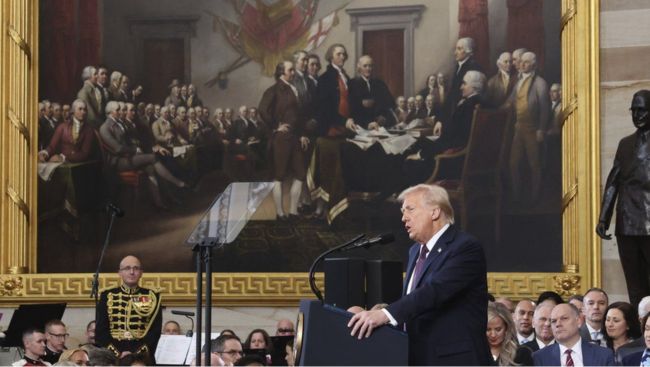
Trump, who gave his inaugural address earlier Monday in the Capitol Rotunda, focused largely on concerns about immigration at the Mexican border and touched on prosecutions of himself and his supporters. Suggesting he still has an eye on tariffs, Trump said he was going to overhaul the trade system to protect American workers and families.
"Instead of taxing our citizens to enrich other countries, we will tariff and tax foreign countries to enrich our citizens," he said during his inaugural address.
Federal and provincial officials in Washington were relieved that tariffs on Canadian goods were not part of Trump's inaugural speech. But many said Canada can't afford to be complacent ahead of what could be a brutal hit to the economy.
"It's always good news when you're not mentioned, so I prefer that," said Liberal MP John McKay, who co-chairs the Canada-U.S. interparliamentary group.
In an interview inside the Canadian embassy in Washington, McKay said Ottawa has an opportunity to establish "an agreed upon set of facts, as opposed to nonsense which is currently occupying the public space."
Trump has insisted for weeks that Washington is subsidizing Canada at an annual rate of $100 billion, a claim McKay called "just nonsense."
Trade Minister Mary Ng sought to reassure Canadians earlier Monday, saying that Ottawa and the provinces have taken a Team Canada approach to convincing Americans that tariffs and restrictions on Canadian goods would only hurt U.S. jobs.
"We are ready and we are prepared," Ng said.
Alberta Premier Danielle Smith said she saw opportunity for Canada in Trump's speech when he said he would "declare a national energy emergency" to drive down prices at the pump and "export American energy all over the world."
Smith said Canada can form a "perfect partnership" with the U.S. to provide oil and gas at stable prices, so the Americans can focus on boosting their own energy exports.
"Americans want to have energy dominance globally, and I believe the best way for them to achieve that is for Canada to be a partner in that," she said.
"If their asks are reasonable, then let's meet them halfway."
Last week, Smith refused to sign a joint statement with other premiers and Prime Minister Justin Trudeau that said every possible countermeasure would be on the table to push back against U.S. tariffs.
Smith, who recently travelled to Trump's Mar-a-Lago resort in Florida to meet with the president-elect, broke from the pack by refusing to consider any plan that would include possible levies on oil exports or cutting off energy supplies to the U.S.
In a statement issued Monday, Trudeau congratulated Trump on his inauguration and cited Canada's efforts to secure the border in response to the Republican leader's demands for a crackdown on migrants and drugs.
"We are strongest when we work together," Trudeau wrote.
When asked who would be his first foreign meeting, Trump said he'd already had meetings. He pointed to Trudeau, making a repeated jab about making Canada the 51st state by calling him a governor.
Monday's inauguration presented a scene quite different from Trump's first inauguration in 2017, when he painted a bleak picture of what he called "American carnage” — a speech that was overshadowed in the news cycle by his claims about crowd sizes.
The celebrations also offered a stark contrast to the nature of Trump’s departure from the nation's capital four years ago. In the wake of the Jan. 6 Capitol Hill attack, Trump refused to accept the outcome of the 2020 election and skipped Biden's inauguration.
Biden and his vice-president Kamala Harris, as well as former presidents Barack Obama, George W. Bush and Bill Clinton, were in attendance on Monday inside the rotunda, as was Industry Minister François-Philippe Champagne.
Trump delivered his oath of office inside the U.S. Capitol after cold weather moved the planned ceremony indoors.
Outside, thousands of people wearing Trump tuques and hats braved the frigid weather near the Capitol One Arena, where Trump spoke later after his inaugural address.
Kenneth Johnson, visiting the capital from Boulder City, Nev., said he believes Trump will stop other countries from "taking advantage" of the U.S. and bring down the cost of groceries.
"We're getting rid of the corruption. We're getting rid of the baloney," he said, citing President Joe Biden's last-minute pardon of administration officials who might face retribution from Trump.
"Our nation's going to be back under control," Johnson said.
Daniel Blake travelled from Connecticut to take in the moment and celebrate with others excited about the promise of smaller government.
"We basically waste our taxpayer money, so I'm excited about that," he said.


