British Columbia had the luxury of time as emergency officials watched a potential tsunami roll across the Pacific Ocean after a massive earthquake near Russia.
But the province's emergency management minister says it's a reminder that B.C. has to always be prepared for the possibility of a quake closer to home.
Kelly Greene said B.C.'s response to Tuesday's tsunami advisory trigger by an 8.8 magnitude earthquake off the coast of Russia "met the moment" given the risk facing the coast.
"We don't know when a big earthquake is going to come. We don't know when a big tsunami event would come," she said.
"So, … being ready is incredibly important, because you don't see it coming, there is not notice. So, without that preparation, you could be in very bad shape indeed."
The province cancelled the tsunami advisory Wednesday that was issued after the underwater quake that was one of the strongest ever recorded and set off tsunami alerts and warnings around the Pacific.
The advisory initially said tsunami waves of less than 30 centimetres were expected to hit Tofino, B.C., late Tuesday.
Overnight, the U.S. National Oceanic and Atmospheric Administration (NOAA) said the waves were highest in B.C. at Winter Harbour on northern Vancouver Island, at 27 centimetres.
An update on Wednesday said the waves were 22 centimetres in Tofino.
The Ministry of Emergency Management issued a bulletin saying the province was standing down its operations centre and "no zones of coastal British Columbia are at risk."
John Cassidy, an earthquake seismologist with Natural Resources Canada, said in an interview Wednesday that there are valuable lessons to be learned from the emergency, related to both the response and the science.
"We have the same type of earthquakes off the coast of Vancouver Island, Washington, Oregon, and off of Haida Gwaii as well. So, we'll be looking at data from this earthquake that will tell us something about how the sea floor moved and how that is related to tsunami generation," he said, referring to how an ocean plate is pushed below another.
"Others will be looking at this, whether you're a tsunami modeler or involved in emergency management, (looking at) the best way to get the information out to individuals along the coast. So, lots to learn."
Cassidy said instruments around the region, including Canada, would have given experts a sense of the magnitude and location of the earthquake within minutes as well as an early indication of tsunami potential.
He said tsunami waves in the open ocean travel at about the same speed as a commercial airliner.
Buoys in the ocean detect how much of a wave is passing overhead, which allows NOAA to issue information to provinces and local governments, he said.
Premier David Eby called the response a "trial run" in which B.C. fortunately did not experience a huge impact — though an expert told him it was a possibility.
Eby said during an unrelated news conference on Wednesday that he initially had to "overcome that feeling that people were overreacting a little bit" when he heard of the quake "halfway around the world," but experts briefed him on "just how unpredictable" these events can be.
He said he knows the province is "prepared for a more significant impact if it happens."
The District of Tofino closed beaches and the province's emergency information agency warned of strong waves and currents.
Tofino's Mayor Dan Law said the risk to his community did not meet the threshold for using the emergency sirens that are set up on the beach.
Law said he was attending a council meeting in the late afternoon when staff, who are part of the emergency operations centre, had to leave following news of the tsunami watch.
“And during our meeting, we were routinely updated by staff about the watch and then the tsunami advisory,” said Law.
He said the community hall was available for visitors and residents who live in low-lying areas and voluntarily chose to evacuate.
“Everybody in Tofino is very well-versed in tsunami preparedness, and people knew the projected size of the tsunami, they knew the direction, they knew the tides,” he said.
The quake struck just before 4:25 p.m. Pacific time Tuesday, and the preliminary magnitude of 8.8 would make it the world's strongest quake since 2011, and one of the 10 most powerful recorded since 1900, according to the U.S. Geological Survey.
The quake sent tsunami waves into Japan, Hawaii and the U.S. West Coast.
Several people were injured, but none gravely.
By Wednesday, the worst appeared to have passed for many areas, including the U.S., Japan and the affected parts of Russia. But Chile raised its tsunami warning to the highest level for most of its Pacific coast and said it was evacuating hundreds of people.
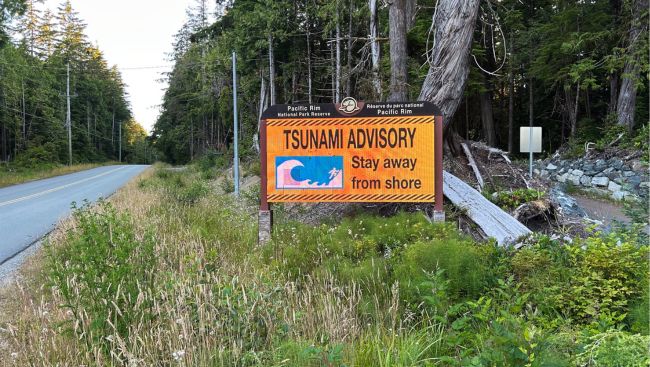
In B.C., signs had been posted Tuesday warning of the tsunami at Wickaninnish Beach in Pacific Rim National Park, southeast of Tofino.
Charles McDiarmid, owner and managing director of the Wickaninnish Inn resort, was born and raised in Tofino and said he has lived through a number of tsunami warnings and advisories, which helps him remain calm
He said the resort has a well-established process of assessing risk and emergency response, and while some guests were initially nervous, the mood had returned to normal by Wednesday morning.
“You can also tell (the guests) that the owner is just down the beach, and he's even lower than you are, and he is going to bed in a very peaceful way tonight, so you don’t have to worry,” McDiarmid said.
He said he and others were asleep by the time the wave reached Tofino.
“If you were standing on the beach at 11:30 last night, you would just see the water come in, the equivalent of a foot, and it might come up on the beach two or three metres or something like that, and that would be it,” he said.
“Of course, none of us stayed awake to stay there and see what happened."
Picture Courtesy: THE CANADIAN PRESS/Dirk Meissner