VANCOUVER - Researchers using a robotic underwater vehicle off British Columbia's northern coast believe they may have found the earliest evidence of human habitation in Canada.
Unfortunately, the site that could date back almost 14,000 years lies beneath hundreds of metres of water in the ocean around the Haida Gwaii archipelago.
Archaeologist Quentin Mackie from the University of Victoria and his team returned earlier this month from a research trip to the archipelago, where they used the autonomous underwater vehicle to scan the sea floor in search of evidence of ancient civilization.
"We're not quite ready to say for sure that we found something," he said. "We have really interesting-looking targets on the sea floor that, as an archeologist, they look like they could be cultural."
Mackie has studied the area for 15 years, and came to believe that ancient residents would have harvested salmon near the coast of what was then a single island that stretched well across Hecate Strait toward the mainland.
At the time, the sea level was about 100 metres lower than it is today and the main island of the archipelago was twice as large.
Stone tools or evidence of campfires would not be possible to see on the ocean bottom. They're too small.
"But we had this idea that if people were harvesting salmon in the rivers... they might have been building fish weirs," Mackie said.
Armed with detailed scans of the sea floor and with the help of Parks Canada and their research vessel, Mackie and his colleagues set out to search.
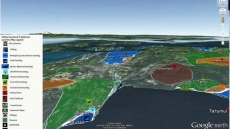
For as many as 12 hours a day, for 10 days, the torpedo-like AUV used sonar to survey 25 kilometres of underwater riverbeds.
He's far from certain, but Mackie is hopeful the images show at least one stone weir — a man-made channel used to corral fish. The scan suggests a wall of large stones placed in a line at a right angle to the stream, a fishing tool common to the Haida and many other ancient cultures.
"That's pretty much the exact archetype of what we were looking for," he said.
Based on radio-carbon dating from another archeological site on the island, the weir could date back 13,800 years.
Alison Proctor, a research engineer from the university's ocean technology lab, programmed and operated the AUV for this expedition and during the 2012 search for the Franklin expedition in the Arctic
There are always technical challenges but "compared to the Franklin project, this one was fairly easy," she said.
There is nothing conclusive but "it gives us a reason to go on, to take this next year, pore over the data ... and go back and try to prove something conclusively," she said.
A geologist will now study the images to ensure the rocks are not a natural formation, then the team will return next summer to take samples of the sediment near the site and to look for stone tools.
If the site is what he hopes, it's a testament to the incredible resilience of the ancient Haida, Mackie said.
They lived through a time of tremendous climatic change, warming from the Ice Age that rapidly returned to near-glacial conditions for a millennium, before rapidly warming again.
"The village that you were born in would be under water by the time you died," he said. "And they're able to take all this change in stride, and they probably even thrived on that."