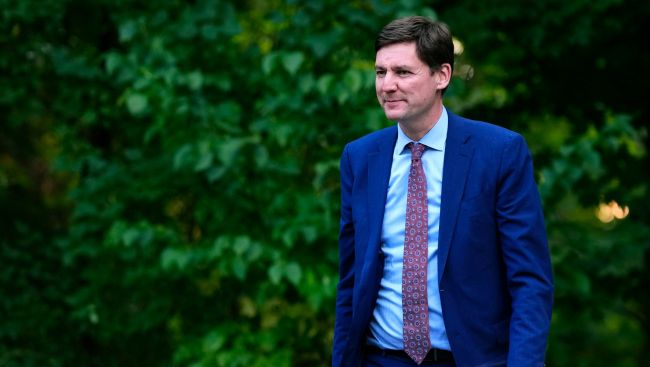
British Columbia Premier David Eby says the province is walking back plans to run anti-tariff advertisements in the United States after a meeting with federal officials about the province's beleaguered forestry sector.
Eby said Monday that B.C. won't be running the ads "by ourselves," in favour of aligning with the federal government in its dealings with the U.S. government under President Donald Trump.
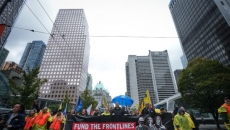
"The unfair and unjustified tariffs imposed by the White House on this sector directly threatens thousands of jobs right across the country," Eby said at a news conference after a forestry summit meeting with federal officials and others.
"Our deep concern is that without imminent action, that things will get significantly worse for families and for communities across the county and particularly in British Columbia."
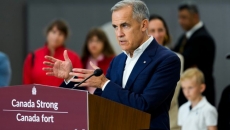
Eby, speaking alongside Dominic LeBlanc, the minister responsible for Canada-U.S. trade, said the shift in strategy is to ensure communications with U.S. authorities are aligned with federal officials as they discuss softwood lumber tariffs from the United States.
"Minister LeBlanc didn't have to ask," Eby answered Monday when a reporter asked LeBlanc if he requested that the B.C. government hold off on its anti-tariff advertising campaign. "I knew that it was a source of anxiety for many people, including potentially the federal government."
The decision comes after Trump last month blamed an anti-tariff ad campaign by Ontario for his cancellation of trade talks with Canada.
The premier said the planned ad campaign by B.C. came up at the Vancouver summit on how to prop up the forest industry in the face of American fees and tariffs.
"Given the reaction to the Ontario tariffs, one of my commitments to the federal government was that if they came to the table with us, if they sat with us, that we would work with them on communications, on strategy, on how to support the sector and how to move forward," he said as the meeting wrapped up.
He said LeBlanc and his team wanted an "integrated approach" and B.C. will ensure future communications are in line when it comes to speaking with the Americans.
Eby said that the forest industry in Canada is larger than the automotive sector and it deserves to be treated with respect.
After the meeting Monday, he said he's confident the federal government understands that.
"This was very heartening to me. I felt like we were going it alone there for a while, and to know that we've got this federal team in our corner is hugely helpful to me and resulted in our commitment to work forward, in terms of any communications with Americans, with the federal government."
LeBlanc said the forestry sector is "massively important" to B.C.'s gross domestic product, and the province and federal government must work together to bolster supports for the forestry sector.
"The hour is grave," LeBlanc said. "This is a critical industry to the fabric of the whole country."
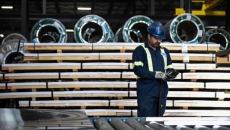
In September, the Trump administration imposed anti-dumping and countervailing duties on Canadian companies ranging from 26 per cent to more than 47 per cent, then threatened to add another 10 per cent last month, claiming Canada’s industry is a risk to U.S. national security.
Eby announced that there will be a working group to set out supports for the sector.
Kim Haakstad, the president of the BC Council of Forest Industries, said in a statement that the group is pleased the governments are working together to keep people working – even when markets are challenging.
Haakstad said the working group should also include the industry to help focus on keeping mills open and people working, which means prioritizing a new "fair and durable" softwood lumber deal and accelerating the rollout of the $1.2 billion the federal government has already set aside for the industry.
She said in an interview Monday that the federal and provincial governments' co-ordination shows that "we're starting to understand the real moment that forestry is in and the urgency of action that's required."
She said Canadian lumber products are still a preferred building material despite that "there's been a lobby group in the United States around for a long time that's been trying to stop Canadian lumber from coming across the border."
"It keeps coming because people like our product."
Haakstad said the industry is "more united" across the country than ever and what happens in the U.S. can't be predicted, but it still remains "our most important market and trading partner.
"There is a need for Canadian lumber that still exists in the United States, and they're just making it more expensive for Americans," she said.
The Canada-U.S. softwood lumber dispute has been a friction point for decades, with the United States imposing duties and fees alleging Canada subsidizes its industry and dumps lumber into the U.S. market.
The U.S. Lumber Coalition said in a statement Monday that Canada has "massive excess and unneeded lumber capacity," most of which it ships across the border "at the direct expense of U.S. jobs."
"Canada should reverse its massive lumber subsidy programs and should stop treating the U.S. market as its dumping ground for Canadian lumber,” said Zoltan van Heyningen, the coalition's executive director.
Picture Courtesy: THE CANADIAN PRESS/Justin Tang