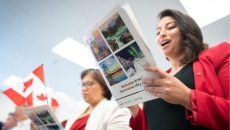
In downtown Vancouver, Sandra Mori walked out of a provincial liquor store on Tuesday with B.C. wine, and raised her elbow to the sky.
“Elbows up,” she said, referencing the common hockey term used to signal it's time to fight back. Mori, who is from Ontario and visiting her father in Vancouver, said she has been buying Canadian products from all over Canada.
“Everybody I know in Ontario, in B.C., are buying Canadian,” she said.
From coast to coast, Canadians are remaining defiant in the face of punishing U.S. tariffs on Canadian goods, promising to use their wallets to fight the trade war launched on Tuesday by President Donald Trump.
In downtown Halifax Tuesday, hours after Trump imposed 25 per cent across-the-board tariffs on products from Canada, and a 10 per cent levy on energy, Haligonians said their resolve was strong. Darcy Comeau said people should find as many alternatives as possible to goods from south of the border.
"I think we should really cut them off, and we should stay (buying) 100 per cent Canadian,” he said.
Christopher Hart, a Halifax resident who is a dual Canada-U.S. citizen, said he’s furious with Trump. "He’s done so many things that are just wrong," he said. "I didn’t vote for him, I did vote in the election. I think he’s sowing a lot of uncertainty and division."
Hart said he's a "wine guy" and California wines have long been a favourite, but he won’t buy any wine made with American grapes from now on. "I’m not going to buying any U.S. stuff, frankly. It’s sad, but it’s where I’m at," he said.
Tom Hetherington, who was holding a Canadian flag in the heavy rain outside of the U.S. Consulate in downtown Vancouver, said he was there to show solidarity amid the trade dispute. Hetherington said his family was buying Canadian products first, and called the tariffs a “wake-up call” for Canada to be more self-sufficient.
“As an individual, I'm here to try and build a better world, a world post Trump, a better Canada, a more sustainable Canada and I'm prepared to pay a little for that,” Hetherington said.
In Edmonton, a dual Canada-U.S. citizen interviewed outside a grocery store Tuesday said she is "mortified" by Trump's behaviour, adding that she also voted against him. "This is very scary economically," Karyn Ball said.
"Canada, along with other countries in the world, needs to start thinking of this as a very urgent threat and figure out a way of defending ourselves against the fascist U.S."
Ken Mutlow, an Edmonton resident out grocery shopping, said nothing in his cart came from the U.S. "I am extremely angry with everything to do with the U.S. these days. We've been trying to buy Canadian for a while … but if it's from the U.S., we are just not buying it."
In downtown Toronto, Claire Tallarico said she was also trying to avoid purchasing any American products at the grocery store.
"I just looked at my vegetables a lot more closely to make sure that if I could buy something from Mexico or from Morocco that I inserted that to the shopping list instead of American products," she said.
Tallarico said she supports removing American goods from Canadian stores, including liquor and wine. "Until this is over, this is a good move," she said. "There are a lot of great Canadian alternatives that people haven't discovered yet."
Halifax-based Narrative Research released a poll Tuesday indicating three-quarters of Canadians have changed at least one purchasing behaviour since Trump began threatening Canada with tariffs since he was elected in November. The online poll conducted from Feb. 12-14 among 1,232 Canadians over the age of 18 asked if residents had sought out Canadian products, looked at labels to avoid U.S.-made items or cancelled a trip south of the border.
Matthew Brown, who manages a restaurant in downtown Halifax, said the tariffs are a huge source of worry, and he's focused on buying local wherever possible. "I’m definitely a proud Canadian, so (I'm) going to do my part where I can to buy products that are Canadian, anything we can do for the economy. But at the end of the day, this is a scary thing," he said.
Kevin Selch, the founder of Winnipeg-based craft brewery Little Brown Jug Brewing Co., said the national push to buy local is encouraging, but the initiative is ultimately a short-term fix.
The Manitoba government dedicated $140,000 last month to a four-week blitz ad campaign aimed at supporting Manitoba businesses that may be harmed by U.S. tariffs.
Selch said it's too soon to know how impactful the ad campaign has been for the beer industry, adding that the real test will be if people stick to buying Canadian products long term. “It's good people are being super local, but maybe their shopping habits overall change as time goes on or as conditions change. Everybody is price sensitive,” Selch said.
Selch is anticipating the tariffs will create a “huge chill” on the business. While the brewery tries to source local products, it relies on the U.S. for machinery and the aluminum beer cans. Tariffs could work out to a five to six cent increase per can, he said.
“That doesn’t sound like a lot, but it has a big impact,” Selch said. “At the end of the day the consumer will pay for it.”
In response to the across-the-board tariffs, the federal government on Tuesday announced immediate 25 per cent retaliatory tariffs on $30 billion worth of American products, and will expand them to cover another $125 billion in U.S. goods in 21 days.