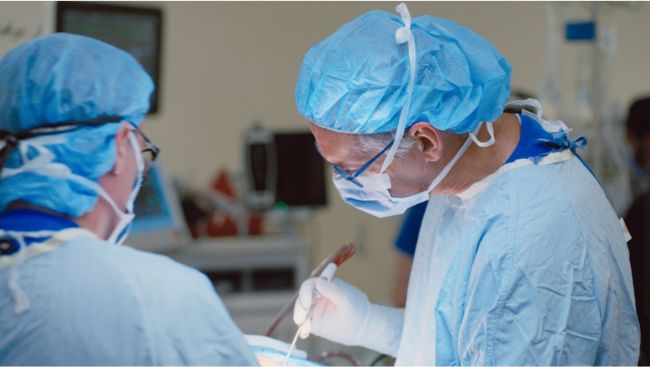
Two Canadian patients with spinal cord injuries have received Neuralink brain implants that have allowed them to control a computer with their thoughts.
They are part of the first clinical trial outside of the United States to test the safety and effectiveness of Elon Musk's Neuralink wireless brain chip, which he introduced to the public in 2020, and was first implanted in a paralyzed American in 2024.
The Canadian men, both around 30 years old – one from Ontario, the other from Alberta – have limited or no ability to use their hands.
Dr. Andres Lozano, a neurosurgeon at University Health Network who led the surgical team at Toronto Western Hospital, said the patients could move a computer cursor almost immediately after. They were able to leave the hospital following their respective surgeries on Aug. 27 and Sept. 3 the next morning, he said.
Electrodes were implanted into the motor area of each patient’s brain to harness neuron signals and translate those signals into actions on an external device, skipping over the need to physically move, Lozano explained.
“The first patient was able to control a cursor by just thinking within minutes. It is extremely rapid. The signals are decoded and the artificial intelligence reads the signals and then translates them into movement on the cursor,” he said.
“They just think about it and it happens.”
Brain-computer interface (BCI) devices are not exclusive to Neuralink, and other companies like New-York based Synchron, are conducting their own clinical trials.
The promise of this technology is encouraging, but expectations should be tempered, said Barry Munro, chief development officer of the Canadian Spinal Research Organization.
Munro, who has been quadriplegic since a diving accident 38 years ago, said he has dedicated his life to spinal cord injury research, and helped with recruitment for Neuralink's U.S. trial. The first person to receive the device last year has said publicly that it started slipping out of his brain weeks after the surgery, setting back his progress, but that he's since stabilized and that it has still been worthwhile.
Munro said he has witnessed “false hope” time again in this field and instead encourages “educated hope,” to learn and be excited, without expecting an implant like this to be available within the next six months.
“We ain't there yet, that's all,” he said.
The Canadian patients will be monitored for at least a year, with the clinical research team permitted to enrol another four patients in the country who have either been paralyzed by a spinal cord injury or who have Amyotrophic Lateral Sclerosis (ALS).
The clinical trial team will be evaluating if the technology is safe and if it adds value to the patient’s quality of life. Side effects they will be looking out for could include seizures, infections or strokes.
In the coming weeks and months, the patients will learn to type on a computer without touching a keyboard. Already, they are able to play video games.
“It's really as a preliminary step to see whether this should be scaled and rolled out to a larger population,” Lozano said.
“The device right now is a cursor, but in the future you could drive a car, you could drive your wheelchair, you could drive a robot.”
Picture Courtesy: THE CANADIAN PRESS/Handout - UHN / Neuralink