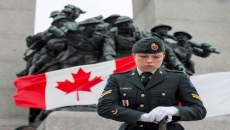
OTTAWA - The secure perimeter around downtown Ottawa, guarded by police checkpoints, will remain through the weekend as the local force tries to maintain peace and order in Canada's capital city without the extra powers they were granted through the Emergencies Act.
Prime Minister Justin Trudeau announced Wednesday the extraordinary, time-limited powers would be pulled back now that the immediate crisis is over. They were brought in last week to respond to protests and blockades against COVID-19 restrictions and the Liberal government.
Interim Ottawa police chief Steve Bell said Thursday the removal of the powers stoked some initial concern among the upper ranks of the force about how they would keep demonstrators out of the city.
The powers proved valuable in helping officers dislodge the massive demonstration that had gridlocked downtown Ottawa after three weeks, Bell said, including by allowing police to designate a no-go zone around Parliament Hill.
The area remains fenced off to anyone who does not live or work there, with police checkpoints dotting the downtown core.
Bell said the checkpoints will stay through the weekend, but police will only intervene in cases where people are taking part in illegal activity, such as blocking streets.
One of the main tools stemming from the Emergencies Act that police relied on, Bell said, was the ability to direct financial institutions to freeze the accounts of people who refused to leave the protest zone downtown. He said the threat was a powerful incentive for people to leave.
Now that the demonstrators are gone, Bell said police no longer need that power.
“There are still financial investigations that will go on," he said.
Some demonstrators, and their trucks, have decamped to farmers' fields, small towns and truck stops in rural areas surrounding Ottawa, and Bell said police have a new plan to prevent them from regaining a foothold should they decide to return to the city.
While the powers under the Emergencies Act have been lifted, questions remain about the long-term effects of invoking such extraordinary measures to quell protests.
The Emergencies Act legislation demands a prompt inquiry into the circumstances surrounding the decision to invoke the extraordinary powers. The report must be tabled in each House of Parliament within 360 days after the emergency is revoked.
A joint committee of members of Parliament will examine the circumstances that led government to invoke the act, and why it was needed, Trudeau said Wednesday.
"It could look at policing. The inquiry could also examine the funding influence and disinformation that supported the illegal blockades and occupations, both foreign and domestic," he said.
The Liberals have proposed an 11-member committee, which would include three Liberal MPs, two Conservatives, one member from the Bloc Québécois, and one from the NDP. The committee would also comprise four senators, representing all groups in the Senate.
Conservatives have suggested that, as the official Opposition, their party should co-chair the committee, and are now demanding that both co-chairs be Tories, according to a statement from government House leader Mark Holland.
But the Liberals have rejected the idea, instead suggesting the Bloc, NDP and a senator steer the inquiry.
"The chair would be neither a Liberal, whose government invoked Emergencies Act, or a Conservative, whose party led the way in supporting protesters," Holland said.
Ottawa's city council and police services board also plan to commission their own reviews of the response to the protests, and Bell said one element will include whether the Emergencies Act was necessary to put an end to them.
The International Civil Liberties Monitoring Group has flagged how the implementation of extraordinary state and policing powers can have long-lasting impacts, particularly on marginalized and vulnerable communities that are already over-policed.
"It is imperative, going forward, that the kinds of violence and threats seen at the blockades not be conflated with protest. Nor should it be allowed to give rise to broader invocations of either the Emergencies Act or the view that protest must be met with extraordinary policing powers," the group said in a written statement Thursday.
The financial measures carried out under the act have been a particular target for criticism and one observer warns the damage will linger long after the initial protests are finished.
Financial intelligence expert Kim Manchester said banks will likely keep tracking those individuals flagged by the RCMP and their names could end up on private-sector third-party databases that banks rely on to mitigate anti-money laundering and terrorist financing.
Banks and other financial institutions were also directed to look into whether any clients seemed to be supporting the protests, and those monitoring actions could well continue, he said.
On a larger scale, Manchester said the actions set a dangerous precedent for how government decides to go after protests, and leaves open the door to using the same tactics in the future.
He said allies will also be watching how the federal government used Fintrac and compare the actions against the protesters to the relatively few resources directed to financial crime generally.
"There are lasting consequences to this. You don't just pull out a fountain pen and sign a piece of paper and hope that it all goes away. It doesn't work like that," said Manchester, managing director of financial intelligence training company ManchesterCF.
For its part, the Canadian Bankers Association said financial institutions moved quickly to unfreeze accounts after the RCMP cleared the individuals and entities flagged for concern, but that some accounts may still be frozen.
"While most customer accounts have been unfrozen, it is important to remember that some accounts may be frozen for a variety of other reasons, including to comply with court orders or proceedings related to illegal activities or other unrelated legal matters," said spokesman Mathieu Labrèche, who declined to comment specifically on the lifting of the Emergency Act.