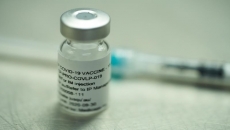
The European Medicines Agency said Friday that people who have received a first dose of AstraZeneca's COVID-19 vaccine should also get the second one despite the rare risk of blood clots that have been linked to the shot.
Peter Arlett, Head of Data Analytics and Methods: “The benefits of AstraZeneca vaccine outweigh the risks. The work introduced today puts the very rare blood clots into the context of #COVID19 hospitalisations prevented, intensive-care admissions prevented and deaths prevented.”
— EU Medicines Agency (@EMA_News) April 23, 2021
We are starting the press briefing on further assessment of data on Vaxzevria, the #COVID19vaccine from AstraZeneca: https://t.co/D7EZUYvtrg
— EU Medicines Agency (@EMA_News) April 23, 2021
In new guidance, the European Union's drug regulator said people should still get a second AstraZeneca dose four to 12 weeks after their first shot and that the benefits of immunization far outweighed the risks of the unusual clotting disorder.
“At this stage, the available data supports continuing to give a second dose of the vaccine," said Noël Wathion, the agency's deputy executive director.
The regulator said it wasn't known whether the risk of a rare blood clot after a second dose might be different than that engendered by the first shot.
In its analysis of Europe-wide AstraZeneca data, the EMA also said there wasn't enough information to know whether age or gender might make some people more susceptible to the unusual clots.
Earlier this month, the Amsterdam-based drug regulator for the 27-nation EU said there was a “possible link” between the AstraZeneca vaccine and rare blood clotting disorders, but that the vaccine dramatically reduced the risk of being hospitalized or killed by COVID-19.
The EMA previously described the clots as “very rare” side effects and said the vaccine labels should be modified to make doctors and patients aware.
It’s still uncertain exactly how frequently the rare blood clots occur. According to data from the U.K., which has administered more AZ vaccines than any other country, there were 30 such cases among 18 million inoculations, as of late March.
Last month, more than a dozen countries, mostly in Europe, suspended their use of the AstraZeneca jab over the blood clot issue. Most restarted — some with age restrictions — after the EMA said countries should continue using the vaccine.
The agency this week identified a similar connection between blood clots and the COVID-19 vaccine developed by Johnson & Johnson. As with the AstraZeneca product, the EMA recommended labeling changes but said the benefits of getting vaccinated outweighed the risks. To date, most of the rare clotting disorders have been reported in women aged under 60.
Both the AstraZeneca and J&J vaccines are made using similar technology, and it’s unclear whether that might be partly responsible for the rare clotting disorders.
EU health commissioner Stella Kyriakides said she hoped the EMA advice would reassure countries about the AstraZeneca vaccine. She said she had written to all of the EU’s health ministers to try to obtain “the maximum possible co-ordination of our (vaccination) approaches, based on science.”
In recent months, countries across Europe have taken wildly different approaches to the AstraZeneca vaccine, despite guidance from the EMA and other health authorities. Some experts say that has seriously undermined trust in the vaccine, with some countries like Norway refusing to use it and others facing sparse demand for the often-maligned shot.
In early April, France said people under 55 who received a first dose of the AstraZeneca vaccine should get other vaccines for their second shot because of the rare clotting risk. Sweden also said people under 65 who had gotten a first AstraZeneca shot would get a different vaccine for their booster shot.
Although studies have begun in Britain and Spain to test whether it’s safe and effective to mix and match different vaccines, including those made by AstraZeneca and Pfizer-BioNTech, no results are yet available.
“We are at the limits of where science can give us reliable answers on that,” said Stephen Evans, a vaccines expert at the London School of Hygiene and Tropical Medicine.
Simon Clarke of Britain’s University of Reading said widespread immunization, including with the AstraZeneca vaccine, was needed to curb COVID-19.
“It would be very bad if people started questioning whether or not they should have their second dose of this safe and effective vaccine,” he said in a statement.
AstraZeneca was supposed to be the workhorse of the EU’s vaccine drive this year — a cheap and easy-to-transport shot to break the pandemic’s back. Yet, the EU said that out of 120 million doses promised for the 1st quarter, only 30 million were delivered.