WASHINGTON — It didn't take the Canadian government long to note the far-reaching policy implications of the Republican wave in Tuesday's midterm U.S. elections.
It swept the party to power in both chambers of Congress. And it carried into state races, where Republicans were flirting with an 82-year-old party record for most governorships. And it left President Barack Obama wobbling with the unwanted distinction of most seats lost throughout a presidency since the Second World War.
But, as Jason Kenney noted, it also held potential implications for the Canadian economy — having, just maybe, created the winning conditions for a certain long-delayed oil pipeline.
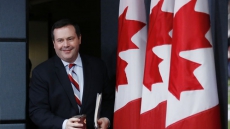
"Good news for Canadian jobs & economy," the employment minister tweeted. "It looks like the new US Senate will have the 60+ votes needed to ensure that Keystone XL is approved."
He could be right.
The impact on Keystone XL is just one of countless results after Americans voted in thousands of races — for one-third of the 100-seat federal Senate; for all 435 House members; 36 state governors; 6,000 state legislators; in 147 referendums; and in municipal contests across the country.
Here are some of those implications:
—Before the vote: Republicans controlled one chamber in Congress, Democrats the other. Bills got stuck, because one chamber would block the other, and the U.S. Congress experienced its least productive period in generations as even routine items became swamped in partisan spite.
—And now: Republicans control both chambers for the first time in eight years. They have enough votes to pass bills — as long as Obama approves. They didn't get the two-thirds congressional majority they'd need to override a presidential veto.
—What the Senate does: It does more than pass laws, like the House of Representatives. It also holds great power to approve or reject the judges, cabinet members, political staff, and diplomats that the White House appoints.
—How will Republicans use this new power? That's the big question. The party is torn. Its more conservative faction will want to beat up on the president, attack his cherished health-care bill, gut the Environmental Protection Agency, and launch congressional investigations into every scandal of the last six years. If so, these may be ugly and unproductive times.
—What about Obama? He also sets the tone. He's expected to make public remarks Wednesday, and has apparently invited the new Senate leaders for a meeting Friday. Obama will need Republican support to make political appointments — let alone to pass legislation. The president can still issue executive orders to federal agencies. Anonymous White House officials have been quoted in news reports sounding defiant, suggesting they plan to fight the new Congress.
—Could things get done? Absolutely. And Canadian interests, ironically, are linked to the most often-cited areas of potential compromise between the Republicans and the president for his remaining time in office: the oil pipeline, a free-trade deal, tax reform, and perhaps even an immigration package.
—What's this about Canada? Keystone XL: Republicans have signalled, loudly, that a top priority will be pushing Obama to approve the pipeline. Free trade: They'll probably even give him fast-track authority to negotiate a Trans-Pacific Partnership trade deal with 12 countries, including Canada — something the Democrats did not do, divided as they were on free trade; Canada has been waiting, reluctant to conclude trade negotiations until Obama gets fast-track from Congress. Tax reform, inspired in part by Timmies': Calls for reform spread like wildfire this summer after news of Burger King moving to Canada in a merger with Tim Hortons, and there's support for it within both parties. Immigration: There's a provision in an omnibus bill that passed the Senate that would have extended the maximum annual U.S. stay for snowbirds. If Republican leaders are willing to withstand the backlash from their base — and that, in itself, may be the biggest "If" in American politics these next two years — that bill could potentially clear both chambers.
—The big battle, bubbling below the surface: A struggle could erupt at any moment over the Supreme Court. Half its judges are older than 75. Their successors could settle some of the biggest issues in American democratic life, with liberals and conservatives eager to revisit lost fights over abortion, gun control, corporate political financing and voter ID laws. If any vacancies open up these next two years, look out. There's already speculation Obama might rather leave a seat empty until the 2016 election, in hope that a president Hillary Clinton gets to present her nominee to a Democratic-controlled Senate.
—History: Presidents almost always lose seats in midterm elections. But Obama has lost more congressional seats in midterms than any since the Second World War. Here's how bad things got: A Republican from New York who faces 20 criminal charges, and was heard on camera threatening to throw a guy off a balcony, and was shunned by his own party during the campaign, won his House seat.
—Why such a big wave? Partly, because this year's electoral map stunk for Democrats. Obama's approval levels are mediocre nationally, at just over 40 per cent; but they're especially low in the swing states that were up for re-election in the 2014 cycle, in more rural states like Kentucky, Arkansas and North Dakota. To complete the perfect storm for Democrats, those seats were up for grabs in a non-presidential election year — when the electorate is older, whiter, and more conservative. The roles could be reversed in 2016 — when Republicans will be defending seats in more liberal states, and the presidential-year election demographics will likely be younger, more multicultural and more Democratic.
—Referendums: Liberal ideas actually made some gains. Oregon and Washington, D.C., voted to follow Colorado and Washington State with marijuana-legalization measures. Ballot measures to increase the minimum wage passed in different states. Background checks for gun purchases passed easily in Washington State. Anti-abortion measures failed in two of three states, although voters in Tennessee gave their state legislature approval to pass measures stifling abortion access.
—Notable names: For the first time, an openly gay Republican was on the verge of being elected to Congress — Carl DeMaio held a slim lead as ballots were being counted early Wednesday in California. And a half-century after Lyndon Johnson predicted that civil rights would cost Democrats the south, the region they'd long dominated, the last white Democrat in the Deep South, Georgia's John Barrow, lost his House seat. Also in Georgia, ex-president Jimmy Carter's grandson, Jason, lost the gubernatorial race. On the other hand, George H. W. Bush's grandson, George P. Bush, won the race for Texas land commissioner.