When Dave Phillips, Environment Canada's senior climatologist, began 26 years ago compiling his annual list of the country's Top 10 weather events, he sometimes had to stretch a bit.
"One of the big stories was, 'Hey, it was a good recreation season, skiers loved it,'" he recalls.
Searching for weather events was not a problem in 2021.
"This year was beyond belief. There's no year in the 26 years that could compare to this year."
There are no happy visions of snow-covered slopes on the 2021 list. Just death, destruction and drought.
Consider late June's heat dome in Western Canada, the top pick by Phillips for the year.
The record temperature of nearly 50 C at Lytton, British Columbia, was well-publicized — as was the village's destruction in an ensuing wildfire. But Lytton was only one of six communities that surpassed Canada's previous all-time high temperature that day.
Local records melted like Popsicles. About 1,000 new daily temperature marks were set between June 24 to July 4.
Heat was a factor in 600 deaths in Vancouver and in another 185 in Alberta. More than 650,000 farm animals perished, despite desperate measures such as chicken farmers spraying their barns with water.
Floods? September gave a sinister new cast to the old gibe of calling B.C. the "wet coast" for the second ranked weather event of 2021.
Some places got 30 centimetres of rain over three days. Forty daily rainfall records fell with totals experienced only once every 100 years.
Saturated mountainsides collapsed. The Fraser Valley flooded, along with several towns and cities. Major highways washed away like sandcastles.
More than 14,000 people were evacuated, including the entire population of Merritt. Four people died and one was missing.
B.C. wasn't the only province afflicted. Much of the Prairies suffered through another drought year that historians compared to the Dirty '30s.
Edmonton had its second driest winter in 136 years, while Calgary's spring rain was less than half of normal. Southern Manitoba was Canada's drought epicentre, where places like Winnipeg had their two driest back-to-back years in more than a century.
Both wheat and canola production were down by a third. Hay crops were as little as 10 per cent of normal.
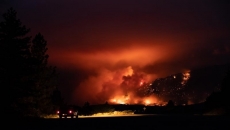
Heat plus drought also equalled wildfires across the country.
B.C. saw almost 60 times more forest burned this year than in 2020 and the third most area ever. The smoke spread to Alberta, where Calgary recorded 512 hours of smoke and haze — more than 40 times the average and enough to cancel chuckwagon races at the Stampede.
Ontario called 2021 its worst fire season on record, with 50 per cent more fires than the 10-year average and five times the area burned. More than 3,000 people were evacuated from First Nations communities.
The list goes on.
Tornadoes powerful enough to push homes off their foundations whipped repeatedly through Ontario and Quebec. One of them killed a man in Mascouche, Que., which saw winds up to 200 km/h.
In February, an arctic blast turned the Prairies gelid with record low temperatures. On Feb. 13, Winnipeg's -38.8 C was colder than the summit of Mt. Everest. In Edmonton, pucks at outdoor hockey games shattered when they hit goalposts.
Newfoundland battened down for Hurricane Larry, which hit Sept. 11 with winds gusting up to 180 km/h. Larry poured rain, toppled trees, flung roofs and knocked out power to 60,000 people.
In all, 2021 was enough to leave a normally eloquent climatologist grasping for superlatives.
"It just is mind-boggling," said Phillips.
This year showed how climate change can exaggerate and extenuate the normal extremes of Canadian weather into dangerous and destructive events, he said.
"What I'm hopeful for is that it becomes the turning point and confirmation for the majority of Canadians that there's clear and present danger to climate change and extreme weather," he said. "This year has really woken people up to that fact."
If there's a lesson to 2021's weather, it's that Canada's buildings, roads and bridges were built for a climate that no longer exists. This year, said Phillips, may be a foretaste of what's to come.
"I'm worried," he said.
"It's kind of scary to think that what occurred in 2021 would be called ho-hum in 2050. This just may be what's going to be more normal-like in the years to come.
"Nature's trying to tell us something."