A researcher on intimate partner violence is calling for British Columbia to increase funding for forensic nurses, saying there is service gap for survivors in most regions.
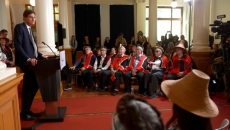
The comments by Amanda McCormick, an associate professor in the school of criminology at the University of the Fraser Valley, come as experts convene to discuss the dangers of non-fatal strangulation at a symposium in Abbotsford.
Hosted by the university, the event has brought together experts to address the often under-recognized form of violence.
McCormick said the signs of strangulation are often hidden, but can cause serious harm, including brain injury.
Forensic nurses, she said, have the training needed to identify and treat injuries through medical exams, documenting injuries in a way "that follows chain of custody for evidence, which will allow that information to be used in court" if a survivor chooses to report to police.
Most doctors don't have the same specialized legal training as forensic nurses, McCormick said.
"They cover both the health care and the legal system and that's what makes them really unique," she said.
"They will do the exam, if you'd like the forensic one, and they will store all the evidence that they collect for possibly up to a year, if not longer if they're able to," she said.
That way, she said, if someone changes their mind about making a report, the evidence can be provided to law enforcement.
Adrienne Olszewski, a forensic nurse specialist, told conference attendees Thursday that the role of a forensic examiner is to act as a bridge between the medical and legal systems.
"Health care and the legal arenas intersect, and that's where forensic nursing lies," she said.
Olszewski said the examiner does not have to be a nurse, "but it does have to be someone that can meet all three, medical, legal and trauma-informed care."
She said the Canadian Forensic Nurses Association encourages physicians and nurse practitioners to also be trained as forensic examiners, but the challenge becomes who has the time to conduct an hours-long exam.
"I just don't see physicians spending this much time — four hours, 12 hours with patients. It's not feasible given the demands of a physician role in society," Olszewski said.
She noted that in the current system, only 10 per cent of patients gain access to this type of exam in Canada.
"That's a problem. We have an opportunity to detect injury, to be able to report on it and to be to support a multidisciplinary response," she said.
"I do think that there's an opportunity for whoever has the specialized training to provide this response consistently to all people affected by violence (but) right now, we aren't getting that level of evidence."
McCormick said forensic nurses typically work on "a casual basis where they are on call," leaving a service gap in most areas of the province.
"We really need funding to commit to having forensic nurses working 24-7 or available 24-7, being on-site, able to meet that demand for multiple forms of gender-based violence," she said in an interview.
The B.C. Health Ministry did not immediately respond to a request for comment.
There is currently no forensic nursing available to people in northern B.C., and in other areas, like B.C.'s Interior, forensic nurses are only used in cases involving a sexual assault, McCormick said.
That means, if there's no sexual component to intimate partner violence, victims may not be able to access the forensic nursing services, she said.
"This is very concerning to us because in the research I've done and the research others have done, what we see is there is a very strong association between partner abuse and strangulation," she said, noting it is the most prevalent indicator of future femicide.
"We're also seeing very high rates in physical (intimate partner violence) where strangulation has occurred and these people currently don't have anywhere to go unless they're in the Fraser Health Authority."
Tiffany Kafka, a forensic nurse in Fraser Health, agreed the service is not being evenly applied in B.C.
"So, in Fraser Health, where we are right now, we are the only service in B.C. that has on-site, fully funded positions in the hospitals," she said, presenting to attendees at the conference on Thursday.
There are on-call nurses elsewhere in the province and no access in the north.
She noted B.C. is developing a virtual care system.
Olszewski explained that a forensic nurse tells a practitioner over camera how to gather evidence. While she said virtual care may help fill the gap, particularly in rural or remote areas, that hasn't yet been scrutinized for "evidence integrity" in court.
McCormick said Fraser Health is conducting a pilot project in Surrey and Abbotsford where forensic nurses were on-site from 7 a.m. until 11 p.m., seven days a week. They are also on call overnight.
"Since they've done that in Abbotsford, they've seen their demand for forensic nursing go up 183 per cent in 12 months," she said.
"They're able to see those patients as soon as they need that care, and this is really critical, and it's not happening elsewhere."
Picture Courtesy: THE CANADIAN PRESS/Ethan Cairns