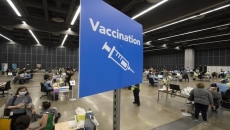
Canada's demand for COVID-19 vaccines is slowly dropping, experts say, and they warn those waiting to see whether cases spike before getting their jabs are wasting time the body needs to build sufficient immunity.
Less than one per cent (0.98) of Canadians were vaccinated per day over the last week, a decrease from the record-high daily rate of 1.44 at the end of June, according Our World in Data. A vaccine tracker created by a University of Saskatchewan student shows daily average first doses have dropped to fewer than 40,000 from roughly 96,000 a month ago.
A drop is to be expected, since 80 per cent of the eligible population already has at least one dose and close to 60 per cent are fully vaccinated. Canada's vaccine uptake and rate of vaccination is still among the highest in the world — France is vaccinating 0.92 per cent of its population per day while the United Kingdom is at 0.34.
But Kelly Grindrod, a pharmacy professor at the University of Waterloo, says a slowing rate is concerning, and the spread of new variants means more Canadians need to be fully protected to mitigate future outbreaks.
Grindrod pointed to countries with high vaccine uptake, including the U.K. and the Netherlands, that are seeing new infection waves, largely hitting unvaccinated populations.
"We're in a very difficult stage of apathy, where people don't think they're at risk," Grindrod said. "But ... there's a real concern that if you wait until the numbers go up to get vaccinated, it's too late."
Grindrod said some of the slowdown might have to do with people delaying second doses when offered a Moderna shot, preferring to wait for Pfizer-BioNTech instead.
Even waiting a few days delays protection, Grindrod said, as immune systems require two weeks after dose 2 to build optimal levels of antibodies. Anyone still waiting for their first jab must wait another four weeks for their second dose, putting themselves at an even greater disadvantage.
Concern over mixing Pfizer and Moderna shots appears to be driving some hesitancy, she said. Though experts have repeatedly said the two mRNA jabs are interchangeable, confusion remains.
Mixing mRNA vaccines became wider spread in Canada last month, when delayed Pfizer shipments coincided with an influx of Moderna.
Kyro Maseh, a pharmacist in Toronto, said he and his colleagues have a harder time moving Moderna vaccines, and he fears a Pfizer preference will result in large amounts of wastage.
"I'm about to throw out 350 doses of Moderna," Maseh said. "Another country would gladly take that off our hands."
Maseh said part of the issue is that each Moderna vial contains 14 doses, compared to Pfizer's six. Once a vial is punctured, its contents need to be used within 24 hours. Vials that are thawed from their freezing temperatures need to be used within a month.
Maseh said the problem isn't that Canada is receiving too many doses now, but that messaging over mixing vaccines has hit roadblocks in recent days.
Last week, a World Health Organization official warned of individuals seeking out different vaccines on their own for third or fourth doses, a quote that was taken out of context to suggest mixing doses wasn't advised.
Grindrod said colleagues recounted seeing people reading and sharing the story with others while in line at a mass vaccine clinic in Cambridge, Ont. — and then walking out.
Travel concerns could also be a factor.
A story last week about Barbados not recognizing Canada's mixed-dose strategy prompted more hesitation, Grindrod said, even though the Caribbean country quickly reversed its policy. Norwegian Cruise Line said on its website that vessels embarking and disembarking from U.S. ports won't accept mixed vaccination, though ships from non-U.S. ports will.
"It doesn't take much for people to delay (their second doses) and that's a real concern," Grindrod said. "People are thinking very far into the future about travel, and that's another way of saying they don't believe they're at risk right now."
Celia Du, a science communications specialist in Toronto, said debunking negative perceptions about mixed doses can be difficult once they're ingrained.
Experts can get bogged down in scientific language and lose peoples' attention, she said, so it's often the quick and simple headlines — even if misleading — that people tend to remember.
"Finding ways to make the truth short and sweet is always a good strategy," she said.
Maseh said people who delay vaccination now, as restrictions lift and travel resumes, risk being vulnerable at a time when COVID-19 could soon rise.
The lack of vaccine access in other parts of the world is also troubling, he added. And while Canada is doing well to keep COVID-19 at bay now, Maseh said the threat of new variants developing and spreading could spell trouble.
"By taking perfectly good vaccines and tossing them in the trash, you're shooting yourself in the foot down the road," he said.