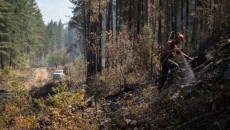
VANCOUVER - A fire ecologist says new provincial funding to expand the BC Wildfire Service to a year-round endeavour is a welcome step toward preventing disasters, while others in the field say the funds could be better spent elsewhere.
Bob Gray said landscape-scale planning, prescribed burns and other tactics for reducing the risk of wildfires can take significant behind-the-scenes planning during the off-season.
"There is so much work to do that this is a welcome decision on the part of the province," he said in an interview from Chilliwack, B.C.
Funding announced Tuesday in the B.C. budget includes $145 million over three years to be used in part to move the BC Wildfire Service from its current reactive model of fire response to a more proactive one.
Another $98 million over three years will help fund the maintenance of forest service roads and prevention work, while more than $26 million is flagged for upgrading the agency's facilities.
The B.C. government imposed a state of emergency last July, a few weeks after fire destroyed much of the town of Lytton during a sweltering heat wave. Many more homes were lost in other communities to wildfires later last summer.
The 2017 wildfire season, where nearly 65,000 residents were forced to leave their homes, set a record for area burned at just over 12,000 square kilometres. That record was eclipsed a year later when 135,000 square kilometres was burned.
Gray, who has done consulting work for some provinces, the federal government and the World Bank, said a year-round service could help fill gaps in much-needed prevention and mitigation work.
Prescribed burns, or intentionally set fires similar to the practice Indigenous communities once used to manage forests, have drawn attention in recent years as a method for reducing fire risk.
But Gray said it can take up to a year to plan a burn, given all the hurdles of obtaining permits, liaising with Indigenous and local communities, while ensuring archeological sites, recreational areas and endangered species are protected.
On a larger scale, investing in more landscape planning that looks at fire risks in whole watersheds could have big payoffs.
If a wildfires scorches up to 1,000 square kilometres, planning should occur on a similar scale, Gray said. It means shifting beyond a focus at the edge of communities to look at the broader ecosystem.
"We have to be managing landscapes of a similar size if we're going to have any impact on that. So, the little postage stamp, which is what we've been doing — 20 hectares here and 40 hectares there — they don't have any impact on these larger processes that take place," Graysaid, referring to buffer areas cleared around communities.
Some consultants already working in prevention and mitigation expressed skepticism at the government's plan to expand the wildfire service to do the same.
John Davies, a registered professional forester and wildland fire specialist in Vernon, said he expects the wildfire service could have difficulty retaining seasonal employees like student firefighters beyond the summer.
"It's really going to be the devil in the details how they make this plan work," said Davies, a former employee of the service.
Davies said he is typically contracted by local governments or First Nations to reduce fuel, conduct controlled burns and undertake other measures to lower the fire risk.
Expanding the focus on prevention and mitigation is welcome, but the problem isn't a lack of experts in the field, he said. It's that local communities haven't had sufficient funding for the level of work that is needed.
Rather than expanding the wildfire service, Davies said he believes the province should increase local funding so that contractors, like himself, can bid on projects at a competitive rate to the benefit of taxpayers.
While last year's budget included $120 million in emergency preparedness supports for communities and $90 million for community-level wildfire prevention, the 2022-23 budget discontinues those funding streams.
Bruce Morrow, who works in forestry and fuel management, also said the government could better incorporate working professionals rather than training BC Wildfire Service employees to do the same.
"If you want to get better at wildfire suppression and management, we need to have everyone involved," he said.
Chief Joe Alphonse of the Tsilhqot'in National Government has been a critic of provincial and federal responses to wildfires, saying their failure to recognize Indigenous knowledge posed a greater threat to the First Nation than the fires themselves.
The Tsilhqot'in territory in the province's Interior saw some of the worst fires in the province's history in 2017.
Alphonse pointed to the fire that tore through Lytton last summer as evidence that there's still room for improvement. The B.C. government has acknowledged that early communication with First Nations in the area didn't live up to expectations.
"I think those moneys would be better used and better served ... to strengthen their relations with First Nations people," Alphonse said.