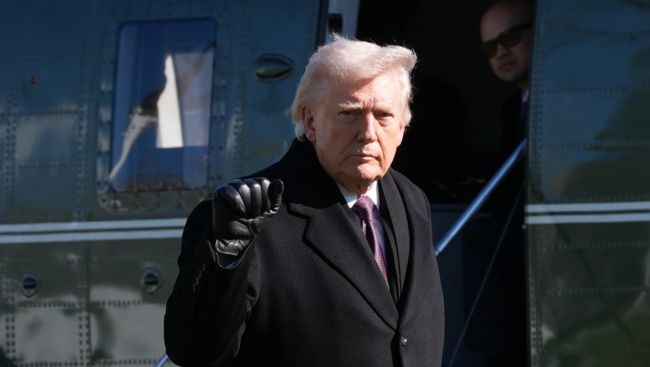
U.S. President Donald Trump is widening the cracks between the United States and European NATO members with his calls for allies to help him finish the war he started with Iran.
Many NATO member countries were already grappling with the future of the alliance after a key member — the United States — threatened to take over Greenland, an ally's territory.
Canada has a different problem: alliances may change, but geography is permanent.
"Geographically, no matter what government there is in the United States or what government that is in Canada, there are some immutable geographic factors," said Aurel Braun, a professor of international relations and political science at the University of Toronto.
Twelve countries, including Canada, signed the North Atlantic Treaty in 1949 in Washington, D.C., in an effort to provide collective security against the Soviet Union. NATO has since grown to 32 member nations and is the longest-enduring defence pact in history.
Article 5 of the treaty, which states that an attack on any member will be met by a response from all of them, has only ever been invoked once — by the United States, after the Sept. 11, 2001, terrorist attacks.
Despite that, Trump has repeatedly claimed he's not convinced NATO members would be there for the United States if it needed help again, and has denigrated the service of allied soldiers who have fought — and died — alongside Americans.
In multiple posts on social media, Trump has suggested the U.S.-Israeli war on Iran is a test of NATO's commitment.
"The United States has been informed by most of our NATO 'Allies' that they don’t want to get involved with our Military Operation against the Terrorist Regime of Iran, in the Middle East, this, despite the fact that almost every Country strongly agreed with what we are doing, and that Iran cannot, in any way, shape, or form, be allowed to have a Nuclear Weapon," Trump said on social media Tuesday.
"We will protect them, but they will do nothing for us, in particular, in a time of need."
On Thursday, Canada joined the United Kingdom, France, Germany, Italy, the Netherlands and Japan in issuing a joint statement on Iran's blockage of the Strait of Hormuz. In it, the countries expressed their "readiness to contribute to appropriate efforts to ensure safe passage through the Strait."
Braun said the problem with Trump is he is "bombastic, is narcissistic, he's vindictive" and "he has demeaned, disparaged and mischaracterized the alliance."
Trump's provocations can elicit responses from NATO partners that are driven by anger or a sense of betrayal, making it difficult for them to focus on real issues, Braun added.
After the start of the airstrikes on Iran, Braun said, many European leaders echoed Trump's own repeated attacks on aid for Ukraine by stating the president's war is not Europe's war.
Trump's insulting tone, and the response from other countries, make it difficult for NATO members to see the international picture clearly and set strategy, Braun said.
Looked at one way, the United States' future in NATO should be on a surer footing now, said Erwan Lagadec, an associate research professor at George Washington University's Elliott School of International Affairs.
In recent years, Congress has passed legislation that prohibits the executive branch from unilaterally reducing troop numbers in Europe below a certain level, and maintains the U.S. role in NATO command. U.S. Ambassador to NATO Matthew Whitaker assured the alliance in February the United States was still committed to Article 5.
"So in principle we should … be clearer about NATO, the U.S. commitment to NATO under this administration, than we were even six months ago," Lagadec said. "But all bets are off with Trump, who now seems to put the U.S.'s commitment to NATO in doubt again."
Canadians know from experience that congressional guardrails don't stop Trump from acting on his impulses. The Canada-U.S.-Mexico Agreement on trade was negotiated during the first Trump administration and passed through Congress. Many experts say Trump's wide-ranging and erratic tariff agenda undermines his own trade pact with America's closest neighbours.
The president also has repeatedly threatened Canada's sovereignty and has called both the current prime minister and the previous one "governor."
While Europe is working to boost its military capacity in response to the instability generated by the Trump administration, not all countries are necessarily looking for a clean break from the United States, Lagadec noted.
Canada is also boosting its military spending, partly in response to the Trump administration's threats. But Lagadec and Braun both agree that — given the length of the Canada-U.S. border, the vast shared landscape and the population difference between the two countries — it's not realistic to think Canada can decouple its defence from the United States.
"The United States would still be a superpower," Braun said. "Geography will not change in Canada."
Picture Courtesy: AP Photo/Jacquelyn Martin