Canada has a need for a co-ordinated flash flood warning system and could deepen its European partnerships as the United States cuts climate- and weather-related funding, says a new report digging into the future of Canada's weather service.
The independent assessment prepared for Environment and Climate Change Canada says significant cuts to the U.S. National Oceanic and Atmospheric Administration threaten a wide range of weather and water monitoring in Canada, from the Arctic to the Great Lakes.
"Disruptions to the flow of data between the United States and Canada, and restrictions on the sharing of satellite data in particular, could be detrimental to Canada’s ability to generate accurate and precise weather and climate analysis," says the report published Thursday.
The report produced by the Council of Canadian Academies says maintaining Canada's own observation network is a critical part of the weather service's mandate, especially as climate change and artificial intelligence reshape how forecasts are built and delivered.
Yet the report notes there are gaps in that network, especially in the North, where weather stations can be hundreds of kilometres apart and miss out on key weather variables.
Less than one-third of the stations north of the 55th parallel record at least three of five key weather variables, and that percentage has been on decline over the last 30 years, the report says.
Extreme weather, fuelled by a changing climate, is leading to increased damage to stations across the country at the same time as there's more demand for high-quality data to inform climate models. It's also increasing the need for timely and accurate warnings, the report says.
Despite that, "program spending on hydro-meteorological services has remained relatively static over the past five years," the report notes.
The federal government oversees a vast network of "backbone" monitoring infrastructure. As of July 2023, that included 575 weather stations, 225 co-operative climate stations, 29 lighthouse stations, 2,200 hydrometric monitoring stations, 32 operational radars and eight ground-receiving stations receiving data from satellite-born sensors.
"The backbone infrastructure is foundational, not only for the weather service; it's foundational for climate. It's foundational for partners in the private sector, the media," said Jim Abraham, the past president of the Canadian Meteorological and Oceanographic Society who chaired the expert panel behind the report.
The federal government asked for the CCA's report to examine the essential functions of the public hydro-meteorological service and how it could adapt to keep pace with growing demands.
The report's findings will support the weather service's planning, "particularly in areas like digital innovation, user-centric service design and potential directions for enhanced public-private (domestic and international) collaboration," a spokesperson for Environment and Climate Change Canada said in a statement.
"Partly in response to the changed U.S. context, ECCC is developing measures to strengthen Canada's data resiliency and sovereignty. These include building on Canada’s already close working relationships with other national hydro-meteorological services and with the World Meteorological Organization."
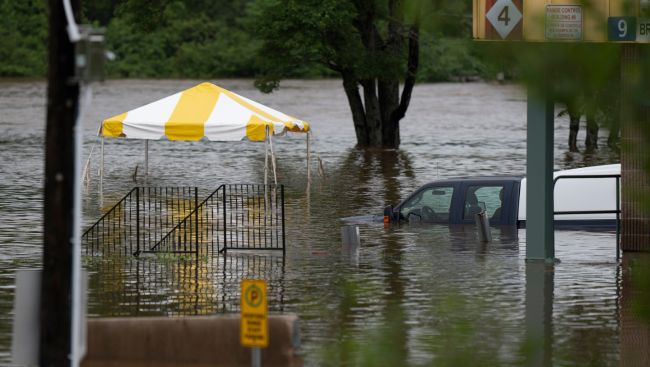
The report does not offer formal recommendations, but it does say there's a need for a co-ordinated flood forecast system, including flash flood warnings. Flood mapping is a collaborative effort between levels of government, while freshwater flood warnings and related mitigation are under provincial jurisdiction.
"It has been noted the distributed nature of flood warning and response initiatives is a weakness in the Canadian weather forecasting system," the report says.
Experts who contributed to the report identified "a need for greater federal leadership in ensuring public safety from flooding through a collaborative approach."
Recent changes at NOAA come up several times in the report.
With the U.S. administration's recent funding cuts and restrictions on its scientists' international collaborations, "Canada's access to rich remote sensing data may be in jeopardy," the report says.
It adds that while artificial intelligence promises to increase the resolution and accuracy of forecasts, it should be paired with proven modelling.
AI models' decision-making processes are often opaque, and they can fail in unprecedented scenarios, such as those caused by climate change where past data may no longer be relevant, the report notes.
"Future forecasting systems that integrate AI and traditional physics-based modelling will help ensure accurate, reliable and more frequent predictions," it says.
Picture Courtesy: THE CANADIAN PRESS/Darren Calabrese