
Wednesday, July 1, 2026
ADVT 
National

Fact File: Posts falsely claim Canada revoked China's equal trade status

Darpan News Desk The Canadian Press, 11 Dec, 2025 11:52 AM
  • Fact File: Posts falsely claim Canada revoked China's equal trade status

Chinese language posts that appeared on social media the past few weeks claimed Canada was one of 32 countries to revoke China's "most favoured nation" trade status on Dec. 1. 


The claim originates from a 2021 rumour that conflates most favoured nation status with "generalized system of preference" certificates, which China stopped issuing to Canada and other countries on Dec. 1 that year. 


China remains a most favoured nation by Canada, meaning it is entitled to equal treatment as a trading partner.


THE CLAIM


Since November, several Chinese language posts across western social media claimed Canada was one of 32 countries to revoke China's "most favoured nation" status. 


Most favoured nation refers to a trade principle that entitles trading partners to equal status. Countries that trade as World Trade Organization members are required to provide the same trade benefits to all countries, with some exceptions. 


An image posted to the X platform, formerly Twitter, and multiple times on Facebook claimed Canada is one of 32 countries that removed China's most favoured nation trade status as of Dec. 1.
Similar claims appeared several times on Threads, as well as YouTube. 


THE FACTS


A keyword search of the Chinese language text shows this isn't the first time the claim appeared online. 


In 2021, Hong Kong-based HKBU Fact Check reported on the claim, which seemingly originated from a Facebook post. The post made an identical claim about 32 countries removing China's most favoured nation status on Dec. 1. 


However, a further keyword search shows the original announcement made by the General Administration of Customs China that references the 32 countries.


In the announcement, the customs agency said it would stop issuing generalized system of preference (GSP) certificate of origins for goods exported to 32 countries, including Canada and the European Union. 


The certificates grant preferential tariffs to imports from developing countries, according to the World Trade Organization. 


The Chinese customs agency said some countries pulled their GSP treatment for China over the years, since rapid economic development meant China was no longer considered a low-income country. The agency said it would stop issuing GSP certificates of origin to the 32 countries on Dec. 1. 


A 2021 article from China Briefing discussed the confusion over the announcement, noting the 32 countries stopped giving China GSP status over several years and not all at once. Canada removed its version of the GSP for China and 71 other countries as of Jan. 1, 2015. 


China and Canada are both part of the World Trade Organization, and remain entitled to most favoured nation status. China remains on Canada's list of countries afforded that status. 


Canada removed most favoured nation status from Russia and Belarus on March 2, 2022 in response to the Russian invasion of Ukraine, and imposed a general tariff of 35 per cent to most goods.

However, it made an exception for cobalt-60, a radioactive isotope used in some medical goods, as the government said it was unable to source enough elsewhere. 

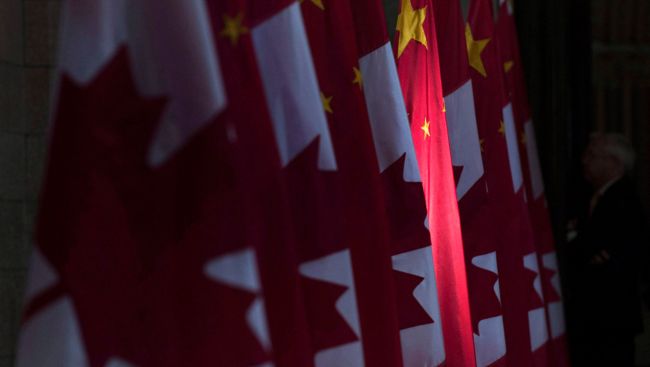
Picture Courtesy: THE CANADIAN PRESS/Adrian Wyld

MORE National ARTICLES

B.C. Lt.-Gov. Janet Austin wraps up seven-year post

B.C. Lt.-Gov. Janet Austin wraps up seven-year post
British Columbia's lieutenant-governor is leaving office after seven years on the job, with Premier David Eby telling her farewell ceremony that her focus on reconciliation with Indigenous Peoples was among her key contributions. Janet Austin's work during her tenure advanced reconciliation in the province, Eby told the ceremony at the legislature in Victoria on Wednesday.

B.C. Lt.-Gov. Janet Austin wraps up seven-year post

Environment Canada warns of wintry conditions along B.C. south coast

Environment Canada warns of wintry conditions along B.C. south coast
Environment Canada says wintry conditions are expected along British Columbia's south coast this week. It says a low pressure system is making its way toward the coast, bringing steady precipitation starting Thursday afternoon. 

Environment Canada warns of wintry conditions along B.C. south coast

Trump's pick for commerce says president's tariff threat could be just the beginning

Trump's pick for commerce says president's tariff threat could be just the beginning
During Wednesday's Senate hearing on his nomination to lead the U.S. Department of Commerce, billionaire financier Howard Lutnick said the plan to impose duties on Canada and Mexico is distinct from Trump's long-term tariff plans.

Trump's pick for commerce says president's tariff threat could be just the beginning

CBC head calls for a 'national conversation' on Conservatives' pledge to defund

CBC head calls for a 'national conversation' on Conservatives' pledge to defund
With Donald Trump making "territorial claims," the new head of CBC says defunding the public broadcaster could erode a pillar of Canada's cultural identity. Marie-Philippe Bouchard, CEO of CBC-Radio-Canada, is calling for a "national conversation" on the Conservative promise to defund, and is launching a tour to get it started.

CBC head calls for a 'national conversation' on Conservatives' pledge to defund

These industries would be hit hardest by Trump's 25 per cent tariffs

These industries would be hit hardest by Trump's 25 per cent tariffs
Statistics Canada says the value of Canadian exports to the United States in 2023 exceeded $594 billion. More than 43 per cent of that came from just six industries: oil and gas extraction, oil and gas refining, auto manufacturing, aluminum production and processing, aerospace and crop and animal production.

These industries would be hit hardest by Trump's 25 per cent tariffs

Ukrainians worry as their three-year emergency visas are set to expire

Ukrainians worry as their three-year emergency visas are set to expire
Many of the 300,000 Ukrainians who have come to Canada on three-year emergency visas since 2022 face an uncertain future as their temporary resident permits come closer to expiring, the Ukrainian Canadian Congress warned Wednesday. Congress executive director Ihor Michalchyshyn said he met with Immigration Minister Marc Miller last week to ask his department to automatically renew the visas for another three years.

Ukrainians worry as their three-year emergency visas are set to expire