
Thursday, July 2, 2026
ADVT 
National

Fact File: Posts falsely claim Canada revoked China's equal trade status

Darpan News Desk The Canadian Press, 11 Dec, 2025 11:52 AM
  • Fact File: Posts falsely claim Canada revoked China's equal trade status

Chinese language posts that appeared on social media the past few weeks claimed Canada was one of 32 countries to revoke China's "most favoured nation" trade status on Dec. 1. 


The claim originates from a 2021 rumour that conflates most favoured nation status with "generalized system of preference" certificates, which China stopped issuing to Canada and other countries on Dec. 1 that year. 


China remains a most favoured nation by Canada, meaning it is entitled to equal treatment as a trading partner.


THE CLAIM


Since November, several Chinese language posts across western social media claimed Canada was one of 32 countries to revoke China's "most favoured nation" status. 


Most favoured nation refers to a trade principle that entitles trading partners to equal status. Countries that trade as World Trade Organization members are required to provide the same trade benefits to all countries, with some exceptions. 


An image posted to the X platform, formerly Twitter, and multiple times on Facebook claimed Canada is one of 32 countries that removed China's most favoured nation trade status as of Dec. 1.
Similar claims appeared several times on Threads, as well as YouTube. 


THE FACTS


A keyword search of the Chinese language text shows this isn't the first time the claim appeared online. 


In 2021, Hong Kong-based HKBU Fact Check reported on the claim, which seemingly originated from a Facebook post. The post made an identical claim about 32 countries removing China's most favoured nation status on Dec. 1. 


However, a further keyword search shows the original announcement made by the General Administration of Customs China that references the 32 countries.


In the announcement, the customs agency said it would stop issuing generalized system of preference (GSP) certificate of origins for goods exported to 32 countries, including Canada and the European Union. 


The certificates grant preferential tariffs to imports from developing countries, according to the World Trade Organization. 


The Chinese customs agency said some countries pulled their GSP treatment for China over the years, since rapid economic development meant China was no longer considered a low-income country. The agency said it would stop issuing GSP certificates of origin to the 32 countries on Dec. 1. 


A 2021 article from China Briefing discussed the confusion over the announcement, noting the 32 countries stopped giving China GSP status over several years and not all at once. Canada removed its version of the GSP for China and 71 other countries as of Jan. 1, 2015. 


China and Canada are both part of the World Trade Organization, and remain entitled to most favoured nation status. China remains on Canada's list of countries afforded that status. 


Canada removed most favoured nation status from Russia and Belarus on March 2, 2022 in response to the Russian invasion of Ukraine, and imposed a general tariff of 35 per cent to most goods.

However, it made an exception for cobalt-60, a radioactive isotope used in some medical goods, as the government said it was unable to source enough elsewhere. 

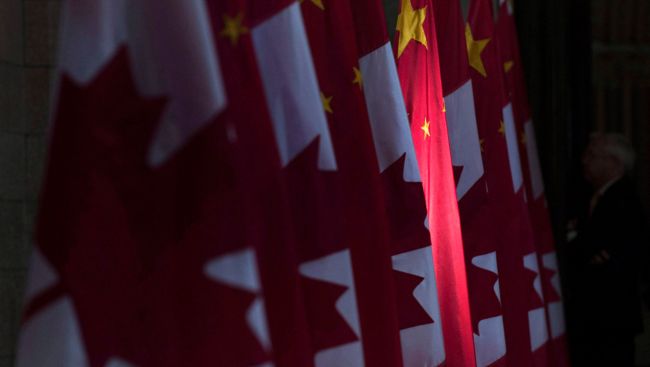
Picture Courtesy: THE CANADIAN PRESS/Adrian Wyld

MORE National ARTICLES

No 'traitors' in Parliament, but more steps needed to counter interference: report

No 'traitors' in Parliament, but more steps needed to counter interference: report
In her final report released Tuesday, inquiry Commissioner Marie-Josée Hogue concludes that while the threat of foreign interference is real, Canada's democratic institutions have held up well against the dangers.

No 'traitors' in Parliament, but more steps needed to counter interference: report

Bridge over Okanagan Lake in B.C. reopens after bomb scare, fire in van

Bridge over Okanagan Lake in B.C. reopens after bomb scare, fire in van
Police have reopened a bridge across Okanagan Lake in the B.C. Interior after an explosives scare that shut it down for about 11 hours. Officers say the incident began early Monday morning when a man parked a white panel van across multiple lanes of the William R. Bennett Bridge and posted online remarks about the contents.

Bridge over Okanagan Lake in B.C. reopens after bomb scare, fire in van

Kelowna Bridge has reopens after an overnight closure prompted by a call about a person in crisis

Kelowna Bridge has reopens after an overnight closure prompted by a call about a person in crisis
Police in Kelowna say the William Bennet Bridge has reopened after an overnight closure that was prompted by a call about a person in crisis. RCMP say officers had responded at about 3:45 a-m, finding the person had parked a vehicle across the eastbound lanes of the bridge.

Kelowna Bridge has reopens after an overnight closure prompted by a call about a person in crisis

Two people are facing charges in Prince George after police seized drugs and guns during an attempted traffic stop

Two people are facing charges in Prince George after police seized drugs and guns during an attempted traffic stop
Two people are facing charges in Prince George after police seized drugs and guns during an attempted traffic stop. R-C-M-P say officers were patrolling along Highway 97 last week when they tried to stop a driver who they allegedly saw committing motor vehicle infractions.

Two people are facing charges in Prince George after police seized drugs and guns during an attempted traffic stop

One dead after a single-vehicle rollover crash in Delta

One dead after a single-vehicle rollover crash in Delta
One person is dead after a single-vehicle rollover crash in Metro Vancouver. Police in Delta say it happened last night along Highway 99, near the exit for Highway 17, where a pick-up truck crashed into a barrier before rolling onto its roof.

One dead after a single-vehicle rollover crash in Delta

Ford's decision to speed up alcohol sales expansion will cost province $612M: report

Ford's decision to speed up alcohol sales expansion will cost province $612M: report
Premier Doug Ford's decision to speed up the rollout of alcohol sales in corner stores — which first sparked early election speculation last spring — will cost the province more than $600 million, Ontario's budget watchdog said Monday. That's nearly three times the amount the Progressive Conservative government said it would cost to accelerate the timeline.

Ford's decision to speed up alcohol sales expansion will cost province $612M: report