Saturday, July 4, 2026
ADVT 
National

Fact File: Posts falsely claim Canada revoked China's equal trade status

Darpan News Desk The Canadian Press, 11 Dec, 2025 11:52 AM
  • Fact File: Posts falsely claim Canada revoked China's equal trade status

Chinese language posts that appeared on social media the past few weeks claimed Canada was one of 32 countries to revoke China's "most favoured nation" trade status on Dec. 1. 


The claim originates from a 2021 rumour that conflates most favoured nation status with "generalized system of preference" certificates, which China stopped issuing to Canada and other countries on Dec. 1 that year. 


China remains a most favoured nation by Canada, meaning it is entitled to equal treatment as a trading partner.


THE CLAIM


Since November, several Chinese language posts across western social media claimed Canada was one of 32 countries to revoke China's "most favoured nation" status. 


Most favoured nation refers to a trade principle that entitles trading partners to equal status. Countries that trade as World Trade Organization members are required to provide the same trade benefits to all countries, with some exceptions. 


An image posted to the X platform, formerly Twitter, and multiple times on Facebook claimed Canada is one of 32 countries that removed China's most favoured nation trade status as of Dec. 1.
Similar claims appeared several times on Threads, as well as YouTube. 


THE FACTS


A keyword search of the Chinese language text shows this isn't the first time the claim appeared online. 


In 2021, Hong Kong-based HKBU Fact Check reported on the claim, which seemingly originated from a Facebook post. The post made an identical claim about 32 countries removing China's most favoured nation status on Dec. 1. 


However, a further keyword search shows the original announcement made by the General Administration of Customs China that references the 32 countries.


In the announcement, the customs agency said it would stop issuing generalized system of preference (GSP) certificate of origins for goods exported to 32 countries, including Canada and the European Union. 


The certificates grant preferential tariffs to imports from developing countries, according to the World Trade Organization. 


The Chinese customs agency said some countries pulled their GSP treatment for China over the years, since rapid economic development meant China was no longer considered a low-income country. The agency said it would stop issuing GSP certificates of origin to the 32 countries on Dec. 1. 


A 2021 article from China Briefing discussed the confusion over the announcement, noting the 32 countries stopped giving China GSP status over several years and not all at once. Canada removed its version of the GSP for China and 71 other countries as of Jan. 1, 2015. 


China and Canada are both part of the World Trade Organization, and remain entitled to most favoured nation status. China remains on Canada's list of countries afforded that status. 


Canada removed most favoured nation status from Russia and Belarus on March 2, 2022 in response to the Russian invasion of Ukraine, and imposed a general tariff of 35 per cent to most goods.

However, it made an exception for cobalt-60, a radioactive isotope used in some medical goods, as the government said it was unable to source enough elsewhere. 

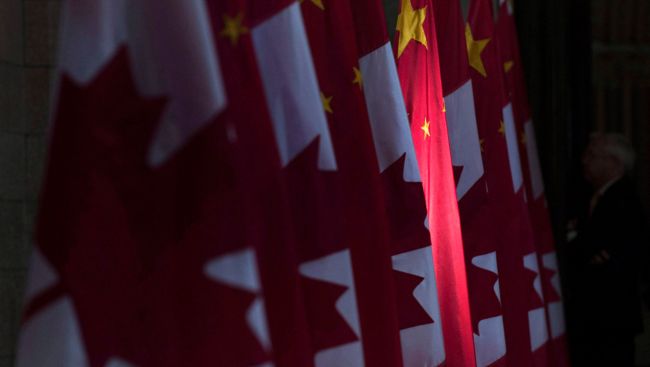
Picture Courtesy: THE CANADIAN PRESS/Adrian Wyld

MORE National ARTICLES

Saskatchewan United Party leader steps down

Saskatchewan United Party leader steps down
The leader of the Saskatchewan United Party says he's stepping aside after it failed to win any seats in October's provincial election. Jon Hromek says in a letter to party supporters that his decision to resign as leader and step away from the party was not made lightly. 

Saskatchewan United Party leader steps down

Climate change taking toll on Canada's lighthouses

Climate change taking toll on Canada's lighthouses
The recent decision to move a Nova Scotia lighthouse inland to prevent it from falling into the Bay of Fundy is highlighting the impact of climate change on the province's coastline. For more than 150 years, the Walton Harbour lighthouse stood watch from a cliff overlooking the bay -- but in recent years, coastal erosion had left the wooden tower perilously close to the edge.

Climate change taking toll on Canada's lighthouses

Rare cougar sighting reported in urban Vancouver, far from wilderness

Rare cougar sighting reported in urban Vancouver, far from wilderness
A rare cougar sighting has been reported in Vancouver's urban Dunbar neighbourhood. The BC Conservation Officer Service says in a statement that the big cat was reported on Dec. 26 around Blenheim Street between 26th and 36th Avenues.

Rare cougar sighting reported in urban Vancouver, far from wilderness

Governor General urges Canadians to care for their mental, physical health

Governor General urges Canadians to care for their mental, physical health
Gov. Gen. Mary Simon is urging Canadians to treat their mental health with the same care as their physical health as they prepare for the year ahead. In a new year's message, Simon says she is thinking of all the inspiring people she met in 2024.

Governor General urges Canadians to care for their mental, physical health

B.C. police find 'ghost gun' in car after driver said she couldn't remember name

B.C. police find 'ghost gun' in car after driver said she couldn't remember name
The BC Highway Patrol says the incident happened in Fort St. John on Dec. 13, when an officer stopped the 39-year-old woman to check for impaired driving. Police say while the driver was not impaired, she told the officer she could not recall her name, prompting a vehicle search.

B.C. police find 'ghost gun' in car after driver said she couldn't remember name

B.C. ringing in new year with new rules, including 20 per cent home-flipping tax

B.C. ringing in new year with new rules, including 20 per cent home-flipping tax
A maximum 20-per-cent home-flipping tax is among a number of new regulations coming into effect in British Columbia starting Jan. 1. The previously announced tax, to be levied against non-exempt people who sell homes within two years of purchase, is aimed at discouraging investors "from buying housing to turn a quick profit," the province says.

B.C. ringing in new year with new rules, including 20 per cent home-flipping tax