
Wednesday, July 8, 2026
ADVT 
National

Fact File: Posts falsely claim Canada revoked China's equal trade status

Darpan News Desk The Canadian Press, 11 Dec, 2025 11:52 AM
  • Fact File: Posts falsely claim Canada revoked China's equal trade status

Chinese language posts that appeared on social media the past few weeks claimed Canada was one of 32 countries to revoke China's "most favoured nation" trade status on Dec. 1. 


The claim originates from a 2021 rumour that conflates most favoured nation status with "generalized system of preference" certificates, which China stopped issuing to Canada and other countries on Dec. 1 that year. 


China remains a most favoured nation by Canada, meaning it is entitled to equal treatment as a trading partner.


THE CLAIM


Since November, several Chinese language posts across western social media claimed Canada was one of 32 countries to revoke China's "most favoured nation" status. 


Most favoured nation refers to a trade principle that entitles trading partners to equal status. Countries that trade as World Trade Organization members are required to provide the same trade benefits to all countries, with some exceptions. 


An image posted to the X platform, formerly Twitter, and multiple times on Facebook claimed Canada is one of 32 countries that removed China's most favoured nation trade status as of Dec. 1.
Similar claims appeared several times on Threads, as well as YouTube. 


THE FACTS


A keyword search of the Chinese language text shows this isn't the first time the claim appeared online. 


In 2021, Hong Kong-based HKBU Fact Check reported on the claim, which seemingly originated from a Facebook post. The post made an identical claim about 32 countries removing China's most favoured nation status on Dec. 1. 


However, a further keyword search shows the original announcement made by the General Administration of Customs China that references the 32 countries.


In the announcement, the customs agency said it would stop issuing generalized system of preference (GSP) certificate of origins for goods exported to 32 countries, including Canada and the European Union. 


The certificates grant preferential tariffs to imports from developing countries, according to the World Trade Organization. 


The Chinese customs agency said some countries pulled their GSP treatment for China over the years, since rapid economic development meant China was no longer considered a low-income country. The agency said it would stop issuing GSP certificates of origin to the 32 countries on Dec. 1. 


A 2021 article from China Briefing discussed the confusion over the announcement, noting the 32 countries stopped giving China GSP status over several years and not all at once. Canada removed its version of the GSP for China and 71 other countries as of Jan. 1, 2015. 


China and Canada are both part of the World Trade Organization, and remain entitled to most favoured nation status. China remains on Canada's list of countries afforded that status. 


Canada removed most favoured nation status from Russia and Belarus on March 2, 2022 in response to the Russian invasion of Ukraine, and imposed a general tariff of 35 per cent to most goods.

However, it made an exception for cobalt-60, a radioactive isotope used in some medical goods, as the government said it was unable to source enough elsewhere. 

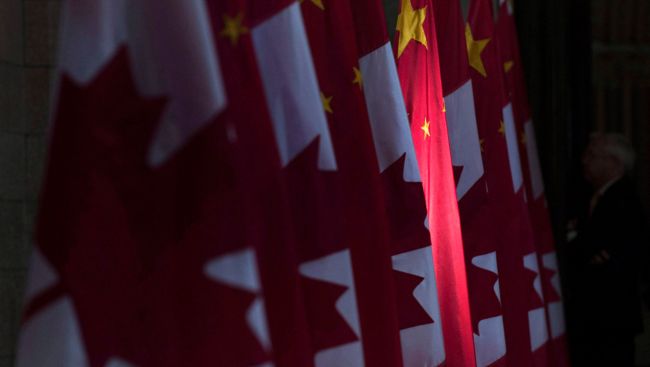
Picture Courtesy: THE CANADIAN PRESS/Adrian Wyld

MORE National ARTICLES

Foreign investment drives growth in BC

Foreign investment drives growth in BC
Invest Vancouver — Metro Vancouver's regional economic development service — has released a new report that it says shows "how foreign direct investment is a powerful driver of employment and economic growth in B-C." The report says in 2022 that foreign multinational enterprises employed more than 349-thousand people in B-C, which marked a 46.3 per cent increase when compared to 2016.

Foreign investment drives growth in BC

RCMP rolls out body-worn cameras for officers nationally

RCMP rolls out body-worn cameras for officers nationally
The RCMP will begin its rollout of body-worn cameras for RCMP officers across the country next week. It expects deployment of more than 10,000 cameras to be finished in the next 12 to 18 months.

RCMP rolls out body-worn cameras for officers nationally

Trudeau off to APEC in Peru, G20 summit in Brazil as peer nations brace for Trump

Trudeau off to APEC in Peru, G20 summit in Brazil as peer nations brace for Trump
Prime Minister Justin Trudeau is on his way to South America this afternoon heading first to Lima, Peru for the APEC summit and then to the G20 summit in Rio de Janeiro, Brazil. Both summits aim to improve the multilateral institutions that have drawn skepticism from U.S. president-elect Donald Trump.

Trudeau off to APEC in Peru, G20 summit in Brazil as peer nations brace for Trump

Rent inflation to slow in the next few years, Desjardins predicts

Rent inflation to slow in the next few years, Desjardins predicts
The rate at which Canadian rental prices are increasing should slow in the coming years as the government's plan to cut back immigration numbers takes hold, a new report from Desjardins says. Rents have been rising fast and rent inflation is "much higher" than increases in the price of owned homes, it said. Inflation of rented accommodation was 8.3 per cent in the third quarter of this year, "the fastest pace since the early 1980s."

Rent inflation to slow in the next few years, Desjardins predicts

Energy experts think Donald Trump will make tariff exemptions for Canadian oil

Energy experts think Donald Trump will make tariff exemptions for Canadian oil
President-elect Donald Trump's promise to slap an across-the-board tariff of at least 10 per cent on all imports including from Canada is unlikely to apply to Canadian oil, energy experts are predicting. The threat of the tariff is causing a lot of concern north of the border, where the Canadian Chamber of Commerce said such a tariff could take a $30-billion bite out of the Canadian economy.

Energy experts think Donald Trump will make tariff exemptions for Canadian oil

NDP expected to unveil campaign pledge to remove GST on internet, heat, diapers, more

NDP expected to unveil campaign pledge to remove GST on internet, heat, diapers, more
With the cost of living playing a central role in provincial elections across Canada and in the U.S. presidential race, NDP Leader Jagmeet Singh is set to unveil a pre-campaign policy plank for the next federal election to differentiate his party from the governing Liberals.  Singh is expected to announce this morning that an NDP government would remove the GST on what his party deems "essentials." 

NDP expected to unveil campaign pledge to remove GST on internet, heat, diapers, more