- The threat of a federal election seemed to be easing as the Liberal government and opposition parties prepared for a return to Parliament amid concerns Canada could already be dealing with a dreaded second wave of the novel coronavirus.
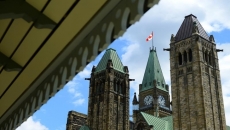
Fears of a COVID-19 resurgence hung over the distinct Old City Hall building down the street from Rideau Hall in Ottawa on Tuesday as Prime Minister Justin Trudeau and his ministers met behind closed doors for a second straight day to plot a path through — and eventually beyond — the pandemic.
Yet politics were also heavy in the air as talk moved to the return of Parliament with a throne speech on Sept. 23 that Trudeau had previously suggested would lay out a bold plan for rebuilding Canada's economy. The government now says it will largely focus on containing the effect of the illness.
There had been questions in the past few weeks about whether the throne speech would serve as the catalyst for a fall election, as the minority Liberal government would need the support of at least one opposition party to survive a confidence vote in the House of Commons.
There was also speculation the Liberals wanted an election, and were planning to use the throne speech as an excuse for launching a campaign in the hopes of winning a majority government.
Such talk was emboldened by Monday's election results in New Brunswick, where the Progressive Conservatives under Blaine Higgs went from a minority to a majority government by riding a wave of support for its handling of the COVID-19 crisis.
NDP Leader Jagmeet Singh appeared to take the wind out of federal election speculation on Tuesday, suggesting his party would hold its nose and give the government a pass on the throne speech and then hold the Liberals to account on the budget or future legislation.
“What they say in the throne speech really doesn’t have that much impact. It doesn’t really matter when it comes down to it because they’ve said a lot of things in the last throne speech that they haven’t followed through on,” Singh said.
“I want to see implementation, perhaps in the budget. The budget bill might be a way for us to really gauge if the government is serious about following through.”
Singh added he is scheduled to speak to Trudeau by telephone later this week, in which the NDP leader planned to push the government not to reduce the $2,000-per-month Canada Emergency Response Benefit.
Trudeau is also scheduled to speak to Conservative Leader Erin O'Toole, Bloc Quebecois Leader Yves-Francois Blanchet and Green party Leader Elizabeth May about the throne speech later this week, according to the Prime Minister's Office.
The theme of congeniality emerged as fears of a second wave of COVID-19 were heightened after another increase in the number of positive cases in Canada. That continues a troubling trend in recent weeks that has hijacked the Liberals' talk of setting a bold new post-pandemic course for Canada.
Health Minister Patty Hajdu was unable to say Tuesday whether the trend is a temporary blip — or a cause for larger concerns, saying: "It's hard to speculate because we still have time to actually keep these numbers under control if we all work together as governments and as individuals.
"But listen, we can't rule that out. We can't rule out that we could continue to see these numbers rise across the country. And that is the real risk of COVID-19."
The threat posed by COVID-19 was underscored on Monday when the Bloc Quebecois announced that Blanchet and the rest of his caucus were self-isolating after a staff member tested positive for the illness. The positive test came after an in-person caucus meeting.
Ministers said they were following public health guidelines to prevent the spread of COVID-19 during their cabinet retreat in Ottawa, which included sitting at several different tables and wearing masks during the closed-door meetings.
Yet the Bloc's experience also focused attention on the pending return of Parliament next week, including the question of how many members of Parliament would be allowed to sit in the House of Commons and how voting on legislation will be conducted.
This was a source of contention between the Liberals and Conservatives, in particular, in the spring, with disagreements over whether electronic voting should be allowed given a number of technical challenges and questions about how certain parliamentary rules would be applied.
The disagreement was largely unresolved. While the Liberals and NDP used their superior numbers to adopt a hybrid model allowing MPs to attend a special COVID-19 committee in person or remotely, that approach was not extended to the full House of Commons.
Parties instead continued to send a minimum number of MPs to represent the rest of the party for a select number of House of Commons sittings.
Government House leader Pablo Rodriguez on Tuesday suggested the hybrid model was the only answer to ensure all MPs have their voices heard in the House while remaining safe.
Heritage Minister Steven Guilbeault urged the Conservatives to agree to such a measure.
"We believe that the return of the House should continue on the basis of the hybrid model that we have so that there's not 338 people packed into a very small room where we could really contaminate each other," Guilbeault said.
"And I really hope the Conservative party will come around and understand that safety is a very important thing for Canadians."
The throne speech is expected to include three main priorities: measures needed to protect Canadians' health and avoid another national lockdown; economic supports needed to help keep Canadians financially afloat while the pandemic continues; and longer-term measures to eventually rebuild the economy.
In particular, it is expected to promise more funding for health care, including long-term care homes, which have borne the brunt of the more than 9,000 deaths from COVID-19 in Canada. It is also expected to promise money for child care so that parents — especially women, hardest hit by the shutdown — can go back to work.
Details on the longer-term recovery measures won't be revealed until an economic statement later in the fall.
Emergency aid to help Canadians weather the pandemic has already pushed the federal deficit for this year up to an unheard-of $343 billion.
With the government operating on the assumption that the pandemic will continue to plague the globe for at least two more years, unprecedented amounts of red ink seem destined to continue flowing.
Guilbeault defended the spending to date, saying it was used to help Canadians through the pandemic. He said Canada isn't alone in the world in terms of spending to counter the damage of COVID-19.
"And compared to many of our trading partners, Canada still has a very advantageous fiscal situation," he said. "Now we do have to be careful, and we will be making decisions, important decisions, in the coming weeks as to what's our path forward. But these decisions haven't been made."