

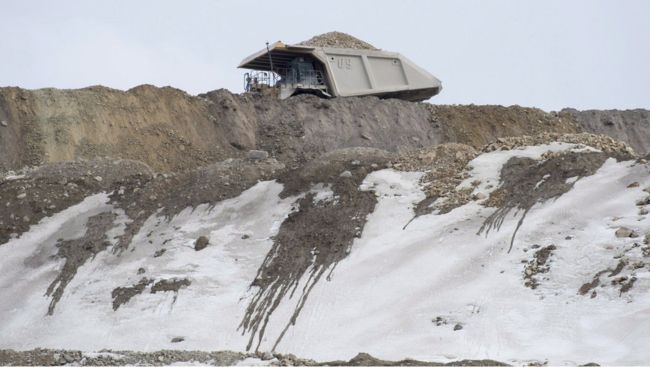
The mining industry is applauding the British Columbia government's decision to fast-track permits for several projects amid the ongoing U.S. tariff threat, but research suggests economic factors have been behind long delays for many other proposals.
Simon Fraser University associate professor Rosemary Collard says research shows that regulatory fast-tracking of mining projects is no guarantee that they will all materialize.
She's the co-lead author of a recent study of 27 B.C. mining projects granted environmental assessment certificates since 1995 and projected to open by 2022, showing that most failed to open on time.
The study says that of the 20 that failed to do so, regulation was a factor in only three, with economic factors and viability instead being the most common cause.
The B.C. government on Tuesday released a list of 18 critical mineral and energy projects, including four mines, that it said would be expedited to diversify the economy during what Premier David Eby called the "on-and-off tariff threats" from the United States.
Tim McEwan, a senior vice-president at the Mining Association of British Columbia, says in a statement that the association is pleased the government recognizes the need to speed up permitting and calls the initial list released earlier this week as "a good first step."
McEwan said there were 17 critical mineral projects currently "on the books" in B.C. and several are poised to enter permitting processes within the year.
He said it was imperative that the provincial government work to expedite approvals for other critical mineral, precious metal and steelmaking opportunities.
About half of the mines in Collard's study, which was published in December, never opened.
Collard, a geographer, said there's a big question mark around whether certainty can be delivered by doubling down on resource extraction in sectors like mining, which she calls "notoriously volatile and uncertain" with swinging commodity prices.
“One of the main surprising things about the study that we did that's relevant to this fast-tracking, I think, is that almost half of the mines that were approved through environmental assessment in B.C. since 1995 haven't been built,” Collard said.
“So, there are 12 fully approved, permitted mines in the province that are sitting waiting for the right economic conditions to be built.”
She said another main finding of the study is that mines that did become operational "have underperformed economically compared to what their forecast said in their environmental assessment."
“When you look back in the past, you see that the track record is of significant underperformance of mining projects on employment and tax revenue,” she said.
Among the handful of mines that the study says were held up by regulation is the Red Chris copper and gold mine which opened in 2015, six years after originally hoped.
Expansion of the Red Chris project in B.C.'s north is among four mining projects slated for fast-tracking this week.
Another is the Highland Valley Copper mine southwest of Kamloops. Owner Teck Resources is seeking an extension of operations beyond 2028 and into the mid-2040s.
The project has received support from First Nations Groups, including the Citxw Nlaka’pamux Assembly, the Lower Nicola Indian Band and the Kanaka Bar Indian Band, although it has been opposed by the Stk’emlupsemc te Secwepemc Nation.
“We value building strong relationships with local Indigenous and non-Indigenous communities who may be affected by our operations and are actively engaging with those communities,” Teck's director of stakeholder relations Dale Steeves said in an emailed statement.
Asked at a news briefing Thursday whether the process of fast-tracking mining and energy projects would mean compromising consultation with First Nations or environmental assessments, Energy Minister Adrian Dix did not respond directly but said the projects would still need to get "through the needed tests of standards in B.C. that are critical."
Dix announced that the province would introduce legislation this spring allowing the regulation of renewable energy projects like wind and solar to move under the single authority of the B.C. Energy Regulator.
Among the 18 projects identified for fast-tracking this week was a series of BC Hydro clean energy ventures that mostly involve wind power.
Dix said that moving clean energy projects to a single authority will enable it to act as a “one window regulator” for the permitting process and the legislation is about “advancing growth and diversity” within the sector.
A statement from Dix's ministry said the province "is committed to working in co-operation with First Nations partners, and is engaging with Nations across the province on the approach to the proposed legislation."


