Nearly two million Canadians could be without jobs this year under forecasts released by the federal government in its long-awaited "fiscal snapshot."
The document released Wednesday details how the Trudeau Liberals see the COVID-19 pandemic dragging down the domestic economy and sending the deficit to a historic $343.2 billion.
The economic and fiscal "snapshot" from the government lays out the Liberals' belief that there will be a slow return to a new normal, with unemployment high and economic growth low through to at least the end of 2021.
Even though the government believes the worst of the economic harm from the pandemic is behind the country, the document says a recovery can't begin in earnest until an effective vaccine or treatment becomes widely available.
Things could, however, get worse under two scenarios the Finance Department lays out.
Should prolonged shutdowns stay in place, or restrictions not fully roll back, a return to normal activity for households and businesses will be uneven and slower than hoped for, leading to a more pronounced drop in economic output than is already expected.
And should the country be hit with a second wave of the novel coronavirus during the annual flu season, the ensuing lockdowns would cause what the Finance Department describes as a "deeper and longer-lasting negative impact on the economy."
The Liberals have repeatedly promised to use the federal treasury as a financial shield between Canadians and irreparable harm, and the cost of that promise is now at $231.9 billion in direct spending and a deficit comparable only to those seen in the Second World War.
The federal debt is set to pass $1 trillion, by the Finance Department's estimates.
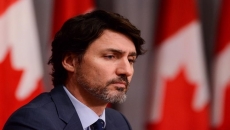
Whatever the costs, they're worth it, Prime Minister Justin Trudeau said in a news conference Wednesday morning, before the snapshot was released.
"As we measure the cost of helping Canadians, we shouldn't forget that the cost of doing nothing would have been far more," Trudeau said, insisting that this is not the time for belt-tightening or austerity.
The document tries to make that case, saying that the $80-billion Canada Emergency Response Benefit, which had paid out $53.5 billion in benefits as of late June, has covered Canadians' estimated $44.6 billion in lost labour income through the first half of the year.
The $2,000-a-month benefit is estimated to have covered the monthly housing, food, phone and internet costs for the bottom and middle thirds of households, according to Finance Department calculations.
Historically low interest rates mean all the hundreds of billions in borrowing comes with "manageable" costs, Trudeau said, and the alternative would be for individuals and households to load up with debt themselves to cope with months of no or little work.
Perrin Beatty, president of the Canadian Chamber of Commerce, noted the deficit and the debt-to-GDP ratio of 49.1 per cent "will undermine Canada's fiscal capacity for decades."
"It is now time for Canada to transition from a subsidy-based crisis response toward restoring economic growth and getting Canadians safely back to work," he said in a statement.
"With much less fiscal breathing room and fewer financial tools available to us, we must focus on the economic fundamentals."
Adding to the deficit is a $37.3-billion boost to the federal wage subsidy program to bring its budget to $82.3 billion, signalling an expansion and coming changes to the benefit that covers up to 75 per cent of wages to a maximum of $847 a week for eligible companies.
The Liberals expect more workers to move onto the wage subsidy and off the Canada Emergency Response Benefit as that $80-billion program winds down.
Those who fall through the COVID-19 financial safety net are expected to be caught by the employment insurance system that has been largely dormant since the CERB replaced it in late March.
Government officials admit there will still need to be policy changes to the EI system to help some self-employed workers qualify, and capture EI-eligible workers who, due to the pandemic, haven't been able to work the necessary qualifying hours.
"Our view is that we need to, over the next little while, make sure that our employment insurance (system) is back up and running, but that we continue to support people in a way that gives them confidence that they'll be able to provide for themselves and their families," Finance Minister Bill Morneau told reporters ahead of the document's release.
"It's not easy. We're in challenging times. We're going to make sure we support people to get through these challenging times because we know that's the right thing to do."
For this calendar year, the government expects the unemployment rate to hit 9.8 per cent, dropping to 7.8 per cent next year based on forecasts by 13 private sector economists.
Although that's a bump from the record-high unemployment rate of 13.7 per cent in May for a labour force of just over 19 million, it is still almost double the record low of 5.5 per cent pre-pandemic.
The document doesn't contain the five-year forecast traditionally part of federal budgets owing to the uncertain path the pandemic will take and the state of the economy beyond that.
"Even when the pandemic is over, lasting consequences may cast a long-term shadow over economic developments, for example via more indebted businesses and households, persistent unemployment and substantial structural changes in the economy that have been accelerated through the crisis," the government's update says.
"In the coming months and as needed the government will announce measures to support the recovery."
Opposition parties had wanted Morneau to provide a road map for reshaping emergency aid measures that are set to expire in the fall and keeping spending and deficits under control.
Speaking in the House of Commons, Conservative Leader Andrew Scheer said the Liberals failed to provide a plan to stimulate economic and job growth to spur an economic recovery.
"Coming out of the pandemic, every single country on the plant will be desperately competing for the same opportunities and the same investments. So where is the prime minister's plan to set us apart?"
Next week, the Bank of Canada is to again update its forecasts when it releases a monetary policy report along with a scheduled interest-rate announcement.
Last month, the central bank said it expected a decline between 10 and 20 per cent in the second quarter compared with the fourth quarter of 2019. That is an improvement from the 15-to-30-per-cent drop in the quarter highlighted in the bank's worst-case scenario in April.