OTTAWA — A spate of public opinion surveys this autumn has prompted the usual end-of-year parsing of political fortunes and chin-stroking prognostications about a federal election that may still be 10 months in the future.
Stephen Harper's Conservatives are up. Justin Trudeau's Liberals are down. Tom Mulcair's New Democrats are out of it.
Reader beware.
In fact, a look at months of results from six different pollsters suggests Trudeau's Liberals remain imperviously buoyant, Harper's Tories have seen only marginal gains despite a number of issues breaking their way, and NDP fortunes are stalled, notwithstanding Mulcair's widely lauded parliamentary performance.
In the past week alone, national polls from recognized opinion surveyors have placed Liberal support as high as 41 per cent (Forum Research) and as low as 32 per cent (EKOS), Conservative support from 33 to 31 per cent and NDP support at 19 (Leger), 20 (Forum) and 17 per cent (EKOS).
Back in September, before an event-packed fall that supposedly moved the public opinion dial, Liberals polled as high as 38 per cent (Abacus and Ipsos Reid), Conservatives were between 30 and 31 per cent and New Democrats between 21 and 23.
ThreeHundredEight.com, which aggregates political polling, says the average of all public polls put Liberal support last week at 36 per cent, Conservatives at 32 and the NDP at 20. In September, those averages were 38-30-22.
"It's important not to make too much of relatively small movements in the polls," says Paul Adams, a former parliamentary reporter and pollster who now teaches journalism at Carleton University in Ottawa.
Nonetheless, Adams says by looking across the various polls conducted since the summer, "the race looks significantly tighter than it has."
It's always easy to construct a narrative around why that might be, he added — but pundits and pollsters should be careful with such storylines.
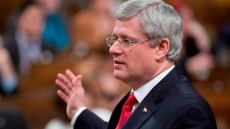
The narrative building in Ottawa is that the Conservatives pulled out of a long malaise in October, spurred by Prime Minister Stephen Harper's tough words for Russia's Vladimir Putin in Ukraine, his decision to send fighter jets to Iraq and the shocking terror attacks on Canadian soil.
Toss in some positive economic numbers and a suite of family-oriented, voter-friendly tax measures and it becomes clear the prime minister spent much of the fall political season playing the game his way, on familiar home soil.
"Mr. Harper has his mojo back," National Post columnist John Ivison wrote on Dec. 3.
The corollary is that Trudeau's Liberals finally started to come down off their extended sugar high, a result of the contrast between Harper's international statesmanship and Trudeau's inability to articulate a clear argument on military involvement in the Middle East.
Both the Liberals and the NDP, meanwhile, were sideswiped by bombshell allegations of serious personal misconduct from two NDP members that led to the suspension of Liberal MPs Massimo Pacetti and Scott Andrews.
The narrative offers a neat story that fits many observable realities and biases alike, but finding corroboration in the polling results is elusive.
"The poll information that we have in the public domain does not speak to that level of granularity," said Adams.
"The pollsters who weave these grand narratives — it's Trudeau's mishandling of the sexual assault or it's ISIS or whatever — in most cases the pollsters themselves don't have granular enough soundings of public opinion to be making those judgments."
Tom Flanagan, the University of Calgary political science professor and former right-hand man to Prime Minister Stephen Harper, says it's not just the public and pollsters who are searching for answers.
"The parties won't have any polls showing anything different," he said in an interview. "I never saw any internal polls that had any magical insight."
Canadian political parties, said Flanagan, simply don't have the resources to conduct routinely the kind of massive surveys — samples of 10,000-plus respondents — that can pinpoint specific, number-moving issues and their demographics.
That will change in the immediate run-up to an election, when parties will poll heavily in order to lay out an advertising strategy and finalize their platforms.
"But in general, people in the parties have the same kind of information you have as an outsider," said the former Conservative insider.
"You can take the obvious from the trend in the polls. I think it's valid — for the time being — that the Conservatives have rebounded somewhat. They haven't caught up to the Liberals, but they've narrowed the gap."
Adams, the former journalist and pollster, and Flanagan, the former political operative, agree on another point about this year's polling.
"It's a reminder that a minority (government) is the likeliest case out of the next election, rather than a majority," said Adams.
Flanagan said it's possible to see a path to a Liberal or Conservative majority, but a minority appears more likely.
"Considering that the difference between getting 35 per cent of the vote and 40 per cent of the vote is the difference between a majority and a minority government — and the difference between getting 30 and 35 is the difference between losing and maybe squeezing through with a minority — well, five-point differences like that are getting pretty close to the margin of error in most polls," said Flanagan.
"We just can't expect more than polls can deliver."