Tuesday, June 30, 2026
ADVT 
National

Federal power to sidestep Indian Act removed from major projects bill

Darpan News Desk The Canadian Press, 19 Jun, 2025 03:13 PM
  • Federal power to sidestep Indian Act removed from major projects bill

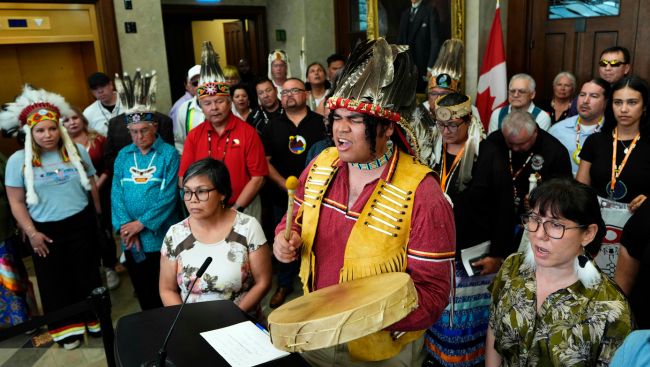
The federal government's major projects legislation was amended by opposition parties on Wednesday to withdraw the power the bill gave cabinet to sidestep the Indian Act, following weeks of criticism from First Nations leaders.

But Assembly of First Nations National Chief Cindy Nepinak Woodhouse said Thursday the "limited changes" made to the bill don't go far enough. She still wants the government to give members of Parliament more time to study the legislation.

The Liberal government’s controversial legislation, which would allow cabinet to quickly grant federal approvals for big industrial projects like mines, ports and pipelines, was introduced on June 6, and sailed through the committee study in about eight hours on Tuesday and Wednesday.

Amendments to the bill made in committee include removing the Indian Act from a list of laws the government can sidestep when determining whether a project should move forward.

Bloc Québécois MP Xavier Barsalou-Duval said in a media statement the change came from a sub-amendment his party posed, and that the Liberals did not vote in favour of it.

In French, Barsalou-Duval said he regrets that the Liberals didn't vote for the amendment, but he is pleased it passed.

From the moment the bill was first discussed, First Nations leaders warned the bill could violate their constitutionally protected rights.

First Nations leaders also said Ottawa could face legal challenges, and its fast-tracked projects could be slowed down, if Indigenous communities are not meaningfully consulted.

Some First Nations leaders are warning of a wave protests if the bill doesn't fundamentally change. Prime Minister Mark Carney said respect for section 35 of the Constitution, which recognizes and protects treaty rights is "at the heart of this legislation."

He said it's also important that the bill doesn't approve projects, it just "creates the possibility of these projects," which must undergo "full consultation with Indigenous Peoples to define what is a nation-building project."

"And then, if something is one of those projects, then what are the conditions in order for that project to move forward, including participation — obviously, I would think, in almost every case, environmental, other conditions — and then only if those conditions are met would the project move forward."

Woodhouse Nepinak said it appears some other "constructive suggestions" to amend the bill were voted down.

"These limited changes don't go far enough and were developed without input from rights-holders. We continue to call on Parliament to honour the Crown and have a full discussion with rights-holders before passing the bill, instead of ramming it through in a week," she said.

"We will continue monitoring the debate closely and will have more to say as the situation develops."

The legislation, which has support from the opposition Conservatives, is expected to pass Friday.

Picture Courtesy: THE CANADIAN PRESS/Justin Tang

MORE National ARTICLES

Safety board says broken wheel caused 61-car CN Rail derailment in B.C.

Safety board says broken wheel caused 61-car CN Rail derailment in B.C.
The Transportation Safety Board says a broken wheel set off a train derailment in B.C.'s Fraser Canyon, spilling six million kilograms of potash.  In September 2020, 61 cars on a Canadian National Railway freight train left the tracks just south of Hope, B.C.

Safety board says broken wheel caused 61-car CN Rail derailment in B.C.

Ottawa will shut down shady post-secondary institutions if provinces don't: Miller

Ottawa will shut down shady post-secondary institutions if provinces don't: Miller
Immigration Minister Marc Miller says Ottawa is ready to step in and shut down shady schools that are abusing the international student program if provinces don't crack down on them. Miller says there are problems across the college sector, but some of the worst offenders are private institutions — and those schools need to go. 

Ottawa will shut down shady post-secondary institutions if provinces don't: Miller

Snowfall warning for parts of Lower Mainland could mean sloppy Vancouver commute

Snowfall warning for parts of Lower Mainland could mean sloppy Vancouver commute
Environment Canada has issued a snowfall warning for parts of B.C.'s Lower Mainland, with a wintry mix heralding a sloppy evening commute for Metro Vancouver. The warning also covers the Fraser Valley and the Sea to Sky Highway, with up to 25 centimetres expected in Whistler.  

Snowfall warning for parts of Lower Mainland could mean sloppy Vancouver commute

Some bundled wireless plans not as cheap as before Rogers-Shaw merger: watchdog

Some bundled wireless plans not as cheap as before Rogers-Shaw merger: watchdog
Certain cellphone plans in Western Canada are not as cheap as they were prior to the Rogers-Shaw merger, Canada's competition watchdog says. Jeanne Pratt, the Competition Bureau's senior deputy commissioner of mergers and monopolistic practices, told MPs on Monday that before Shaw was purchased by Rogers Communications last April, the company was "a particularly growing and disruptive competitive force" in B.C. and Alberta.

Some bundled wireless plans not as cheap as before Rogers-Shaw merger: watchdog

Online harms: Liberals seek to create digital safety commission, new ombudsperson

Online harms: Liberals seek to create digital safety commission, new ombudsperson
The Liberal government plans to create a new digital safety regulator to compel social-media platforms to take action against online harms and remove damaging content — including child sex-abuse material and intimate images shared without consent — under penalty of millions of dollars in fines.  Justice Minister Arif Virani tabled the long-awaited Online Harms Act on Monday, along with a suite of other amendments to the Criminal Code and the Canadian Human Rights Act.   

Online harms: Liberals seek to create digital safety commission, new ombudsperson

Real estate association economist doubts B.C.'s flipping tax is worth the trouble

Real estate association economist doubts B.C.'s flipping tax is worth the trouble
Policy watchers are split on the value of British Columbia's upcoming provincial flipping tax targeting those looking to make a quick buck in the real estate market. Brendon Ogmundson, chief economist of the British Columbia Real Estate Association, says the tax could end up reducing the overall number of homes on the market while only applying to a small number of properties.

Real estate association economist doubts B.C.'s flipping tax is worth the trouble