
Saturday, December 20, 2025
ADVT 
National

Federal power to sidestep Indian Act removed from major projects bill

Darpan News Desk The Canadian Press, 19 Jun, 2025 03:13 PM
  • Federal power to sidestep Indian Act removed from major projects bill

The federal government's major projects legislation was amended by opposition parties on Wednesday to withdraw the power the bill gave cabinet to sidestep the Indian Act, following weeks of criticism from First Nations leaders.

But Assembly of First Nations National Chief Cindy Nepinak Woodhouse said Thursday the "limited changes" made to the bill don't go far enough. She still wants the government to give members of Parliament more time to study the legislation.

The Liberal government’s controversial legislation, which would allow cabinet to quickly grant federal approvals for big industrial projects like mines, ports and pipelines, was introduced on June 6, and sailed through the committee study in about eight hours on Tuesday and Wednesday.

Amendments to the bill made in committee include removing the Indian Act from a list of laws the government can sidestep when determining whether a project should move forward.

Bloc Québécois MP Xavier Barsalou-Duval said in a media statement the change came from a sub-amendment his party posed, and that the Liberals did not vote in favour of it.

In French, Barsalou-Duval said he regrets that the Liberals didn't vote for the amendment, but he is pleased it passed.

From the moment the bill was first discussed, First Nations leaders warned the bill could violate their constitutionally protected rights.

First Nations leaders also said Ottawa could face legal challenges, and its fast-tracked projects could be slowed down, if Indigenous communities are not meaningfully consulted.

Some First Nations leaders are warning of a wave protests if the bill doesn't fundamentally change. Prime Minister Mark Carney said respect for section 35 of the Constitution, which recognizes and protects treaty rights is "at the heart of this legislation."

He said it's also important that the bill doesn't approve projects, it just "creates the possibility of these projects," which must undergo "full consultation with Indigenous Peoples to define what is a nation-building project."

"And then, if something is one of those projects, then what are the conditions in order for that project to move forward, including participation — obviously, I would think, in almost every case, environmental, other conditions — and then only if those conditions are met would the project move forward."

Woodhouse Nepinak said it appears some other "constructive suggestions" to amend the bill were voted down.

"These limited changes don't go far enough and were developed without input from rights-holders. We continue to call on Parliament to honour the Crown and have a full discussion with rights-holders before passing the bill, instead of ramming it through in a week," she said.

"We will continue monitoring the debate closely and will have more to say as the situation develops."

The legislation, which has support from the opposition Conservatives, is expected to pass Friday.

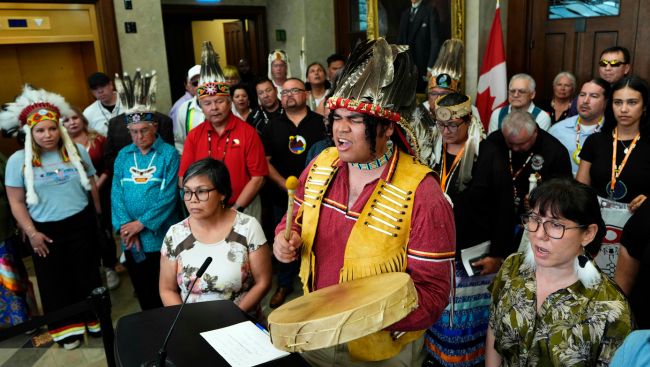
Picture Courtesy: THE CANADIAN PRESS/Justin Tang

MORE National ARTICLES

Commercial truck hits B.C. highway overpass, losing lumber load and snarling traffic

Commercial truck hits B.C. highway overpass, losing lumber load and snarling traffic
British Columbia's Highway Patrol says another commercial truck has hit an overpass in Metro Vancouver, causing no visible damage, but snarling traffic on Wednesday. Police say a load of lumber the tractor trailer was hauling along Highway 99 hit the Blundell Road overpass.

Commercial truck hits B.C. highway overpass, losing lumber load and snarling traffic

Consumers could find 'meaningful savings' as carbon price ends: Desjardins

Consumers could find 'meaningful savings' as carbon price ends: Desjardins
Canadians can expect to feel the absence of the consumer carbon price at the pumps immediately but it may take longer to notice a difference in the price of other goods, a new report released Wednesday suggests. The analysis by Desjardins Economics comes less than a week after Prime Minister Mark Carney and his new Liberal cabinet ordered that the consumer levy be set to zero on April 1.

Consumers could find 'meaningful savings' as carbon price ends: Desjardins

End of consumer carbon tax leaves $1.5-billion hole in B.C. budget

End of consumer carbon tax leaves $1.5-billion hole in B.C. budget
The budget released earlier this month shows the province was forecasting revenue of just over $2.5 billion from the tax in the 2024-25 fiscal year, while the estimated cost of the climate action tax credit was $995 million.

End of consumer carbon tax leaves $1.5-billion hole in B.C. budget

Ottawa caps non-sufficient funds fees at $10 starting March 2026

Ottawa caps non-sufficient funds fees at $10 starting March 2026
Ottawa has put in place new rules limiting the fees banks can levy on customers who don't have enough in their accounts to cover a cheque or other pre-authorized charges. The updates, included in an order-in-council last week, cap non-sufficient funds fees at $10 for personal deposit accounts, prohibit charging more than one NSF fee in a period of two business days, and prohibit charging an NSF fee when an account shortfall is under $10.

Ottawa caps non-sufficient funds fees at $10 starting March 2026

Federal government promises $2.55B in low-cost loans to build Toronto rental homes

Federal government promises $2.55B in low-cost loans to build Toronto rental homes
The federal government is promising billions in low-cost financing to help build thousands of rental homes in Toronto, including more than a thousand affordable units. Ottawa says it will provide $2.55 billion in financing through its Apartment Construction Loan Program, to be administered by the Canada Mortgage and Housing Corporation.

Federal government promises $2.55B in low-cost loans to build Toronto rental homes

Statistics Canada says population rose to 41,528,680 at Jan. 1 as growth slowed

Statistics Canada says population rose to 41,528,680 at Jan. 1 as growth slowed
Statistics Canada says the population grew to 41,528,680 people as of Jan. 1 as the pace of growth continued to slow after peaking in the third quarter of 2023. The total number of people was up 63,382 compared with Oct. 1, 2024, for a quarterly growth rate of 0.2 per cent.

Statistics Canada says population rose to 41,528,680 at Jan. 1 as growth slowed