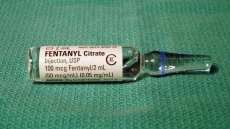
VANCOUVER — Illicit drugs have always been a problem in port cities, but experts say the emergence of highly potent synthetic opioids that are fuelling British Columbia's overdose crisis are slipping through borders in new ways, presenting challenges for law enforcement.
International regulations, online ordering and the potency of the drug are among the factors making it difficult to prevent the drug from slipping through Canada's borders.
More than 1,000 people have died from illicit drug overdoses in B.C. since January 2016, many as a result of the powerful opioids fentanyl and carfentanil which law enforcement says largely comes from China.
Canada Border Services Agency says seizures of fentanyl at Vancouver International Mail Centre have more than doubled to 54 last year from 23 in 2015.
But RCMP national drug program co-ordinator Sgt. Luc Chicoine said while lives are saved with every seizure, there's no knowing how much of a dent every confiscation of drugs makes.
"For example, if we seize 100 kilos of a certain drug that's coming into the country, was it only 100 kilos coming in or was it a million kilos?" he said. "We don't have the capability of identifying what is the full scope."

The high potency of fentanyl has allowed traffickers to transport smaller quantities with other imports, on individuals or through the mail, making it harder for agencies to detect.
Chicoine said people trafficking cocaine would need to bring in large quantities. Three-quarters of a kilogram of pure cocaine once diluted would only produce one to two kilos for street distribution.
"While fentanyl, by bringing in 100 grams of it, you can cut it 10 to 15 times and you can have one to one and a half kilos of the substance," he said.
He said the combination of high potency and today's technology means users or dealers can now order illicit substances from China online and have it delivered straight to their door, making it harder for police to intercept.
Canada Border Services Agency said in a statement that detecting illicit substances is a priority, and all packages coming into Canada are opened and inspected if necessary before going through the mail system.
The agency said it's waiting on legislative changes now before Parliament that would allow officials to open and inspect mail weighing less than 30 grams, a practice currently prohibited due to privacy concerns.

Chicoine said Vancouver's proximity to China has made it the epicentre of Canada's overdose crisis because it's often the first landing point for opioids entering the country.
The RCMP have long had a relationship with Chinese officials, which was renewed last fall, to investigate crime between the countries. But fentanyl use has not been a problem in China, giving little incentive for officials to crack down on its manufacturing there, Chicoine said.
China announced earlier this month that it would outlaw the substance carfentanil and three other synthetic opioids but it unclear how that will influence international trafficking.
Thomas Kerr, addictions researcher and professor of medicine at the University of British Columbia, said it's no accident Vancouver's geography is playing into the overdose crisis.
"People who work in the area of drug policy have known for decades that no matter which continent you are on, port cities tend to have a higher availability of a greater diversity of drugs, and that those drugs also tend to be more potent," he said.
Simon Fraser University criminology professor Neil Boyd said the use of opiates in the Vancouver area dates back to the late 1800s.

Smoking opium was the recreational drug of choice in China at the time, he said, and was brought to B.C. with migration and trade.
He said the drug didn't become illegal until the early part of the 20th century, and even then, public health was not the concern behind the law. Moral attitudes about opioids in Western countries, including Canada, drove prohibition, Boyd said.
Vancouver police spokesman Staff Sgt. Randy Fincham said the department has seen waves of different drugs come and go but the arrival of fentanyl in 2012 has brought the most devastating death toll.
Despite the effect the drug is having on the community, he said police are not cracking down on street-level dealers, many of whom are vulnerable people struggling with substance abuse.
Instead, he said police are targeting those "quite a few hands up the chain, who are importing, manufacturing, cutting and distributing fentanyl to these other people at the street level."
Investigating the "bigger fish" involved in trafficking is much more challenging, Fincham said, and requires more time, staffing, police resources and coordination with other law enforcement including the RCMP.
The high cost with uncertain outcomes has some experts saying that policing is the wrong solution for stopping the flow of drugs.
"Those kind of supply control interventions, they're incredibly expensive, very time consuming and they have limited impact. The answer is demand reduction," said Kerr.
Reducing demand requires high quality addiction treatment programs, Kerr said, which is sorely lacking.
"It's not even a question of the system being broken, the system doesn't exist," he said.