

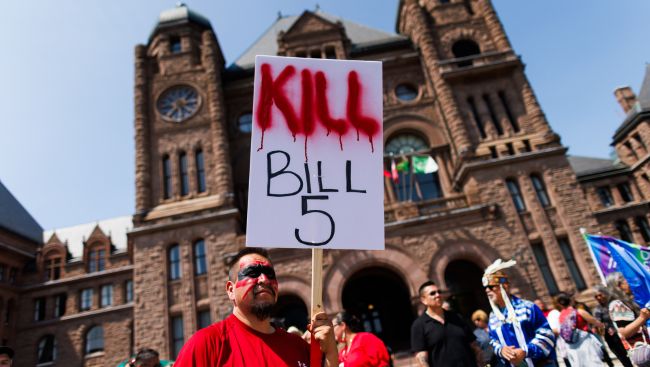
First Nations chiefs behind a legal challenge to a pair of federal and provincial laws meant to fast-track infrastructure projects say they are turning to the courts because they worry the laws will lead to environmental destruction.
Nine Ontario First Nations want the court to declare the federal law known as Bill C-5 and the Ontario law known as Bill 5 unconstitutional and are seeking an injunction that would prevent the governments from using some of the most contentious aspects.
Chief June Black of Apitipi Anicinapek Nation in northeastern Ontario became emotional at a press conference Wednesday, when saying that her people have been on those lands "since time immemorial."
"We have a sacred responsibility to protect the lands," she said. "What's about to happen is going to be very harmful. Bill 5 and Bill C-5 are pieces of legislation that attempt to bulldoze over First Nation rights and lands with no respect for our decision making and jurisdiction."
There are already 40,000 active mining claims in her territory, Black said, and she worries what will happen to the earth and the spring water they drink when governments use the laws to bypass the normal approval and environmental processes for large projects.
"We live off the land," she said. "We eat the animals on the land. We fish. This is all natural for us, and this is all at risk...If we look at what's coming as a result of these bills, it's destruction."
Bill C-5 allows cabinet to quickly grant federal approvals for big projects deemed to be in the national interest such as mines, ports and pipelines by sidestepping existing laws, while Ontario's bill allows its cabinet to suspend provincial and municipal laws through the creation of so-called "special economic zones."
Indigenous leaders say the laws cut out proper consultation with them, and Chief Sheri Taylor of Ginoogaming First Nation said she believes that was done purposefully, not as an oversight.
"To me, these bills were developed because as First Nations, we're the red tape," she said.
"It's to bypass our rights, focusing on speeding through projects instead of working together in a way that considers and protects our rights...Canada, Ontario have an obligation to respect First Nations rights and foster nation-to-nation relations. Bill 5 and Bill C-5 not only ignore this obligation, but bulldoze it to the ground."
The legal challenge comes just before First Nations chiefs are set to meet with Prime Minister Mark Carney to lay out their concerns with Bill C-5, though the Chiefs of Ontario say the government is already levelling an unfair playing field for the discussion.
Speaking at a press conference Wednesday to announce supports for the steel industry, Carney said that dialogue is beginning.
"The first thing (the law) enables is consultations about what are we actually talking about when we say nation-building projects," he said.
"The first part of that...is that engagement about the modalities, how this can work, how we work together, what are the priorities — that's before any consultation on any specific project or types of projects."
Ontario has already started some consultations with First Nations who "share our vision of unlocking economic opportunity and critical infrastructure in their community and will continue these consultations throughout the summer," the premier's office wrote in a statement.
Both the federal and Ontario governments have said their laws are tools to counteract the effects of U.S. President Donald Trump's tariffs by allowing Canadian development, such as natural resource development, to proceed more quickly.
But this is not a battle of development versus no development, the First Nations argue. Rather, they advocate for "doing it right" by ensuring that necessary information is gathered before proceeding and rights and protections are respected "so the real costs of development do not end up far exceeding their asserted benefit," they write in the court filing.
Lawyer Kate Kempton said Bill C-5 was made in "panic, in haste, in fear" to address the Trump tariffs.
"But in doing so, we cannot be throwing out the values that Canada supposedly holds dear, or the constitution that mandates that those values must be followed in every instance," she said.
"We can't throw out the baby with the bath water. We can't throw out the essential heart of who we profess to be as if it's extraneous and peripheral. The cost of doing large-scale development must be taken into account and addressed. We can't be developing things despite the costs, economically, environmentally, humanly, that will come back to bite us — and it will hurt First Nations most."
Picture Courtesy: THE CANADIAN PRESS/Cole Burston


