

The U.S. Supreme Court struck down a set of President Donald Trump's tariffs in a landmark ruling Friday — but that decision didn't affect all duties on Canadian goods entering the United States.
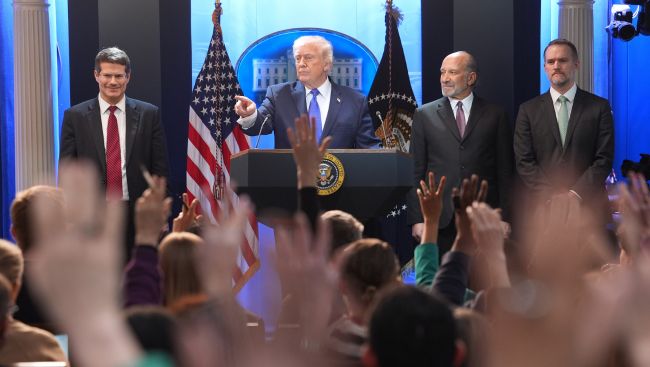
Trump on Friday signed an executive order imposing a 10 per cent global tariff — and lashed out at Supreme Court justices hours after America's top court struck down his use of an emergency legal tool to realign global trade.
Here's what you need to know about the ruling and the fallout for Canada.
IEEPA tariffs are over, but impact on Canada is minimal
In a 6-3 ruling on Friday, the U.S. Supreme Court said tariffs imposed under the International Emergency Economic Powers Act, or IEEPA, were illegal.
Trump had justified using the tool for the so-called "reciprocal tariffs" he levied against countries around the world in April, as well as the earlier fentanyl-related tariffs on Canada, Mexico and China.
Those tariffs previously stood at 35 per cent on Canada, but most U.S. businesses were not paying those rates on imported Canadian goods in practice.
Exports compliant with the Canada-U.S.-Mexico agreement on trade, or CUSMA, were deemed exempt from the IEEPA tariffs and have thus far been able to cross the border duty-free.
"Most Canadian exporters won't see a difference at all," said William Pellerin, a partner in international trade at McMillan LLP.
In a press conference Friday afternoon following the Supreme Court decision, Trump announced he would impose global tariffs of 10 per cent under Section 122 of the 1974 Trade Act. Tariffs imposed this way can last only for 150 days unless Congress agrees to extend them.
In a fact sheet Friday evening, the White House said the CUSMA exemption would remain under the new global tariff, meaning most Canadian goods would not be hit.
Section 232 tariffs on steel, autos remain
Other tariffs imposed under a separate authority are unaffected by the Supreme Court's IEEPA ruling.
U.S. tariffs targeting Canadian goods such as steel, aluminum, copper, autos and lumber under Section 232 of the Trade Act remain active as of Friday.
Industries that rely on the free passage of those goods across the Canada-U.S. border have been particularly exposed in the trade war over the past year.
Striking a deal to end those steep tariffs — as high as 50 per cent on key industries like steel and aluminum — has been a focus of Canada's negotiating efforts with the United States.
Some Canadian businesses could get refunds
The Supreme Court ruling could open the door to affected businesses applying for refunds for tariffs paid to the U.S. government.
While U.S. tariffs are primarily paid by domestic businesses, Pellerin said there could be an opportunity for Canadian firms to get a share of any refunds.
Some Canadian firms might have paid all or part of the duties up front as part of their contracts with U.S. importers, he said, and could get paid back after the ruling. Canadian exporters also could be importers south of the border — a common situation in the softwood lumber industry, Pellerin noted.
In his press conference, Trump suggested the question of tariff refunds would end up in a lengthy court battle. He criticized a lack of clarity from Supreme Court justices on what path refunds should take.
“I guess it has to get litigated for two years," Trump said.
Pellerin said the refund process will be "extremely complicated" and will place an enormous administrative burden on U.S. Customs and Border Protection.
"In many cases, the system is still manual and refunds would have to be issued on an entry-by-entry basis … which might mean literally thousands if not tens of thousands of refund cheques to various importers that paid the tariff," he said.
CUSMA implications
The Supreme Court ruling lands as the planned review of CUSMA is underway between the three North American trading partners.
The Trump administration floated pulling out of CUSMA ahead of the negotiations, an outcome that many economists said would be a worst-case scenario for Canada because it would have meant the end of the IEEPA tariff exemption.
CIBC chief economist Avery Shenfeld said that with the IEEPA tariffs struck down, the United States has lost leverage and Canada's negotiating position in the CUSMA talks is somewhat improved.
Pellerin said the Supreme Court intervention shows Canada there is still a judicial check on the president's power to impose sweeping tariffs at will.
"I think that's helpful to Canada's position, knowing that those limits exist, but I think that's not going to move the needle very significantly," he said.
Political fallout
With the IEEPA tariffs apparently settled, political attention in Canada is trained firmly on the remaining Section 232 tariffs.
Canada-U.S. Trade Minister Dominic LeBlanc said in a social media post Friday that the Supreme Court decision backs up Canada's position that the IEEPA tariffs are "unjustified."
"We recognize that critical work lies ahead to support Canadian businesses and workers who remain affected by Section 232 tariffs on steel, aluminum and automotive sectors," LeBlanc said.
A successful CUSMA review must see Trump's separate sectoral tariffs dropped, said Conservative Leader Pierre Poilievre in a social media post.
Poilievre criticized Prime Minister Mark Carney for not securing a deal with the Trump administration. Carney did not immediately weigh in on the Supreme Court ruling Friday.
In his post, LeBlanc also repeated a line Carney has used more than once — that Canada "has the best trade deal" with the United States of any trading partner.
Both Shenfeld and Pellerin suggested that title could now be at risk, depending on how Canada is affected by the next steps in the Trump administration's global tariff campaign.
U.S. Trade Representative Jamieson Greer told "Fox News" Friday that while the 10 per cent tariff is in place, the Trump administration will begin investigations of countries under Section 301 of the Trade Act of 1974.
That allows a president to take trade actions if the investigation finds a trading partner's policies are unreasonable and discriminatory.
Meanwhile, on Friday Canada's new Ambassador to the United States Mark Wiseman posted a photo to social media of himself next to Trump in the Oval Office.
He said in the post that he began the role this week and that "it is a profound privilege to serve my country and to work to advance the Canada-U.S. relationship."
Picture Courtesy: AP Photo/Evan Vucci


