

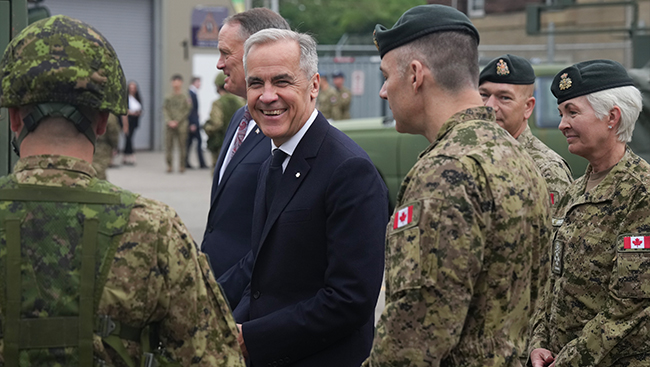
Prime Minister Mark Carney is promising that Canada will quickly boost its defence spending to hit the NATO member target of two per cent of national GDP this year.
Canada has long promised to meet the target but has never had a detailed plan to get there. The announcement comes as NATO allies prepare for talks on raising the spending target to five per cent at the annual summit this month.
Here's what you need to know about the announcement.
1. What is the NATO spending target?
All NATO allies, Canada included, committed to spending the equivalent of two per cent of their GDP on defence in 2006.
In 2014, NATO leaders agreed formally that countries that were not meeting the target must move toward it within a decade.
After Russia launched its full-scale invasion of Ukraine in 2022, allies agreed at the 2023 NATO summit to make two per cent the minimum spending target.
Many European countries have rapidly scaled up their defence spending in response to Russia's war on Ukraine. As of this year, 22 of the 32 NATO member states are spending at least two per cent of their national GDP on defence. Canada is not among them.
A leaked Pentagon document obtained by The Washington Post in 2023 quoted then-prime minister Justin Trudeau telling NATO officials that Canada would not meet the two per cent target.
Under pressure from allies, the Trudeau government later promised to hit the two per cent benchmark by 2032.
In January, then-defence minister Bill Blair told reporters he was trying to speed up that timeline to 2027.
2. Why is the target changing?
At this year's NATO leaders' summit in The Hague, allies will discuss a proposal to boost the spending target to five per cent of GDP.
That's expected to be broken down into two parts — 3.5 per cent for what NATO calls core defence spending and another 1.5 per cent for a broader category of defence and security-related spending.
NATO Secretary-General Mark Rutte told reporters last week there was "broad support" among allies for the change and that he had total confidence they would agree to it at the summit, which is being held June 24-26.
The change is seen as a response to U.S. President Donald Trump's demands for allies to pull more weight in NATO. Among NATO members, the U.S. spends the most on its military in dollar terms.
In March, Trump suggested America might not defend its allies if they don't meet the target. "If they don’t pay, I’m not going to defend them," he said.
According to NATO’s most recent figures, U.S. defence spending was estimated at 3.19 per cent of GDP in 2024, down from 3.68 per cent a decade ago. It's the only NATO ally whose defence spending has dropped since 2014.
3. How much is Canada spending on defence?
According to the latest NATO projections, Canada was on track to spend 1.45 per cent of GDP on defence in 2024-25.
NATO allies also have agreed that 20 per cent of their spending should go toward equipment. In 2024, Canada was on track to spend 17.8 per cent of its total on equipment, making it one of only three countries to miss both parts of the target.
Carney's announcement on Monday amounts to another $9.3 billion in spending in this fiscal year, 2025-26.
Senior government officials told reporters at a briefing Monday morning that the country's defence spending for the fiscal year was projected to be $53.4 billion.
With the announcement of this new spending, that sum is expected to rise to $62.7 billion for 2025-26 — or two per cent of Canada's national GDP, which is estimated at just over $3.1 trillion this year.
While most of that — $53.4 billion — is Department of National Defence spending, about $14 billion is going to other government departments, including $370 million for the Communications Security Establishment.
3. What is the money being spent on?
A large amount of the spending announced on Monday — $2.63 billion — is meant to "empower the military to recruit and retain the personnel needed to carry out its mandate," said a Government of Canada press release.
The government says that funding will help accelerate military recruitment and expand the civilian defence workforce. It includes a pay raise for members.
The Canadian Armed Forces is short more than 13,000 personnel in its regular and reserve forces.
In February, Chief of the Defence Staff Gen. Jennie Carignan said the Armed Forces was on track to meet its recruitment goal of enrolling 6,496 members this fiscal year. The military said it was aiming to reach its approved strength of 71,500 regular forces members and 30,000 reserve members by April 2029.
Another $2.1 billion is set aside to diversify Canada's defence partnerships and help build the domestic defence industry.
Carney has said Canada wants to join ReArm Europe, an 800 billion-euro plan to beef up the defence of EU countries. Government officials said Monday that $2.1 billion could help Canada enter joint procurements or multilateral initiatives with other countries.
5. What is happening with the Coast Guard?
The government is planning to include $2.5 billion it spends on the Canadian Coast Guard in its NATO spending this year — about 60 per cent of the agency's total budget.
The Coast Guard will remain part of the Department of Fisheries and Oceans.
It's responsible for ensuring the safety of people in Canadian waters, carrying out search-and-rescue operations and conducting research, and has a fleet of icebreakers. The Coast Guard also has a mandate to "ensure Canada's sovereignty and security by establishing a strong federal presence in our waters," according to the Government of Canada.
Government officials said there is no plan to arm the Coast Guard or its members. They say its inclusion in Canada's overall defence and security strategy reflects its role in providing what they call maritime domain awareness.
The intent, officials told reporters, is to improve inter-service communication, particularly in the Arctic region. The increased co-operation could involve sending military members on Coast Guard trips, for example.
The government said it's boosting the Coast Guard budget by $100 million.
Picture Courtesy: THE CANADIAN PRESS/Chris Young


