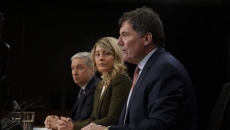
Mark Carney was sworn in Friday as Canada's 24th prime minister in a ceremony in Rideau Hall, alongside his new cabinet.
Here are five things to know about the new prime minister's plans and his new cabinet.
Fewer ministers
The most noticeable difference between Justin Trudeau's cabinet and Carney's is its size. The new cabinet is made of 24 MPs — 13 men, including Carney, and 11 women. Trudeau's last cabinet had 37 members.
Carney said his cabinet has two main priorities: protecting Canadians from the effects of the trade war with the U.S. and reining in government spending.
Who's in, who's out?
Carney's former leadership rival Chrystia Freeland was named minister of transportation and internal trade, but Karina Gould, the only other sitting MP on the leadership ballot, was left out. Gould left cabinet in January to join the race.
Internal trade has become a bigger priority since U.S. President Donald Trump began his trade war with Canada and much of the world. After being sworn in, Carney said that he wants to shift Canada from 13 economies to one national economy.
Nine ministers who previously talked about running for another term were left out: Marc Miller, Ahmed Hussen, Terry Beech, Diane Lebouthillier, Darren Fisher, Jenna Sudds, Ya'ara Saks, Jean-Yves Duclos and Ruby Sahota.
There are three new faces in the new cabinet: Agriculture Minister Kody Blois, Government Transformation Minister Ali Ehsassi and government House leader Arielle Kayabaga.
Carney's first international trip
Carney said that he will be heading to Europe in the coming days to meet with French President Emmanuel Macron.
Carney said the focus of these talks will be to reinforce trade relationships between the two countries and discuss national security. He said that he will have similar discussions with British Prime Minister Keir Starmer.
Carney said he received invitations to visit from France and the U.K.
The Republican elephant in the room
Carney said he has no current plan to travel to Washington to meet with President Donald Trump.
He said he intends to speak with him in the coming days but nothing has been scheduled.
Carney reiterated that Canada will never become a U.S. state — something that Trump has called for in exchange for lifting his tariffs.
Carney called the notion of Canada becoming a U.S. state "crazy."
The prime minister said that Canada is the United States' biggest commercial client, and clients "expect respect" and the ability to work together in a "proper" way.
He also made a specific move to appoint a new minister of Canadian culture and identity. The role is being filled by Steven Guilbeault, formerly the minister of environment, and replaces the heritage file.
Carney said the job will be focused on "reinforcing" all aspects of Canadian identity.
Ending the consumer carbon price
After suggesting he would remove the consumer carbon price by the end of the day, Carney signed an order-in-council Friday to terminate it "as of April 1, 2025."
Carney also said people who have been getting a rebate on the carbon price will get one final payment for the next quarter in April.
The price was scheduled to rise from $80 to $95 per tonne on April 1.
While Carney has long supported carbon pricing as an effective way to reduce emissions, he promised to end the consumer levy during his Liberal leadership campaign.
Conservative Leader Pierre Poilievre made opposition to the carbon price a central theme of his attacks on the government, blamed it for cost of living increases and repeatedly called for a "carbon tax election."
When asked when Canadians can expect to go to the polls, Carney said "before November."