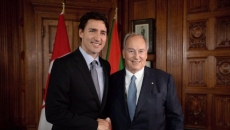
Prime Minister Mark Carney has launched a new artificial intelligence ministry and has named former journalist Evan Solomon to lead it.
Experts welcomed the move Tuesday, though they cautioned there are many unanswered questions about how the new minister will split responsibility for digital issues with his counterparts.
Benjamin Bergen is president of the Council of Canadian Innovators, which represents the tech sector. He said the move recognizes that when it comes to AI, "we need to move faster and think bigger as a country."
The new portfolio was part of a major cabinet shuffle Monday which saw Carney make significant changes and additions to his cabinet.
Solomon was elected for the first time in the April 28 election in the riding of Toronto Centre. He previously worked as a TV host for both CBC and CTV.
Michael Geist, Canada research chair in internet and e-commerce law at the University of Ottawa, said the new ministry is "good signal about prioritizing AI and digital innovation."
"Naming Evan Solomon — who is smart and tech savvy — is an excellent choice," Geist said.
While the previous government introduced an AI regulation bill targeting "high-impact" systems, the bill did not become law before the election was called.
During the election campaign, Carney spoke about the economic potential of AI and promised to invest in AI training, adoption and commercialization. There was little talk during the campaign about regulating the emerging technology - though the Liberal platform did include a promise to make it a criminal offence to distribute non-consensual sexual deepfakes.
Geist said that while there will be calls for the government to move quickly on regulation, "there has been a notable shift globally in recent months toward a more innovation-focused approach."
The Liberals’ election platform promised to move fast on building data centres, introduce a tax credit to incentivize AI adoption by small and medium-sized businesses, and push to expand programs at Canada’s artificial intelligence institutes to drive AI commercialization. The platform also vowed to keep Canadian intellectual property in the country.
Critics have been saying for years that, despite Canada’s strength in artificial intelligence research, the country has been slow to commercialize the technology and has struggled to retain intellectual property.
"We were world leaders in AI research but have really struggled to ingest the technology into our government and to adopt it more broadly across Canada, and... to turn that initial strength in research into prosperity and wealth for Canadians," Bergen said.
"So I think this is really a signal that there's a real opportunity for Canada to try and capitalize on this."
Carney also has promised to use AI to make government more efficient through a dedicated office of digital transformation, and to build up AI capacity in the labour market.
Geist said there are unanswered questions about how responsibility for the file will be distributed in cabinet. Artificial intelligence previously fell largely under the industry portfolio, which is now headed by former foreign affairs minister Mélanie Joly.
Responsibility for digital files also has been shared with what was previously the heritage ministry. Steven Guilbeault is now back heading that file, which has been renamed Canadian identity and culture. During his time as heritage minister, Guilbeault caused controversy over his handling of legislation to update the Broadcasting Act to incorporate online services.
Geist said it’s not clear how ministerial responsibility will be split on AI-related issues like copyright.
The question of whether generative AI systems can use copyrighted content is currently in front of courts in the United States and Canada. While the federal government held a consultation on the question, it hasn’t proposed legislative changes.
Florian Martin-Bariteau, university research chair in technology and society at the University of Ottawa, said it’s also not clear who in cabinet will take responsibility for incorporating AI into the public sector.
Joël Lightbound has been named minister of government transformation, while Shafqat Ali is president of the Treasury Board, which recently led consultations on an AI strategy for the federal public service.
"I welcome this, but I would say until… we know exactly who will be in charge of what, maybe I will wait until I fully celebrate," said Martin-Bariteau, adding the division of digital files among various departments "is why in my opinion we don't have a coherent digital policy for the country."
"I think it will be good to have a whole-of-government approach on those issues, to tackle also the big picture issues," he added.
Picture Courtesy: THE CANADIAN PRESS/Spencer Colby