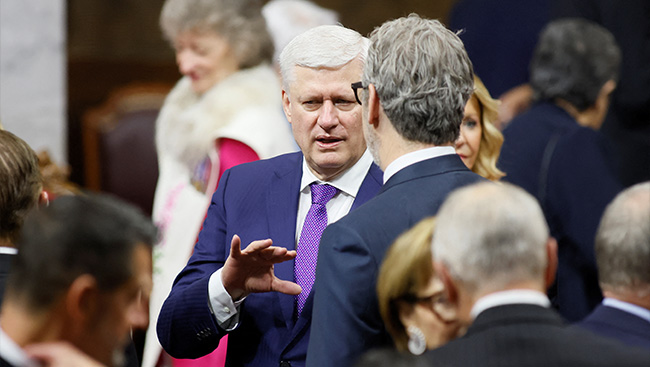
Former prime minister Stephen Harper called on Canada to move past its dispute with India, arguing in a speech on Saturday that the country is an indispensable partner in a volatile world.
He also said Canadian political parties — including the Conservative party he once led — should cut all ties with activists calling for a new Sikh nation to be carved out of India.
In his remarks at an event in Brampton, Ont., Harper did not mention the RCMP linking the government in New Delhi to widespread acts of murder, extortion and coercion across Canada.
"There is no reason why countries like Canada and India cannot be those enlightened voices working together, which we can do and should do by putting our recent disputes behind us," Harper said.
Harper made the comments this past Saturday at the IMEC Canada-India Charity Gala in Brampton, where he accepted an award from a group that focuses on doing business with India.
He called on Canada's parties to "sever" ties with Sikh separatists who have for decades campaigned for a separate country called Khalistan to be carved out of India.
Relations between Ottawa and New Delhi have been in a deep freeze since fall 2023, when then-prime minister Justin Trudeau said his government had seen "credible allegations" linking agents of the Indian government to the murder of Sikh activist Hardeep Singh Nijjar near Vancouver.
A year later, Ottawa expelled six Indian diplomats after the RCMP alleged that New Delhi was behind widespread and violent criminal acts across Canada.
The allegations have not been proven in court. The Canadian Press has asked Harper to explain why he didn't mention the allegations against India in his remarks. Harper has in the past said he can't speak to the details of those cases.
India has said the Khalistan movement threatens its national security. Ottawa has long said that it upholds India's territorial integrity but won't crack down on freedom of expression in Canada.
Harper said Sikh separatists "have a right to their democratic views" but he suggested those views have no place within the Canadian government.
"Those political parties cannot have a strong relationship with India unless they sever relations with those who seek to bring the battles of India's past to Canada, and sever relations with those who seek to divide the great country that is modern India," he said.
Harper also revealed that his government's 2006 decision to open a trade office in Modi's home state of Gujarat in 2009 was made "completely contrary to the advice of Global Affairs Canada."
The Canadian Press has asked Harper's office why this decision went against public sector advice. Modi has been accused of failing to prevent sectarian violence between Hindus and Muslims in 2002 during his term as chief minister of Gujarat.
Harper's Saturday comments come as New Delhi and Ottawa signal a desire to repair relations. Modi congratulated Prime Minister Mark Carney shortly after his April election victory.
Foreign Affairs Minister Anita Anand said she had a "productive discussion" with her Indian counterpart on May 25 about "deepening our economic co-operation and advancing shared priorities."
Those comments alarmed Sikh organizations, which accused Ottawa of putting economic concerns ahead of human rights.
The Sikh Federation has called on Ottawa to break with a five-year tradition by not inviting Modi to the G7 summit this month in Kananaskis, Alta.
Vina Nadjibulla, research vice-president for the Asia Pacific Foundation, said Canada can get relations with India back on track by creating a mechanism for law enforcement in both countries to allow them to discuss security concerns without overwhelming the bilateral relationship.
"That needs to be dealt with, but in its own track," she said, proposing "a mechanism to deal with this immediate issue, but also to build trust, and create a platform for dialogue."
Nadjibulla said Canada's failure to seek closer ties with India makes it an outlier among G7 countries, particularly when both countries are reworking their trade flows in response to American tariffs.
She said the election of a new government in Canada and the upcoming G7 summit offer "an opening" for a reset that could involve reinstating high commissioners or relaunching trade talks.
"Since 2019, India has been invited to every G7 in recognition of its growing importance, both as the fourth-largest economy as well as an important voice for the Global South," she said. India will be a crucial player ensuring that the rules-based global order is respected, she argued.
In February, Nadjibulla led an unofficial delegation of Canadian experts to India to look at how Ottawa could get relations with New Delhi back on track.
The Crown corporation's resulting analysis, published last month, said India feels Canada mishandled the criminal investigation of the 1985 Air India bombing and hasn't done enough to thwart terrorism by Sikh separatists.
The analysis said India's views, along with Canada's concerns about Indian repression and political interference, could be aired through a working group similar to a mechanism Washington launched after American investigators reported having foiled a murder plot against a Sikh activist in New York City.
"We need to proceed step by step and address the issues that are difficult. And at the heart of that are national security concerns, on both sides," Nadjibulla said.
This past February, Harper told a conference in India he didn't "entirely understand" why Canada has such a poor relationship with New Delhi.
At that time, Harper accused the Khalistan movement of "infiltrating" the Liberal party and praised Modi "for not disrupting those people-to-people ties," even after India dropped diplomatic protection for most Canadian envoys in the country.
The Liberals originally made India a major focus of their Indo-Pacific strategy in late 2022, describing the country as a democratic nation with strong trade potential.
Picture Courtesy: THE CANADIAN PRESS/Blair Gable-Pool