

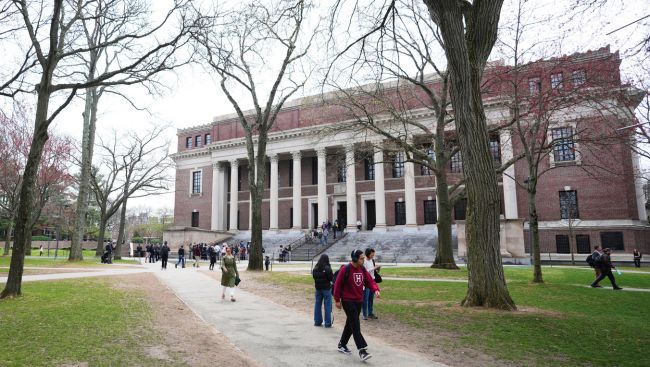
Thomas Mete says he is feeling "great relief" now that he knows he'll be returning to Harvard University to finish the last year of his degree, after a tumultuous summer of limbo.
"I can't wait to be back in Cambridge," the fourth-year economics student said in an interview from Montreal this week.
Mete is among hundreds of Canadians who expect to be back at the Massachusetts-based Ivy League school in the fall after United States President Donald Trump's administration wreaked uncertainty earlier this year.
Harvard enrolled nearly 6,800 international students from more than 100 countries in the fall of 2024.
According to the university's fact book, 751 of those new students were Canadian. The only country from which more students joined Harvard was China.
Mete told The Canadian Press that he was picking up his brother from school in Ridgeway, Ont., when he learned in May that Trump's government was moving to block international students from studying at Harvard.
At the time, it was "a complete shock," he said.
"There was just a sense of fear of not being able to go back, and I think that was overwhelming for me and a lot of my other Canadian friends and international students," he recalled.
"There was this idea we weren't going to be able to go back and my senior year wasn't going to start. ... I had a whole life in Cambridge that was sort of put on pause."
Mete said the questions over his own future were a "heavy burden" to carry as the political battle over international students seized the American news cycle.
"It was just a shame that politics had to get involved with higher education and Harvard specifically. It was never something I thought of when I applied to college," he said.
"I hope (this is) going to be a great year and that there aren't any more bumps in the road."
Since the spring, Harvard has been locked in a battle with the Trump administration after rejecting a list of federal demands calling for sweeping changes to campus governance, hiring and admissions with a view to limiting activism on campus.
The feud has included an investigation into alleged campus antisemitism, the slashing of more than $2.6 billion in research funding and the end of several federal contracts.
In late May, the situation escalated further as the U.S. Department of Homeland Security issued a letter saying it would not allow international students to study at Harvard.
The letter accused the university of creating an unsafe campus environment by allowing "anti-American, pro-terrorist agitators" to assault Jewish students.
The next day, Harvard filed a lawsuit in a federal court in Boston that challenged the Trump administration's decision, calling it an unconstitutional retaliation for defying the White House's political demands and saying the move violated the First Amendment that protects fundamental rights.
In June, a federal judge granted a preliminary injunction stopping the policy from taking effect, and Harvard announced it would continue enrolling international students as the case moved forward.
The administration signalled last week in court documents associated with the lawsuit that it does not intend to enforce its May letter. The documents dated Aug. 6 say the department agrees the letter will not be used to revoke Harvard's status as an entity that can enrol international or exchange students.
Meanwhile, The Associated Press and New York Times reported Wednesday that Harvard and the Trump administration were getting close to an agreement that would require the Ivy League university to pay $500 million to regain access to federal funding and to end investigations.
Jared Gaffe, who is also gearing up to return to Harvard in a few weeks for his final year of law school, said there was a great deal of confusion amid initial reports that international students could be blocked from attending Harvard.
He said he planned to "follow the guidance of the university" as much as possible.
For now, he added, the school is telling students like him that they "should be fine" to return to the U.S.
"I sort of feel resigned to the fact that there's pretty much nothing I can do to change the situation," Gaffe said.
Harvard University pointed The Canadian Press to its prior statements about the situation facing international students.
In several communications to its community this year, the school has stated that it intends to comply with U.S. laws while upholding university policies.
"We will continue to do all that we can to ensure that our international community can continue to research, study, work and thrive at Harvard," it said in an update to students last month.
During this summer's uncertainty, Harvard announced several contingency plans should international students be unable to get back into the country.
One was an agreement between Havard and the University of Toronto, which agreed in June to host graduate students enrolled at Harvard's Kennedy School of Government at its Munk School of Global Affairs & Public Policy.
U of T declined to answer questions about whether any of Harvard's foreign students enrolled at the Munk School.
Picture Courtesy: AP Photo/Charles Krupa


