

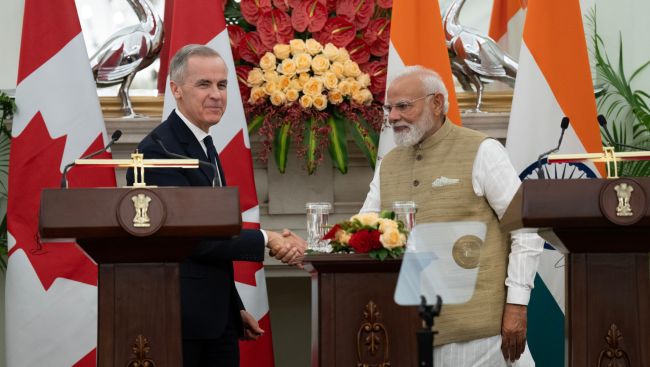
Some of Canada's renewable energy organizations are applauding commitments Ottawa signed with India this week to advance development of solar, wind and hydrogen power.
Prime Minister Mark Carney spent four days in Mumbai and New Delhi, a trip which concluded with a meeting with Prime Minister Narendra Modi and signing a series of agreements, including a strategic energy partnership.
Canada also committed to joining the India-led International Solar Alliance, an organization dedicated to building solar capacity. All other G7 countries are already members.
Simon Fraser University also signed an agreement with the Hydrogen Association of India to collaborate with Indian researchers to advance hydrogen development.
Canada will also upgrade to full member status in the Global Biofuels Alliance Canada, a group launched by Modi at the 2023 G20 to accelerate the global uptake of biofuels. Canada was previously only an observer.
Rachel Doran, executive director of the think tank Clean Energy Canada, said the agreements build on Canada's commitment to multilateralism cited in Carney's speech in Davos earlier this year.
"We know there's going to be a glut of things like LNG on the horizon … whereas something like solar battery supply chains, many countries around the world are trying to make sure there are options available," Doran told The Canadian Press.
"They don't want to be sourcing from one country, i.e., China. And so to be partnering with a market that is as big and as quickly developing as India in some of these spaces, this is a great signal that Canada's new multilateral approach is going to kind of focus on and consider some of these other advantages."
Doran said India is one of the global leaders on moving to renewable energy. The country's ministry of new and renewable energy says India is producing more than 271 gigawatts of power from renewables as of this month, and renewables account for more than half of its power supply.
While Canada has a higher percentage of its grid powered by non-emitting sources — largely hydroelectricity — it has much to learn from India about scaling up solar and storage.
"India is building its electricity system faster than ever before," said Vittoria Bellissimo, CEO of the Canadian Renewable Energy Association.
"They're going to depend heavily on solar. They're going to learn how to build solar in ways that Canada hasn't thought of yet, and we will get that experience."
Canada and India also signed agreements to supply India with uranium and critical minerals, expanding Canada's global customer base for energy exports.
Adam Chambers, the Conservative party critic for international trade, said that while his party welcomes India’s requests for more Canadian energy, the government isn't moving fast enough to get it to market, particularly to the West Coast.
"The demand for more energy is not a surprise, nor is India’s requests as it now joins a long list of countries that has specifically asked for more Canadian energy," Chambers said in a statement.
"The Prime Minister has yet to act swiftly to meet these demands — there are no proposed routes, no consultations and no leadership by the federal government to make this a reality."
Bellissimo pointed to Canada's plan to host an India-Canada Renewable Energy and Storage Summit later this year.
The summit, according to a joint statement from Carney and Modi, looks to "bring together industry, investors and government decision-makers to expand and diversify trade of these technologies into Canada, including through future procurements and supply chain partnerships."
"We're on a path to build more electricity than we ever have before, and we're going to need really strong supply chains to do that," Bellissimo said.
"And any step in the right direction with more co-operation is a good move in my books."
Picture Courtesy: THE CANADIAN PRESS/Adrian Wyld


