Half of Canadians are in favour of building a new bitumen pipeline between Alberta and B.C., while fewer than one in five outright oppose it, a new poll suggests.
The Leger poll, which was conducted online and can't be assigned a margin of error, suggests support is particularly strong in Alberta and among men, older Canadians and Conservative voters.
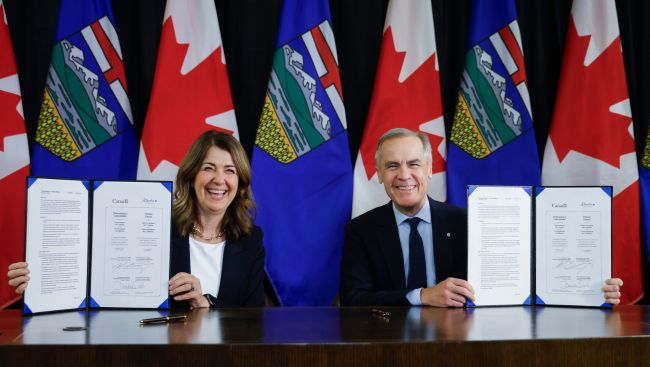
Prime Minister Mark Carney signed a memorandum of understanding last month with the Alberta government that sets out an agreement to work toward the approval of a pipeline project.
The Leger poll asked 1,548 Canadians between Dec. 5 and Dec. 7 if they personally support or oppose the idea of a privately financed bitumen pipeline from Alberta to the B.C. coast. The pipeline is intended to expand Canada’s access to energy markets outside North America.
Of the 50 per cent of respondents who support the project, 24 per cent said they strongly support it, while 26 per cent somewhat support it.
One in five respondents said they neither support nor oppose the project, while 17 per cent said they oppose it and 13 per cent said they don't know.
Two in three respondents from Alberta and half of those in Ontario and B.C. back a new pipeline. Support is lowest in Quebec at 37 per cent.
At 58 per cent, male respondents were more likely to support the project than women, who reported a support level of 42 per cent.
People aged 55 and older were more likely to support a pipeline project, at 56 per cent. Support for the project hit 49 per cent among people aged 35 to 54 and 41 per cent among those aged 18 to 34.
The poll suggests Conservative voters are the ones most likely to support the project, at 71 per cent, compared to 54 per cent of Liberal voters and 23 per cent of NDP voters.
The survey asked Canadians how important new pipelines are to Canada’s overall economic future.
Forty-five per cent of respondents said pipelines are "extremely" or "very" important, while another 34 per cent said they are "moderately" or "slightly" important. Seven per cent said they are "not at all important."
Forty-nine per cent of respondents said they're confident new pipelines can be built while respecting Indigenous rights, 51 per cent said they could be built while respecting the rights of local communities, and 53 per cent said they could be built while still protecting the environment.
Fifty-six per cent of respondents said they're confident new pipelines can be built in Canada while respecting provincial governments through consultation and participation in decision-making.
Andrew Enns, executive vice-president of Central Canada for Leger, told The Canadian Press Canadians seem uncertain on how the project could be completed.
"When I look at the data, I see a lot of potential collisions here of expectations and how this will all unfold if and when it gets to that," Enns said. "Canadians are starting to get a little bit, I think, anxious or losing a little bit of patience in terms of the government's ability to really move forward on some of these big announcements.
"There'll be a lot of negotiations and some interesting twists and turns on this before we see it sort of start to move."
Respondents were asked how important it is for Indigenous communities in British Columbia to support the proposed pipeline before construction starts. Sixty-eight per cent of respondents said that was important to them, while 21 per cent said it was not important.
Respondents were asked if they would support or oppose a pipeline project being fast-tracked if the federal government names it a project of "national interest."
Fifty-five per cent of respondents said they would support a fast-tracked pipeline project, while 26 per cent said they would oppose it. At 73 per cent, Conservative voters were more likely to support fast-tracked approvals under Bill C-5 — the One Canadian Economy Act — compared to Liberal voters at 61 per cent.
Enns said those results show that Canadians are still "quite seized" by the need to bolster the domestic economy.
"A pipeline seems to fit into those plans," Enns said.
The polling industry's professional body, the Canadian Research Insights Council, says online surveys cannot be assigned a margin of error because they do not randomly sample the population.
Picture Courtesy: THE CANADIAN PRESS/Jeff McIntosh