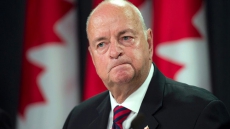
OTTAWA - Prime Minister Stephen Harper laid out his case Friday for a Canadian combat mission in the Middle East, promising a fixed six-month window for airstrikes in Iraq — and possibly Syria — with no ground combat.
The 69 special-forces "advisers" already committed to the mission against the militant group known as the Islamic State of Iraq and the Levant, whose initial window was just 30 days, would remain part of the operation, Harper said.
And should the Syrian government give its blessing to airstrikes within its borders, Canadian CF-18s would be striking targets there, too.
Harper made the announcement during a rare statement in the House of Commons, which was accompanied by the text of a long-awaited motion which, if passed, would extend Canada's role in the battle against ISIL.
"ISIL has established a self-proclaimed caliphate, at present stretching over a vast territory roughly from Aleppo to near Baghdad, from which it intends to launch a terrorist jihad not merely against the region, but on a global basis," he said.
"Indeed, it has specifically targeted Canada and Canadians, urging supporters to attack 'disbelieving Canadians in any manner,' vowing that we should not feel secure even in our homes."
Neither Harper nor the motion made specific reference to the number of Canadian CF-18 fighter-bombers that would take part in the mission; reports have ranged from between four to eight jets would be involved.
Harper did say Canada would also send one air-to-air refuelling aircraft, two Aurora surveillance planes and all the necessary air crews and support personnel.
"Today we are bringing forward a motion asking this House to confirm its confidence for a government decision to join our allies and partners ... in launching airstrikes against ISIL," he said.
"There will, however, be no ground combat mission, which is explicitly ruled out in the resolution."
Harper also said that while the mission is currently focused on Iraq, Canada would participate in airstrikes against targets in Syria once that government granted permission to do so.
"We will strike ISIL where, and only where, Canada has the clear support of the government of that country. At present, that is only true in Iraq," he said.
"If it were to become the case in Syria, then we would participate in airstrikes in that country also."
The motion says ISIL has called on its members to target Canada and Canadians at home and abroad, and it says the global threat posed by the al-Qaida splinter group is only expected to grow.
It acknowledges the group poses a "clear and direct threat" to the people of the region, including religious and ethnic minorities who have been subjected to "brutal sexual violence, murder and barbaric intimidation."
The motion also affirms Canada's desire to protect vulnerable and innocent civilians in the region, including through "urgent" humanitarian assistance.
Harper urged all parliamentarians to support the motion.
"I do this, Mr. Speaker, recognizing that in a democracy, especially one approaching an election, there is rarely political upside in supporting any kind of military action and little risk in opposing it," he said.
"The evidence of the necessity of this, Mr. Speaker: there is none better than the fact that the mission has been launched by President Obama, the leader who had withdrawn American troops and proudly ended the war in Iraq."
Both NDP Leader Tom Mulcair and Liberal Leader Justin Trudeau spoke in the House in response to Harper's speech. Mulcair savaged the government for having been so tight-lipped about its intentions towards combat.
"The prime minister hasn't outlined a broad strategic blueprint for the mission," Mulcair said. "He can't even answer basic questions about the length or breadth or cost of Canada's military deployment."
Mulcair said the strife in the Middle East has been happening for generations and won't end with another war in the region.
"It will end by helping the people of Iraq and Syria to build the political, institutional and security capabilities they need to oppose these threats themselves," he said.
"Canada, for our part, should not rush into this war."