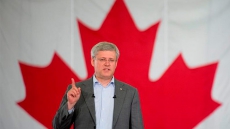
OTTAWA — Justin Trudeau is out to build some campaign momentum with a big-ticket, multibillion-dollar infrastructure plan — and Stephen Harper is wasting no time in trying to tear him down.
Trudeau's campaign event Thursday in Oakville, Ont., complete with a crane and supporters wearing red hard hats, was framed as a major plank in the Liberal platform — one aimed at both stimulating a faltering economy and shoring up the country's crumbling roads, bridges and public facilities.
He billed it as a necessary investment in future generations — one that would require a Liberal government to run modest, short-term deficits until 2019 in order to kickstart the economy.
That willingness to leave the budget out of balance has separated Trudeau from Harper and — in a surprising role-reversal — NDP Leader Tom Mulcair, who both say they would bring in balanced budgets immediately.
"I will be open and transparent and tell the truth about our plans and I certainly hope Mr. Harper and Mr. Mulcair will begin to be open and transparent about their plans," Trudeau said.
While doubling current federal infrastructure funding, any shortfalls in the federal treasury over the next two years would be capped at $10 billion per year, he added.
The prospect of a deficit-friendly Liberal government was a sledgehammer Harper needed no invitation to pick up and swing.
"Mr. Trudeau has made tens of billions of dollars of spending promises ... he has no idea what he's talking about when it comes to these things," the Conservative leader said.
"That's why you could be sure that his small deficits will become large deficits and would get Canada into the same pickle of high taxes and program cuts that we had under the last Liberal government."

The Conservative government's own infrastructure program was three times higher than that of its Liberal predecessor, he added.
Harper promised some modest new spending of his own, pledging $40 million to a loan program to help new Canadians while they complete the foreign credential recognition process. The funding would be over five years, on top of the $35 million already allotted for it in this year's budget.
Mulcair was campaigning in Toronto with former Saskatchewan finance minister Andrew Thompson.
The New Democrats are touting Thompson's record of balancing his province's budget in 2006 and 2007 after Mulcair said unequivocally this week that an NDP government would balance its first budget.
It's all made for a dizzying U-turn on the Canadian political spectrum: the Liberals openly acknowledging a plan to spend billions and run deficits, and the NDP insisting they have found religion when it comes to the merits of balanced books.
A pivot of a different sort also appeared to be taking shape on the New Democrat campaign Thursday.
Mulcair said an NDP government would still seek to reverse cuts to provincial health transfers — one of the party's long-standing promises — but he suggested it wouldn't happen soon, because it appears the Conservatives wouldn't be leaving much of a budget surplus behind.
Last summer, Mulcair said it would be a top priority to put any surplus towards countering Harper's plan to begin slowing the rate of increases in federal health care transfers two years from now.
Over the next 10 years, the current plan means the provinces would receive $36 billion less in health transfers.