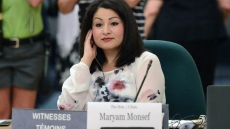
OTTAWA — The gloves have come off as provincial and federal ministers square off in Ottawa for another round of what has deteriorated into a bitter clash over long-term health funding.
The provinces are accusing the Trudeau government of refusing to negotiate a new federal health-care funding framework, instead putting forward a lacklustre take-it-or-leave-it offer.
Federal Health Minister Jane Philpott, meanwhile, is ducking questions about their concerns, describing Ottawa's offer of mental health and home care cash as "historic" and "transformative."
As the two sides meet in an Ottawa hotel with no deal in sight, Quebec Health Minister Gaetan Barrette says his province will walk out if the federal government doesn't put more money on the table.
The provinces say Ottawa's most recent proposal is a step back from the previous Harper government's plan.
But the federal Liberals don't appear ready to budge from an offer that would fix health-care increases at 3.5 per cent per year — up from three per cent — and add in about $8 billion over 10 years for home care and mental health.
"This is not a negotiation process; this is an ultimatum," Barrette said earlier Monday. "We cannot resolve that over a one day period ... and we will walk away if the proposal doesn't change."
Philpott appeared wilfully blind to the dissent, saying she was "absolutely delighted" with her government's "substantial offers on the table" for the provinces to invest in those areas.
"This is a transformative, historic offer — we're changing the face of health care in this country," said Philpott, who skated around questions about the provincial concerns.
In response to questions about a possible walkout, she said: "We are still working out the details of the offer and I think as we reflect on this and as we have this conversation together I think that we'll find that the ministers gathered together will start to get a vision of what this could actually mean."
British Columbia Finance Minister Michael de Jong was asked if his province would also walk out of the talks. "We'll see," he said.
"I don't want to over-dramatize this, but I think we are at a point of departure, potentially, for the federal government where we will see to what degree that notion of collaboration and co-operation is real or something else."
Without a deal, the health-transfer arrangement would likely revert back to the Harper plan of at least three per cent a year, but provinces would also be looking to Ottawa to make good on an election promise to add $3 billion for home care.
Provinces say that framework punches a hole in their budgets and leaves them without the ability to innovate and modernize their health care systems.
Talks have been acrimonious from the get-go. Several provinces wondered out loud late last week whether it was worth the trek to Ottawa for the meeting; Barrette has been tweeting aggressively at Morneau to be more generous.
A Sunday dinner meeting at Rideau Gate on the grounds of the Governor General's residence yielded no compromise, leaving provincial ministers bitter and critical of what they described as an inadequate, take-it-or-leave-it offer from the Trudeau government.
Morneau said late Sunday that he hoped the provinces would have an open mind heading into the discussions. His Monday news release emphasized other subjects on the agenda — the state of the economy, infrastructure and retirement income.
Health ministers from across the country were to join the finance ministers during a special afternoon session. When asked Sunday about his expectations for Monday, de Jong gave a short reply: "Intense discussions."
Barrette and de Jong say Morneau has proposed a firm 3.5 per cent annual increase in transfers as well as another $8 billion over 10 years for specific areas such as home care and mental health. Ottawa is also talking about investing $1 billion into home-care infrastructure over four years, Barrette said.
The money is back-end loaded, with more of it to be transferred in later years rather than right away.
De Jong says the offer could mean even less money for provinces over the next decade, compared to the existing Liberal plan: invest $3 billion over four years into home care and allow the six per cent annual increase in transfers fall to either three per cent or an average of nominal economic growth — whichever is higher.
Even with the 2015 Liberal platform's pledge of $3 billion for home care, de Jong said he didn't think his province would necessarily be better off. At the end of the day, he said it would essentially be "a wash."
The federal government's own projections predict that nominal growth will average above 3.5 per cent over the next decade, de Jong noted.
"A clever proposal but not one that really addresses the pressures and a disappointment for us."
His concern was what he called Ottawa's lack of collaboration and co-operation with the provinces on health funding.
"It's just an example of a federal government that says here's the solution and if you don't like that's too bad — it's take it or leave it," he said. "For me, for an issue of this importance, it's ridiculous. I want to work together with the Canadian government."
An analysis by provinces released Monday compared the potential outcomes of the status quo versus Morneau's latest offer.
The data said that the status-quo scenario of annual increases of three per cent, or the average rate of nominal economic growth, in addition to $3 billion in targeted funding, would mean a total of $445.2 billion in federal health-care cash over the next decade.
It would also lower the federal share of funding in provincial health budgets to 20.2 per cent in 2026-27 from 22.9 per cent next year.
In comparison, the document said Morneau's offer of a firm 3.5 per cent annual increase and $8 billion over 10 years would provide the provinces with total of $445.9 billion over the next decade.
Under that scenario, the share of federal funding would fall to 19.8 per cent in 2026-27 from 23.1 per cent in next year, the data noted.