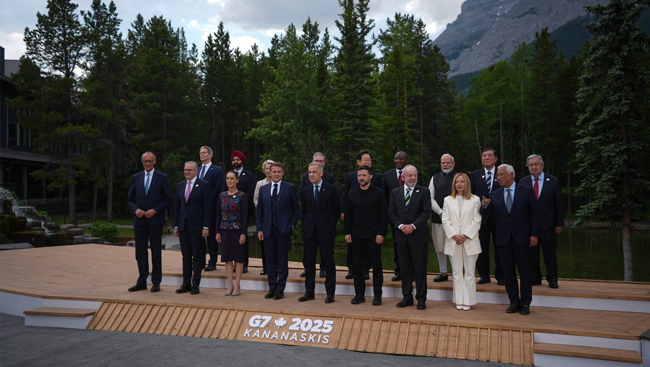
Canada hosted the G7 summit in Kananaskis, Alta., with the agenda on Day 2 focused on foreign policy.
The summit continued without U.S. President Donald Trump, who left early due to the conflict in the Middle East. Prime Minister Mark Carney was set to meet with several leaders, including NATO Secretary General Mark Rutte, Ukrainian President Volodymyr Zelenskyy and Indian Prime Minister Narendra Modi.
Here are some highlights from the second day of the summit.
Canada pledges $4.3 billion in support for Ukraine
While meeting with Zelenskyy, Carney condemned "in the strongest terms" the latest Russian attacks on Ukraine and outlined $4.3 billion in new support for Ukraine's defence.
That sum includes $2 billion for weapons like drones, ammunition and armoured vehicles — which Canada will count toward its NATO defence spending target — as well a $2.3 billion loan to help Ukraine rebuild its infrastructure.
Canada also announced a new sanctions package targeting Russia's shadow fleet and energy revenues.
Canada and India agree to name new high commissioners
Canada and India have agreed to designate new high commissioners and restore regular diplomatic services to citizens in both countries following a meeting between Carney and Prime Minister Narendra Modi.
Canada expelled six Indian diplomats and consular officials last fall, following news that law enforcement had linked agents of the Indian government to a targeted campaign against Canadian citizens.
During a bilateral meeting with Carney, Modi said through a translator that attending the G7 summit was a great opportunity to serve the global good. He said India-Canada relations are "extremely important" and that both countries stand for democratic values.
Carney said it was "a great honour" to host Modi and that it's a testament to the importance of India, Modi's leadership and the issues that the countries look to tackle together, like the future of AI and the fight against transnational repression and terrorism.
Carney faced backlash for inviting Modi to the summit, including from Sikh groups who protested in Calgary during the event.
In 2023 and 2024, former prime minister Justin Trudeau and the RCMP said there was evidence linking agents of the Indian government to the murder of Canadian Sikh separatist activist Hardeep Singh Nijjar in Surrey, B.C., in June 2023.
Carney says there was no "problem" related to missing Ukraine statement
In his closing press conference after the meetings, Carney insisted repeatedly there was no problem in generating a joint G7 statement on the Russian invasion of Ukraine, even though they didn't produce one.
Carney included mention of the war in Ukraine in his "chair's summary," which he issued in the absence of the typical overall summary agreed to by all leaders. He said that summary was agreed upon by everyone including U.S. President Donald Trump.
Carney said that, while G7 leaders discussed the ongoing war in Ukraine, they chose to focus on delivering a statement on the Middle East given the "fast moving" situation in Iran.
Pressed about why comments on Ukraine were reserved for his statement, Carney said "there would be things that some of us, Canada included, would say above and beyond what was said in the chair summary."
Carney doesn't say whether U.S. trade deal will come in 30 days
Speaking to reporters Tuesday evening, Carney said having a form of deadline is helpful to "concentrate the mind," though the prime minister fell short of confirming whether or not Canadians can expect to see a deal announced in 30 days.
Carney's office said Monday that Trump had agreed to have a deal on a new economic and security relationship between Canada and the U.S. by mid-July. Canada's formal summary of the meeting said the leaders agreed to pursue negotiations toward a deal within 30 days.
Carney said Tuesday that his government will pursue what's in the best interests of Canada and aligned with U.S. interests. He added that Canada hasn't retaliated to the doubling of steel and aluminum but retains flexibility to do so.
Carney said a "full deal" does exist — the Canada-United States-Mexico Agreement.
G7 leaders issue statements on topics like AI and migrant smuggling
G7 leaders released a series of joint statements on issues ranging from transnational repression and migrant smuggling to AI and quantum computing.
A wider group of signatories, which includes Australia, India and South Korea, committed to work together to invest in responsible critical minerals projects.
Australia, India, Mexico, South Korea and South Africa also signed on with the G7 to a wildfire charter that calls for co-operation to prevent, fight and recover from devastating fires.
There was no joint statement on Ukraine. A senior Canadian government official who briefed reporters on background said the U.S. was offside with the other countries on Ukraine and sought weaker language than what the other members proposed. However, a PMO spokeswoman later apologized and called that statement a "miscommunication."
Picture Courtesy: THE CANADIAN PRESS/Darryl Dyck