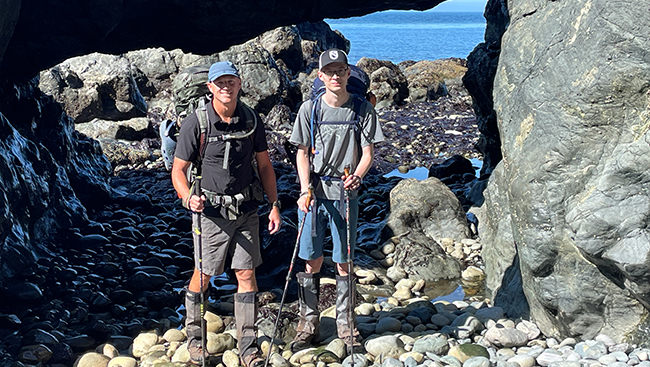
Trish Fougner still remembers the taste of the beer she enjoyed after completing the 47-kilometre Juan de Fuca Trailon Vancouver Island two years ago.
"Like I had never had a beer in my life, which is not true," Fougner said.
But now the resident of Victoria is among hikers with a sour taste in their mouth after the British Columbia government announced that the trail, one of Canada's most popularwilderness hikes, would be closed for the summer so crews can repair damage caused by fall and winter storms.
"It's sad," said Fougner, calling the closure "a loss to the hiking community." But she also can see the government's side.
"It's understandable because we live on the West Coast, where storms can happen and we have to take care of our parks too and make sure they are safe, for one thing, and that we can keep them for generations to come."
The Juan de Fuca Trail snakes along the southwest coast of Vancouver Island, offering views of the Pacific Ocean and the Olympic Mountains in Washington State.
The government announced its closure last week, saying several key trail sections had been washed away or blocked by fallen trees, making it impassable and unsafe.
Bridges, boardwalks, shelters and campsites had suffered extensive damage, it said, and five backcountry campgrounds along the trail also remain closed.
The island was battered by a series of powerful storms in fall and winter, including November's bomb cyclone weather system that brought winds of 170 kilometres per hour.
The government said it was planning a phased reopening of trail and backcountry campsites as crews completed repairs.
Calgary Academy teacher Jason Lindsay had been planning to bring a group 21 students and five adults to hike the trail in early May. Instead, they'll have to make do with a hike in Alberta.
Lindsay, who is the outdoor education lead at the academy and has hiked the Juan de Fuca Trail 13 times, said the students were disappointed.
"For my Grade 12s, this would have been their capstone trip, their pinnacle trip, something they had looked forward to forthe last three years," he said, adding that some Grade 11 students had also signed up for the trip.
"Coming from the Prairies, coastal hikes are so different and so awesome. We were really looking forward to an opportunity to see something new and unique."
"It's spectacular," Fougner agreed. "The views, and the scenery is so lush, and you are in such a remote area. There is lots of wildlife. We ran into a couple of bears."
The rugged trail also inspires a sense of camaraderie with other hikers, she said. "You still meet up with people, which is kind of fun, and it is a really neat opportunity to share in a special place."
Hikers typically access the trail from its southern end near Jordan River or from its northern end at Port Renfrew, as well as at several spots along Highway 14, with trails leading to camping sites and day-use areas.
Fougner said this made the trail appealing for both those who want to hike the whole route or just parts of it. Some even run the whole trail in one day — including her son-in-law, she said.
Its accessibility and beauty have made the trail popular. While it draws about 40,000 registered users per year, the actual number is higher, since so many hike individual sections without completing the entire route.
That type of use distinguishes the Juan de Fuca Trail from the nearby and better known West Coast Trail.
"You can't do that on the West Coast Trail — you have to do the whole trail," said Fougner.
And unlike the West Coast Trail, the Juan de Fuca Trail does not require a reservation.
Fougner has hiked both.
"Some people say the Juan de Fuca (Trail) is harder than the West Coast Trail, but some people argue it is the other way around," she said.
Fougner completed the Juan de Fuca Trail at the age of 59. It took four days as part of a five-person group.
"I don't think I have ever been so tired and so sore in my life," Fougner says. "It was really, incredibly hard."
But she also felt a deep sense of accomplishment. It's not clear when she will be able to repeat it.
Fougner, who operates a Facebook page dedicated to hiking, said she would be checking out other trails across Vancouver Island and elsewhere in B.C., with an eye toward flatter terrain because of her "wonky" knees.
"I still love hiking and you just have to adapt to what you can and what you cannot do," she said.