Tuesday, December 30, 2025
ADVT 
National

HMCS Fredericton returns after six-month mission

Darpan News Desk The Canadian Press, 28 Jul, 2020 08:26 PM
  • HMCS Fredericton returns after six-month mission

Nearly three months after a helicopter crash claimed the lives of six crew members, HMCS Fredericton returned to its home port of Halifax Tuesday.

After a six-month deployment, the Royal Canadian Navy frigate sailed into port accompanied by Nova Scotia's fabled schooner Bluenose II and the navy's training sailing vessel HMCS Oriole.

A navy band played military music and a line of Air Force personnel stood dockside holding cardboard letters spelling out: "Welcome Home!"

But in remarks to the crew and gathered dignitaries, the vessel's commanding officer, Cmdr. Blair Brown, referred to the tragedy that coloured the mission.

"When we departed in January, none of us knew the challenges that we would be facing overseas on Operation Reassurance," Brown said.

The mission was rocked when the frigate's CH-148 Cyclone helicopter — known as Stalker 22 — crashed into the Ionian Sea off the coast of Greece on April 29 while returning from a NATO training mission. That crash caused the worst single-day loss of life for the Canadian Armed Forces since six soldiers were killed in a roadside bombing in Afghanistan on July 4, 2007.

"The loss of our shipmates in the crash of Stalker had a profound impact on all of us," Brown said, as family members of two crash victims, Sub-Lt. Abbigail Cowbrough and Sub-Lt. Matthew Pyke, looked on clutching bouquets of flowers.

Capt. Brenden Ian MacDonald, Capt. Kevin Hagen, Capt. Maxime Miron-Morin and Master Cpl. Matthew Cousins were also killed in the April crash.

"The loss of this outstanding group of sailors and aviators was felt by every single one of us on board every day and has left a space in our hearts that will remain there for all of our days," Brown said.

The ship was docked in Italy for two weeks following the fatal incident and resumed its mission in the Mediterranean Sea in mid-May.

Brown said the decision to continue the mission may have been hard for some to understand, but it was an important part of Canada's commitment to its allies.

"Our role in Operation Reassurance was vital, and our ship's company displayed tremendous resilience, a positive attitude and commitment to that mission," he said.

He then thanked the Canadian public for its support following the tragedy, saying it was vital in helping the crew complete its task.

"We received so many care packages, cards from across our nation that they covered the bulkheads — the walls — in the ship," Brown said.

A Royal Canadian Air Force flight safety investigation into the circumstances of the crash is ongoing. The investigation is focused on aircraft systems and human factors as possible causes of the crash.

Brown addressed his crew before they were allowed to leave the ship.

"Despite immense challenges, both physical and mental, your resilience and commitment was steadfast, and you got it done," he said. "Enjoy your reunion with your families."

Earlier, Defence Minister Harjit Sajjan and Gen. Jonathan Vance, chief of the defence staff, had boarded the frigate before it reached land and sailed into port with the crew. The ship was officially welcomed by Nova Scotia Lt.-Gov. Arthur LeBlanc.

The Halifax-class frigate arrived amid COVID-19 measures, which drastically changed normal return protocols. Everyone on the dock was wearing a mask, and the sailors were transported by bus to reunite with family at a separate part of the base.

Brown said that prior to docking, the ship's company had been in isolation for 14 days and showed no signs of COVID-19 infection.

This report by The Canadian Press was first published July 28, 2020.

Note to readers: This is a corrected story. A previous version said the crash was the worst single-day loss of life for the Canadian Forces since Easter Sunday 2007. There was a more recent incident involving six deaths on July 4, 2007.

MORE National ARTICLES

Search for missing B.C. woman prompts homicide fears, second death

Search for missing B.C. woman prompts homicide fears, second death
Police are releasing more details about a British Columbia woman they fear may be the victim of a homicide. Metro Vancouver's Integrated Homicide Investigation Team says 45-year-old April Parisian was last heard from on March 28 and was declared missing earlier this month.

Search for missing B.C. woman prompts homicide fears, second death

Reports of hate crimes are up in Vancouver: police

Reports of hate crimes are up in Vancouver: police
An assault on a 92-year-old Asian man with dementia in Vancouver is being investigated as a hate crime and police say they have recently noticed an increase in reports of hate-motivated incidents. Vancouver police say the man has "severe dementia" and wandered into a convenience store on March 13 when another man yelled racist remarks that included comments about COVID-19.    

Reports of hate crimes are up in Vancouver: police

More signs COVID-19 is slowing in Canada; students to get federal help

More signs COVID-19 is slowing in Canada; students to get federal help
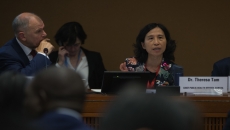
Chief Public Health Officer Dr. Theresa Tam said Canada was making progress in slowing the epidemic but warned against letting down its guard. The focus, Tam said, must be placed on stopping outbreaks in places like seniors homes and in other places where vulnerable populations live together in close quarters. How exactly Canada gets on the road to normalization will largely depend on the provinces, Prime Minister Justin Trudeau said on Wednesday. However, the closure of the Canada-U.S. border will stay in place until May 21st at least, he said.

More signs COVID-19 is slowing in Canada; students to get federal help

Prime Minister Justin Trudeau defends not creating universal COVID-19 benefit, announces student aid

Prime Minister Justin Trudeau defends not creating universal COVID-19 benefit, announces student aid
As he announced yet another emergency financial aid package Wednesday — this one aimed at students — Prime Minister Justin Trudeau defended his decision not to create a universal benefit that would ensure no Canadians affected by COVID-19 fall through the cracks. His focus for specific help Wednesday was students, announcing a $9-billion suite of programs for students whose education and job prospects are disrupted by the novel coronavirus.  Trudeau says his government's approach has been to try to target its emergency financial assistance in stages to those who need it most, rather than to everyone at once, including those who don't need it.      

Prime Minister Justin Trudeau defends not creating universal COVID-19 benefit, announces student aid

What BC is doing to fight COVID-19

What BC is doing to fight COVID-19
B.C. declared a provincial state of emergency on March 18, a day after announcing a public health emergency, and it has been extended to April 28. The measure gives the province authority to take any action necessary to protect people and communities, including charging people who ignore public health orders.

What BC is doing to fight COVID-19

Feds scramble to bring stranded Canadian travellers home from India PM: Canadians stranded in India need more help

Feds scramble to bring stranded Canadian travellers home from India PM: Canadians stranded in India need more help
Prime Minister Justin Trudeau says 20,000 Canadian travellers stranded abroad have been repatriated to Canada. But he says many more flights are needed to bring back large numbers of Canadians from India in particular.

Feds scramble to bring stranded Canadian travellers home from India PM: Canadians stranded in India need more help